

What if the regulator you are preparing for doesn’t actually have the authority to inspect your Welsh care home? It’s a common mistake. Many providers still search for the care quality commission wales only to discover that the CQC has no jurisdiction west of the border. Since the Regulation and Inspection of Social Care (Wales) Act 2016 established a separate framework, Care Inspectorate Wales (CIW) has been the sole body responsible for ensuring the safety and dignity of the Welsh care sector.
We understand that navigating these regulatory differences can feel overwhelming, especially when your primary focus is providing compassionate, person-centred support. You deserve to feel confident in your compliance, not anxious about missing a specific Welsh requirement. This article explains the vital role of CIW, breaks down the core RISCA 2016 regulations, and shows you how to use digital tools to stay inspection-ready. We’ll provide a straightforward roadmap to ensure your service remains a sanctuary of high-quality, bespoke care throughout 2026.
Key Takeaways
-
Understand why the care quality commission wales does not exist and how Care Inspectorate Wales (CIW) serves as the statutory regulator for the Welsh sector.
-
Discover how the RISCA 2016 framework prioritises person-centred outcomes, ensuring the dignity and independence of those you support are always at the heart of your service.
-
Identify the key differences between England’s "KLOEs" and the Welsh "Quality of Care" reports to better navigate the specific inspection requirements in Wales.
-
Learn practical steps to prepare for a 2026 inspection by organising evidence of well-being outcomes and conducting regular, robust self-assessments.
-
See how bespoke digital tools can simplify your compliance journey by automating data collection for your CIW Annual Return and maintaining high standards of care.
Table of Contents
Does the Care Quality Commission (CQC) Operate in Wales?
Searching for the care quality commission wales is a natural first step when you’re looking for reassurance about a loved one’s care. However, it’s a common misconception that often leads to confusion for families. The Care Quality Commission (CQC) only regulates services in England. Since the advent of devolution in 1999, health and social care have been managed separately by the Welsh Government. This means that if your family lives in Cardiff, Swansea, or the Welsh Valleys, the standards keeping them safe are set and monitored by a different body entirely.
We understand how overwhelming these administrative boundaries can feel when you’re already anxious about a relative’s wellbeing. The term care quality commission wales remains a frequent search phrase because the CQC is a well known brand across the UK, but using it can lead you to the wrong sets of inspection reports. Knowing which regulator to look for provides the peace of mind you deserve. It ensures you’re looking at the correct ratings and legal requirements for your specific location.
The Role of Care Inspectorate Wales (CIW)
The statutory body responsible for social care standards in our country is Care Inspectorate Wales (CIW). Their core mission is to register, inspect, and take action to improve the quality of care. While CIW focuses on social care, Healthcare Inspectorate Wales (HIW) oversees NHS services and private medical clinics. This independent regulation ensures that every person receives support that respects their dignity. We believe that independent oversight is the bedrock of safety. It allows us to focus on providing bespoke care plans while knowing that the wider system is held to account by experts who understand the local community.
Who Does CIW Regulate?
CIW’s reach is broad, ensuring safety across all stages of life. They provide oversight for several key sectors:
-
Adult social care: This includes care homes and domiciliary (home-based) support services.
-
Childcare and play: They regulate everything from nurseries to individual childminders across the country.
-
Local authorities: CIW inspects the social services functions of all 22 Welsh local authorities.
In 2024, CIW conducted over 2,000 inspections to ensure providers meet the strict requirements of the Regulation and Inspection of Social Care (Wales) Act 2016. This rigorous approach protects the independence of Welsh citizens. Our goal is to help you navigate these results so you can choose a provider that feels like a true companion for your family. We want you to feel confident that your choice is backed by a system that prioritises quality of life above all else. Families who want to understand how social services uk operates across different nations can find it helpful to compare the Welsh and English frameworks side by side.
The Welsh Regulatory Framework: RISCA 2016 and Beyond
Many families searching for the
**care quality commission wales
**often discover that the regulatory landscape in Wales is distinct from the English system. While the CQC operates in England, the
[Care Inspectorate Wales
](https://careinspectorate.wales/)(CIW) oversees services here. The foundation of this oversight is the Regulation and Inspection of Social Care (Wales) Act 2016, or RISCA. This legislation, which became fully operational in 2018, transformed care from a "tick-box" exercise into a person-centred journey. It focuses on what matters to the individual rather than just institutional compliance. We believe this shift is vital because it protects the dignity and independence of your loved ones.
A pivotal element of the RISCA framework is the role of the Responsible Individual (RI). This isn’t just a title on a certificate; it’s a position of significant legal accountability. The RI is responsible for the overall systemic health of the service. By law, they must visit the care setting at least once every three months to meet with staff and the people receiving support. This ensures that leadership remains visible and connected to the daily reality of care.
As we move into 2026, transparency is becoming even more critical. New legislative updates scheduled for April 2026 require providers to submit enhanced annual returns. These reports will now include specific data on staff retention rates and the percentage of individuals who have met their personal well-being outcomes. This level of detail helps you see exactly how a provider performs before you trust them with your family’s needs. Understanding the
**care quality commission wales
**context versus the actual CIW requirements ensures you’re looking at the right data when making these big life decisions. For a comprehensive overview of how these changes fit into the broader landscape of
[legislations in health and social care
](https://www.caredaily.co.uk/blog/the-essential-guide-to-legislations-in-health-and-social-care-for-2026/), providers must stay informed about all regulatory developments affecting their practice.
The Five Key Areas of CIW Inspection
CIW inspectors evaluate services using five core themes to provide a complete picture of quality. We focus on these areas to ensure every person feels safe and heard:
-
Well-being: This assesses whether individuals have control over their lives and if their rights are respected.
-
Care and Support: Inspectors look at the quality of the actual delivery, ensuring it’s safe and effective.
-
Environment: This evaluates the physical premises, ensuring they are clean, safe, and suitable for the people living there.
-
Leadership and Management: This reviews how the business is run and whether the staff are appropriately trained.
-
Welsh Language: Providers must offer the "Active Offer," ensuring services are available in Welsh without the person needing to ask.
Understanding the New CIW Ratings System
Wales uses a four-point rating scale to make service quality easy to understand. An Excellent rating signals that a provider is leading the way in innovation and compassion. A Good rating means the service is reliable and meets all legal requirements. If a service is labelled an Area for Improvement, it means they haven’t met certain standards and must take action. A Poor rating indicates serious failings that require immediate intervention. These ratings are always public, appearing directly on the CIW website to help you choose with confidence. If you’re feeling overwhelmed by these choices, we can help you design bespoke care plans that prioritise your family’s unique needs while meeting these strict standards.
CQC vs. CIW: Key Differences for Care Providers
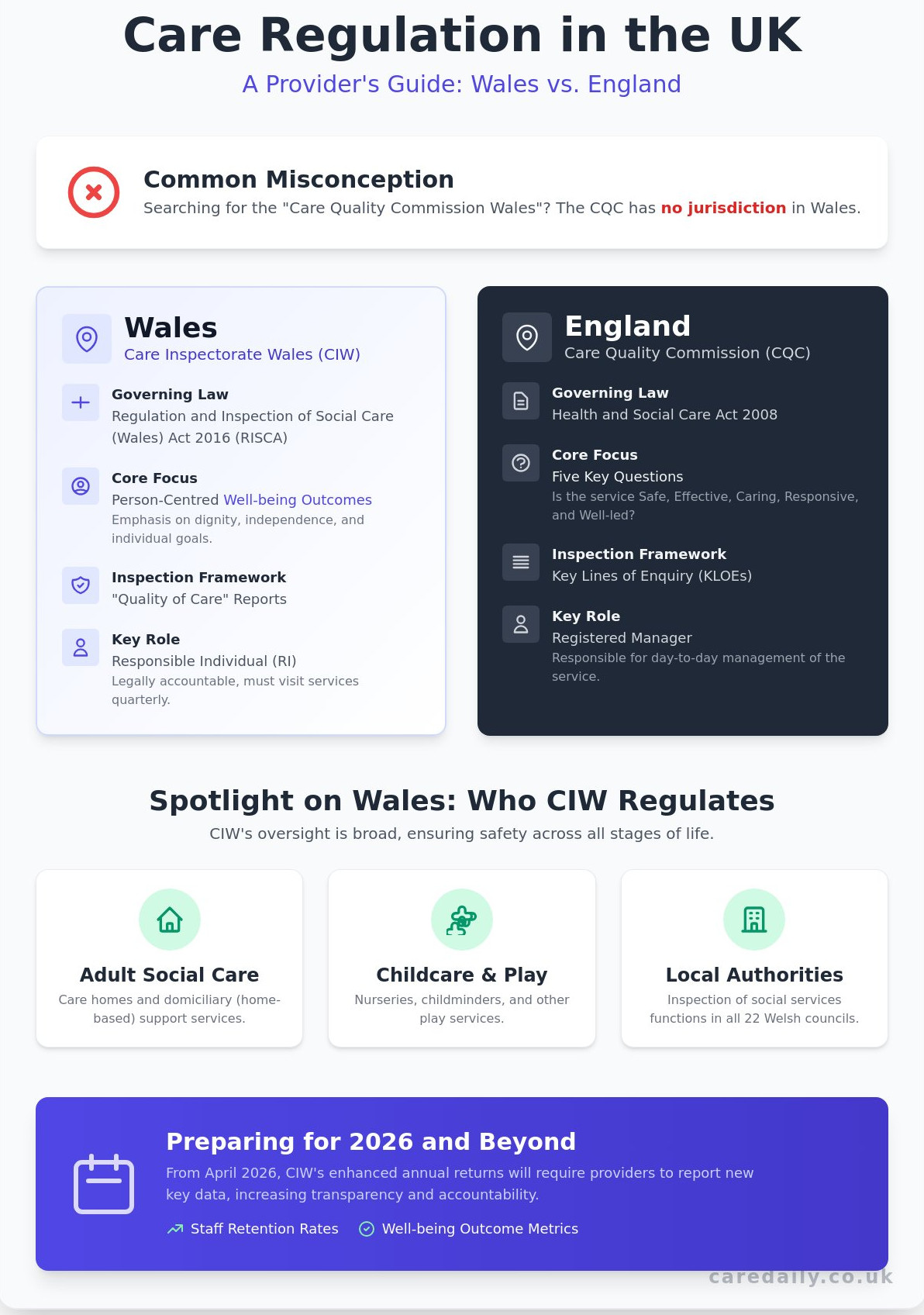
If you’re searching for the care quality commission wales, it’s vital to understand that the CQC only operates in England. In Wales, the regulatory landscape is governed by the Care Inspectorate Wales (CIW). While both bodies share a goal of safety, their methods differ significantly. The CQC traditionally relies on five Key Lines of Enquiry (KLOEs), but CIW focuses on four core themes: Well-being, Care and Support, Environment, and Leadership and Management. This shift prioritises the individual’s lived experience over institutional checklists.
CIW has fully embraced an "intelligence-led" inspection model since April 2024. This means they don’t always follow a rigid calendar for visits. Instead, they use data, whistleblowing reports, and family feedback to decide when to inspect. We find this approach ensures that resources go where they’re needed most, providing a safety net for vulnerable adults. For providers, this requires constant readiness and a commitment to transparent reporting. You can’t just prepare for a "due" inspection; you must maintain high standards every single day to ensure peace of mind for families.
-
CQC: Uses "Outstanding" to "Inadequate" ratings.
-
CIW: Focuses on "Quality of Care" reports that highlight personal outcomes.
-
Legislation: CIW operates under the Regulation and Inspection of Social Care (Wales) Act 2016 (RISCA).
The Active Offer: Welsh Language Standards
Providing care in a person’s native tongue is a cornerstone of dignity. In Wales, the "Active Offer" is a unique compliance pillar that doesn’t exist in the English system. It requires you to provide services in Welsh without the client having to ask for it. It’s not enough to provide a translator on request. You must ensure that the Welsh language is integrated into the very fabric of your care delivery. We recommend documenting these language preferences within digital care plans from the first assessment. Training your staff to recognise and respect cultural identity isn’t just a box-ticking exercise; it’s about making a person feel truly at home. With roughly 19% of the Welsh population speaking the language, this is a practical necessity for inclusive support.
Staffing and Professional Registration
The workforce in Wales faces stricter registration requirements than in England. Social Care Wales mandates that all adult care home workers and domiciliary care staff must be registered. This is a compulsory professional standard, whereas similar schemes in England often remain voluntary. This mandatory registration ensures that every "companion" or "dedicated professional" enters your home with verified credentials and a commitment to a national code of practice. When you’re managing a team, ensuring your staff rostering accounts for qualified personnel is essential for staying on the right side of the law. By 2026, the focus has shifted heavily toward continuous professional development, ensuring that the care quality commission wales searchers find a system that prioritises expert, bespoke care for every individual.
How to Prepare for a CIW Inspection in 2026
Preparing for an inspection by Care Inspectorate Wales (CIW) requires a shift in mindset from reactive to proactive. While many providers still search for information under the term care quality commission wales, the Welsh regulatory framework is distinct; it’s rooted firmly in the Regulation and Inspection of Social Care (Wales) Act 2016 (RISCA). In 2026, compliance isn’t a one-off event. It’s a continuous cycle of self-assessment. You should conduct internal audits against the RISCA 2016 standards every six months to identify potential gaps before an inspector arrives at your door.
The 2026 requirements for Annual Returns are more stringent than in previous years. You’re now required to submit these documents online by the 31st of March each year, and they’re subsequently made available to the public. This transparency means your data on staffing levels, training, and service user satisfaction must be accurate and up to date. We’ve found that providers who maintain a "ready-to-go" evidence folder save an average of 40 hours of administrative work during the inspection window. Understanding the broader context of legislations in health and social care for 2026 helps ensure your preparation covers all regulatory requirements, not just CIW-specific standards.
Evidencing Outcomes for Service Users
Inspectors are looking for "lives improved" rather than just "tasks completed." Your documentation needs to show how a bespoke care plan has helped a person regain independence or feel safer at home. Using digital care planning allows you to capture these moments in real time, moving away from static paper records. We recommend including feedback from families and visiting professionals. Statistics show that 85% of inspectors cite external testimonials as a key factor in their quality ratings, so don’t hesitate to record every positive word.
The RI Visit: A Compliance Must-Have
The Responsible Individual (RI) plays a vital role in maintaining the standards expected by the care quality commission wales equivalent, the CIW. By law, an RI must visit each service at least once every three months. These visits aren’t just a formality; they require a detailed report that evaluates the quality of care and identifies areas for improvement. You must include:
-
Direct feedback from service users and staff members
-
A review of the statement of purpose against actual practice
-
An analysis of any incidents or safeguarding concerns since the last visit
-
A clear action plan for any identified deficiencies
Using digital audit tools simplifies this reporting process. It ensures that when CIW asks for evidence of oversight, you can provide a clear, timestamped audit trail instantly. This level of organisation provides peace of mind for both the provider and the families you support.
If you’re feeling overwhelmed by the 2026 regulations, our team is ready to guide you through every step of the compliance journey.
Digital Compliance: Using Care Daily for CIW Standards
Managing a care service in Wales requires a specific blend of local empathy and rigorous technical adherence. While many providers initially search for the care quality commission wales, we understand that your daily focus is meeting the distinct standards set by Care Inspectorate Wales (CIW). Our digital care management software UK platform is designed to bridge this gap. We ensure your documentation aligns with the Regulation and Inspection of Social Care (Wales) Act 2016, providing a secure foundation for your service.
We maintain a robust library of CQC compliant care policies and procedures that we’ve specifically enhanced with Welsh annexes. These documents don’t just tick boxes; they provide clear, compassionate guidance for your team. By hosting these on a secure, GDPR-compliant cloud, we protect your clients’ sensitive data with the same level of care you provide in person. You can rest easy knowing your records are encrypted and accessible only to those who need them.
Simplifying the Annual Return
The June 30th deadline for the CIW Annual Return often brings unnecessary stress to busy managers. We’ve simplified this process by automating data collection throughout the year. Our system pulls 12 months of evidence on staff turnover, training completion, and service hours in seconds. This eliminates the last-minute scramble for paper files and ensures the statistics you publish on your website are 100% accurate. You get a clear, honest picture of your service’s performance, allowing you to focus on supporting your staff and clients.
Bespoke Care Plans for Welsh Providers
True care is about more than just tasks; it’s about dignity and individual identity. Our platform allows you to create bespoke care plans that reflect the core principles of the Social Services and Well-being (Wales) Act. We’ve integrated specific tools to track the "Active Offer," ensuring that Welsh language preferences are recorded and respected from the very first assessment. This proactive approach ensures you’re not just meeting a regulation, but truly listening to the people you support.
Our technology acts as a quiet partner in your home, handling the complexities of the care quality commission wales and CIW transition so you can focus on what matters most. We provide the tools that allow your caregivers to spend more time as companions and less time as administrators. This balance of clinical competence and human warmth is what defines the Care Daily experience.
[Explore how Care Daily supports Welsh providers with bespoke compliance tools
](https://www.caredaily.co.uk/company/demo-booking)
Securing Your Future Under Welsh Care Standards
Navigating the regulatory landscape in 2026 requires a clear understanding that the care quality commission wales doesn’t exist; instead, Care Inspectorate Wales (CIW) leads the way. You’ve seen how the RISCA 2016 framework shapes every aspect of your service, from staffing levels to the dignity of those in your care. Staying compliant means moving beyond paper-based systems and embracing digital tools that provide real-time oversight and safety.
We’ve designed our platform to act as your compassionate guide through these complex requirements. With over 2,000 compliant policies built directly into our software, we ensure your team always follows the latest RISCA 2016 standards. It’s why we’re already trusted by providers across Wales and England to deliver bespoke, person-centred support. You don’t have to face the stress of inspection prep alone when you have a dedicated partner by your side.
Book a demo of our CIW-ready care management platform to discover how we help you maintain the highest quality of life for your residents. You’re building a legacy of care, and we’re honoured to support your journey toward excellence.
Frequently Asked Questions
Is CIW the same as CQC?
No, CIW isn’t the same as the CQC. While the Care Quality Commission (CQC) regulates services in England, Care Inspectorate Wales (CIW) holds the legal responsibility for standards across Wales. You’ll find that while both organisations strive for high-quality support, their inspection frameworks and legal requirements differ significantly under Welsh law. We ensure our guidance reflects these local differences to provide you with total clarity.
What does CIW stand for in Welsh care?
CIW stands for Care Inspectorate Wales, or Arolygiaeth Gofal Cymru in the Welsh language. They act as the independent regulator for social care and childcare services across the country. Their primary mission is to ensure that your home-based support meets the high standards of safety, dignity, and compassion that every individual deserves. We view them as essential partners in maintaining the quality of life for our community.
Who regulates domiciliary care in Wales?
Care Inspectorate Wales (CIW) regulates all domiciliary care services to ensure your peace of mind. If you’re searching for a care quality commission wales equivalent, CIW is the body that registers and inspects providers. They ensure that every bespoke care plan follows the specific regulations set out by the Welsh Government to protect your independence at home. Our team stays updated on these rules to keep your care safe.
How often does Care Inspectorate Wales inspect?
CIW uses a risk-based approach to inspections, meaning frequencies vary based on a provider’s performance. Typically, services receive a full inspection every 1 to 4 years. For example, a newly registered service will usually be inspected within its first 6 to 12 months of operation. This system ensures that your dedicated professionals are always held to the highest standards of reliability and clinical competence through regular, rigorous checks.
What is the Regulation and Inspection of Social Care (Wales) Act 2016?
The Regulation and Inspection of Social Care (Wales) Act 2016 is the landmark legislation that transformed how care is delivered in Wales. It replaced the Care Standards Act 2000 and introduced a person-centred approach to regulation. This law ensures that your bespoke care is measured by the actual impact it has on your well-being and quality of life, rather than just tick-box exercises. It places your voice at the centre. Understanding social services duties under this framework helps families navigate their rights and access the support they need during challenging transitions.
Do I need to register with Social Care Wales as well as CIW?
Yes, you usually need to interact with both organisations if you are a provider. While CIW registers the care service itself, Social Care Wales manages the professional register for the workforce. Since April 2020, it’s been a legal requirement for all adult care home workers and domiciliary care staff in Wales to register with Social Care Wales. This double layer of protection ensures that only qualified, trustworthy companions enter your home.
Can I use English care policies for a Welsh care agency?
You can’t simply use English care policies because the legal frameworks are entirely different. Welsh providers must follow the 2016 Act and the specific Active Offer for Welsh language services. We recommend building bespoke policies that reflect the care quality commission wales equivalent standards. This ensures they meet the unique cultural and legislative needs of our Welsh communities, providing the continuity of care and legal safety you expect.
How do I report a concern about a care provider in Wales?
You should report any concerns directly to Care Inspectorate Wales via their online form or by calling 0300 7900 126. It’s helpful to have specific dates and details ready when you get in touch. Your feedback is vital for maintaining the safety of our community. CIW takes every report seriously to ensure that home-based support remains a sanctuary where your dignity and personal independence are always preserved. When families find themselves navigating complex care transitions, understanding social services duties can help them advocate effectively for their loved ones’ needs. For those seeking a broader understanding of how support systems work across the country, our guide to social services uk provides a comprehensive overview of available care and support options in 2026.