
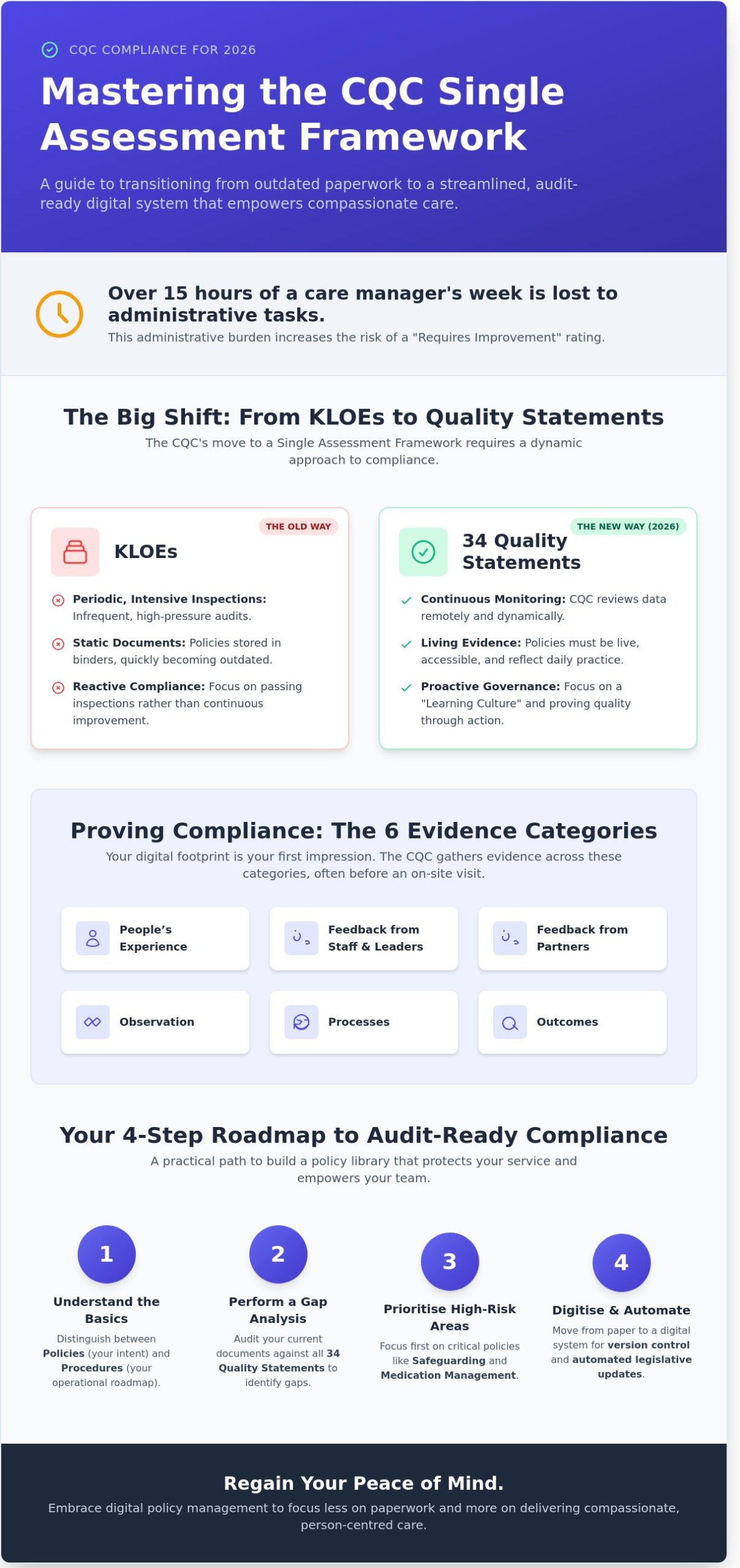
What if your next inspection felt less like a trial and more like a quiet validation of the compassion you provide every day? We understand that the shift from KLOEs to the new Quality Statements has left many managers feeling buried under paperwork; in fact, recent sector data shows that administrative tasks now consume over 15 hours of a care manager’s week. It’s natural to feel anxious about maintaining cqc compliant care policies and procedures when the regulatory goalposts seem to be moving. You want to focus on bespoke care and the independence of your residents, not get lost in a sea of outdated documents that risk a “Requires Improvement” rating.
We’re here to help you regain your peace of mind. This 2026 guide will help you master the transition to the CQC Single Assessment Framework with policies that protect your service and truly empower your dedicated professionals. We’ll walk through how to build a streamlined, audit-ready library that ensures your staff don’t just read the rules, but live them out with confidence.
Key Takeaways
- Understand the legal necessity of your documentation and how to distinguish between your strategic intent and your daily operational roadmap.
- Learn how to align your service with the 2026 Single Assessment Framework by successfully transitioning from KLOEs to the new “Quality Statements.”
- Discover why moving from paper folders to digital cqc compliant care policies and procedures is essential for maintaining version control and protecting your rating.
- Follow a practical roadmap to prioritise high-risk areas such as safeguarding and medication through a thorough gap analysis of your current documentation.
- Explore how automated legislative updates can provide you with peace of mind, allowing you to focus your energy on delivering bespoke, compassionate care.
What Are CQC Compliant Care Policies and Procedures?
Your journey to providing exceptional support begins with a clear understanding of what makes your documentation work. We view policies as your statement of intent. They define your values, your commitments, and the promises you make to the people you support. Your procedures act as the operational roadmap. These documents guide your team through daily tasks, ensuring every action aligns with your core mission. Together, they form the backbone of cqc compliant care policies and procedures.
The Health and Social Care Act 2008 established the legal requirement for these documents. It isn’t just about administrative compliance; it’s about meeting the law to protect vulnerable individuals. The Care Quality Commission uses these records to verify that your service remains safe and effective. We often see providers buy “off-the-shelf” templates to save time, but these often fail during inspections. A generic document doesn’t reflect your unique local community or the specific needs of your residents. CQC inspectors look for evidence that you’ve tailored your approach to your actual service, proving you’ve considered the specific risks and strengths of your team.
The Role of Policies in Maintaining Dignity and Safety
Robust policies protect the human rights of service users by setting clear boundaries for acceptable practice. When your team follows these guidelines, they ensure that every interaction preserves a person’s independence and privacy. There’s a direct connection between staff training and policy adherence; if a staff member hasn’t read the bespoke guidance for your home, they cannot safely implement it. A compliant policy is a living document that reflects current UK legislation.
Fundamental Standards: The Non-Negotiables
The CQC uses a set of baseline standards that your service must never fall below. Regulation 9 focuses on person centred care, ensuring that support is tailored to individual preferences. Regulation 12 mandates safe care and treatment, requiring you to do everything reasonably practicable to mitigate risks. These standards are the primary tools used to measure your “fitness to practice.” If your cqc compliant care policies and procedures don’t explicitly address these regulations with practical examples, you risk a lower rating during your next inspection. Our goal is to help you build a service where safety and compassion are woven into every page of your operational manual.
Aligning Your Documentation with the 2026 Single Assessment Framework
The CQC has moved away from the periodic, intensive inspections of the past. By 2026, the Single Assessment Framework has fully embedded a system of continuous monitoring that requires a more dynamic approach to paperwork. Your cqc compliant care policies and procedures are no longer static documents stored in a ring binder; they’re now living evidence of how you meet the 34 Quality Statements that replaced the old Key Lines of Enquiry (KLOEs). This shift ensures that the focus remains on the person receiving care, providing you and your families with genuine peace of mind.
From KLOEs to Quality Statements: What Changed?
The 34 Quality Statements act as the new “We” statements, describing what a “Good” service looks like in plain English. You must ensure your policy library isn’t just a list of rules but a direct response to these specific statements. For example, under the “Safe” key question, the CQC now prioritises a “Learning culture” statement. Your policies must explicitly detail how you record incidents and use them to improve. This alignment is a legal requirement under the CQC regulations, specifically Regulation 17, which focuses on good governance. We recommend a bespoke audit of your current documents to ensure every “We” statement has a corresponding procedural action that your staff can follow with confidence.
Evidence Categories: Proving Policy Compliance
The CQC now gathers evidence across six distinct categories to form a judgement, often reviewing your data remotely before they even step through your door. This means your digital footprint is your first impression. The six categories include:
- People’s experience
- Feedback from staff and leaders
- Feedback from partners
- Observation
- Processes
- Outcomes
If your policy states that you conduct weekly safety checks, the CQC will look for digital timestamps in your care management software to prove it. In 2024, the CQC began increasing their use of “People’s experience” as a primary evidence source, giving weight to what your clients and their families actually say about their support. This continuous monitoring means you’re always ready, proving that your commitment to dignity and independence is a daily reality. Creating an “Evidence Audit Trail” is the only way to secure an “Outstanding” rating in this era of oversight. If you’re feeling overwhelmed by these changes, we can help you find a bespoke care solution that fits your specific needs and keeps your documentation perfectly aligned.
Static Paper Folders vs. Digital Policy Management: A Comparison
Traditional paper folders often become “compliance graveyards” where vital information goes to gather dust. We’ve seen providers struggle when an inspector asks for a specific protocol, only to find three conflicting versions of a Safeguarding policy scattered across different binders. This lack of version control is a major CQC red flag. It suggests that your staff might be following outdated, unsafe guidance. Maintaining cqc compliant care policies and procedures requires a system that lives and breathes alongside your team, rather than one that sits forgotten on a shelf.
Accessibility is another critical factor for your peace of mind. If a dedicated professional needs to access the Whistleblowing policy at 3 AM on a Sunday, they shouldn’t have to hunt for a physical key to a locked office. Digital systems provide instant access on tablets or smartphones. This ensures that your team feels supported and informed at every hour. These platforms also allow you to create bespoke content. You can tailor templates to reflect the specific needs of your Manchester or London community, ensuring your care remains person-centred and locally relevant. The CQC regulations for service providers clearly state that information must be accurate and up to date. Relying on paper makes this a Herculean task for any manager.
The Hidden Costs of Manual Policy Updates
Managing a paper-based system is an expensive drain on your resources. Industry data suggests that care managers can spend up to 15 hours every month manually editing, printing, and distributing updated documents. This is time that should be spent with residents, fostering their independence and dignity. When you miss a legislative shift, such as the 2025 updates to Liberty Protection Safeguards, you risk more than just a poor rating; you risk the safety of those you support. You can see how this compares to modern efficiency in our guide to digital care management software UK.
Real-Time Compliance: The Digital Edge
Digital systems transform compliance from a static chore into a dynamic safety net. These platforms send instant alerts to every staff member’s device the moment a policy changes. Electronic signatures provide you with an undeniable audit trail. This proves that every companion has read and understood their responsibilities. By integrating cqc compliant care policies and procedures directly into your staff rostering and daily care planning, you ensure that high-quality support is always at the forefront of your operations.
A Roadmap to Building Your CQC Policy Library
Creating a robust library of cqc compliant care policies and procedures feels like a mountain to climb, but it’s the foundation of your service’s safety. You aren’t just ticking boxes. You’re building a culture of excellence that protects your team and the people you support. Follow this structured roadmap to ensure your documentation stands up to scrutiny in 2026.
- Step 1: Conduct a Gap Analysis. Begin by reviewing your existing domiciliary care
How Care Daily Simplifies CQC Compliance for 2026
Managing a care service in 2026 involves balancing complex regulatory demands with the daily needs of those you support. We’ve developed the Care Daily Policy Library to act as your foundational support system. It contains over 2,000 bespoke, professionally written documents designed to ensure your organisation stays ahead of the curve. By providing cqc compliant care policies and procedures that are ready to use, we help you avoid the administrative bottleneck that often leads to manager burnout.
We handle the heavy lifting of legislative monitoring. When the CQC updates a quality statement or a new piece of legislation emerges, our team of experts updates the library. You won’t need to spend hours scouring government websites for changes. Instead, you’ll receive automatic updates that keep your service safe and compliant. This approach creates a “calm in the storm,” giving you the headspace to focus on the human side of care delivery.
- Linking policies directly to digital care plans for real-time staff guidance.
- Integrating eMAR charts to ensure medication policies are followed at the point of care.
- Providing clear, actionable evidence for every “Good” or “Outstanding” rating criteria.
A Complete Compliance Ecosystem
Our software does more than store documents; it creates a robust, automatic audit trail for every policy interaction. This means you can prove to inspectors that your staff have read, understood, and implemented your cqc compliant care policies and procedures. It’s about having the right evidence at your fingertips when you need it most. To help you get started quickly, we offer domiciliary care policies and procedures for sale that are fully customisable to your specific service needs. Our UK-based compliance professionals are always on hand to provide expert support, ensuring you feel confident in the 2026 regulatory environment.
Your Partner in Outstanding Care
We believe that compliance shouldn’t be driven by fear. Our goal is to help you transition from a “fear of inspection” to a place of genuine “confidence in quality.” When your systems are organised and your policies are current, the quality of care naturally improves. Care Daily supports your journey toward an “Outstanding” CQC rating by providing the tools that promote dignity, safety, and independence for every client. You’re not alone in this process; we’re your companions in excellence. Book a demo of our CQC compliance tools today to see how we can transform your service.
Future-Proof Your Care Service for 2026
Navigating the transition to the 2026 Single Assessment Framework doesn’t need to be a source of anxiety for your team. By moving away from static paper folders and embracing a digital roadmap, you ensure that your documentation remains a living part of your daily practice. Maintaining cqc compliant care policies and procedures is about more than ticking boxes; it’s about protecting the dignity and safety of every person you support. Having a comprehensive CQC inspection checklist ensures you’re always ready to demonstrate the quality of care you provide.
We’ve designed our platform to act as your compassionate guide through these regulatory changes. CareDaily is already trusted by hundreds of UK care providers to deliver 2,000+ professionally written UK care policies that adapt as the law does. You’ll benefit from automatic updates for all 2026 legislative changes, allowing you to spend less time on paperwork and more time delivering bespoke, person-centred care.
Secure your 2026 CQC compliance with our bespoke policy library
You’ve built a service based on heart and clinical expertise, and we’re here to ensure your compliance reflects that same high standard. Let’s step into the future of care together with confidence and clarity.
Frequently Asked Questions
How often should I review my CQC policies and procedures?
You should review your policies at least once every 12 months or immediately following any legislative changes. The CQC’s Single Assessment Framework, which became the standard in late 2023, emphasises that policies must reflect current best practices to ensure safety. Regular audits help you identify gaps before an inspection occurs. This proactive approach ensures your team always provides bespoke care that meets the latest regulatory expectations.
Can I use free policy templates for my care agency?
You can use free templates, but we don’t recommend them as a standalone solution. Generic documents often lack the specific detail needed for cqc compliant care policies and procedures. In 2024, approximately 15% of new providers faced registration delays due to inadequate documentation. You must tailor every template to your specific service, staff, and the unique needs of the people you support to ensure they’re truly fit for purpose.
What are the 5 core domains the CQC still uses to categorise Quality Statements?
The CQC continues to use the five key questions: Safe, Effective, Caring, Responsive, and Well-led. These domains now sit above 34 specific Quality Statements introduced in the 2023 assessment update. Each domain helps inspectors determine if your service provides high-quality, person-centred care. Understanding the 5 CQC domains in detail helps you build a culture of transparency and dignity that shines through during every assessment, providing peace of mind for families.
Is it a legal requirement to have digital care policies in 2026?
It isn’t a strict legal requirement to have digital policies in 2026, but the Department of Health and Social Care aims for 80% of CQC-registered providers to use digital social care records. Digital systems make it much easier to update your cqc compliant care policies and procedures instantly. They provide a clear audit trail, which helps you prove that your service is modern, efficient, and focused on the safety of those you support.
What happens if the CQC finds my policies are out of date?
If an inspector finds outdated policies, they may issue a requirement notice for breaching Regulation 17 regarding good governance. This often results in a “Requires Improvement” rating for the Well-led domain. In 2023, governance failings were a primary reason for enforcement actions. Maintaining current documentation is essential for your professional reputation and ensures that your dedicated professionals are following the safest, most recent clinical guidelines available. Following a detailed CQC inspection preparation checklist can help prevent these issues.
How do I prove to an inspector that my staff have read the policies?
You can prove staff engagement through signed acknowledgement logs, digital read-receipts, or short competency quizzes. Inspectors look for evidence that your team understands and applies the guidance in their daily work. We suggest holding regular “policy of the month” meetings to discuss procedures openly. This creates a culture where staff feel confident and empowered to deliver compassionate, high-quality support to every individual in their care.
Which policies are most important for a new domiciliary care startup?
Your priority should be Safeguarding, Medication Management, Recruitment, and Health and Safety. These core documents form the foundation of safe practice for any new home-based support service. Since the CQC updated its fees and registration process in April 2024, having robust, bespoke policies from day one is vital. They provide the necessary framework to protect both your clients’ independence and your staff’s professional integrity during those first crucial months.
Can one policy library cover both CQC and Ofsted requirements?
No, a single library cannot adequately cover both CQC and Ofsted requirements because their regulatory frameworks differ significantly. While some safeguarding principles overlap, Ofsted focuses on the Education Inspection Framework, whereas CQC prioritises the Health and Social Care Act 2008. You need separate, specialised documents to meet the distinct standards of each regulator. This ensures you provide the correct level of clinical and educational support for different service groups.