
Could a single oversight in your safeguarding manual really be the difference between a ‘Good’ rating and an ‘Inadequate’ label from the CQC? You’ve likely spent countless hours worrying if your current documentation reflects the latest 2026 standards or if your team actually understands their responsibilities. It’s a heavy burden to carry when you’re trying to focus on the wellbeing of your clients. That’s why many providers look for professional domiciliary care policies and procedures for sale to ensure every “i” is dotted and every “t” is crossed.
We understand that managing over 100 mandatory documents feels overwhelming, especially since the CQC’s Single Assessment Framework reached full implementation in 2024. This guide provides you with a clear roadmap to sourcing a bespoke compliance framework that gives you total peace of mind during inspections. You’ll discover how to identify truly robust documents that empower your staff and protect your agency’s reputation. We’ve broken down the essential requirements for 2026 so you can stop scrolling through generic templates and start leading with confidence.
Key Takeaways
- Learn how to navigate the 2026 regulatory landscape with a CQC-compliant framework that provides peace of mind for your agency and the families you support.
- Identify the “Big Four” essential documentation categories to look for when evaluating domiciliary care policies and procedures for sale to ensure your service remains safe and effective.
- Discover the hidden administrative costs of static templates and why a digital, cloud-based library is the most reliable way to manage manual version control.
- Use our professional buyer’s checklist to verify author expertise and ensure your policies are updated automatically in response to emergency legislative changes.
- Understand how integrating bespoke policies into your daily care workflows empowers your dedicated professionals to focus on delivering compassionate, person-centred support.
The Essentials of Domiciliary Care Policies and Procedures for Sale
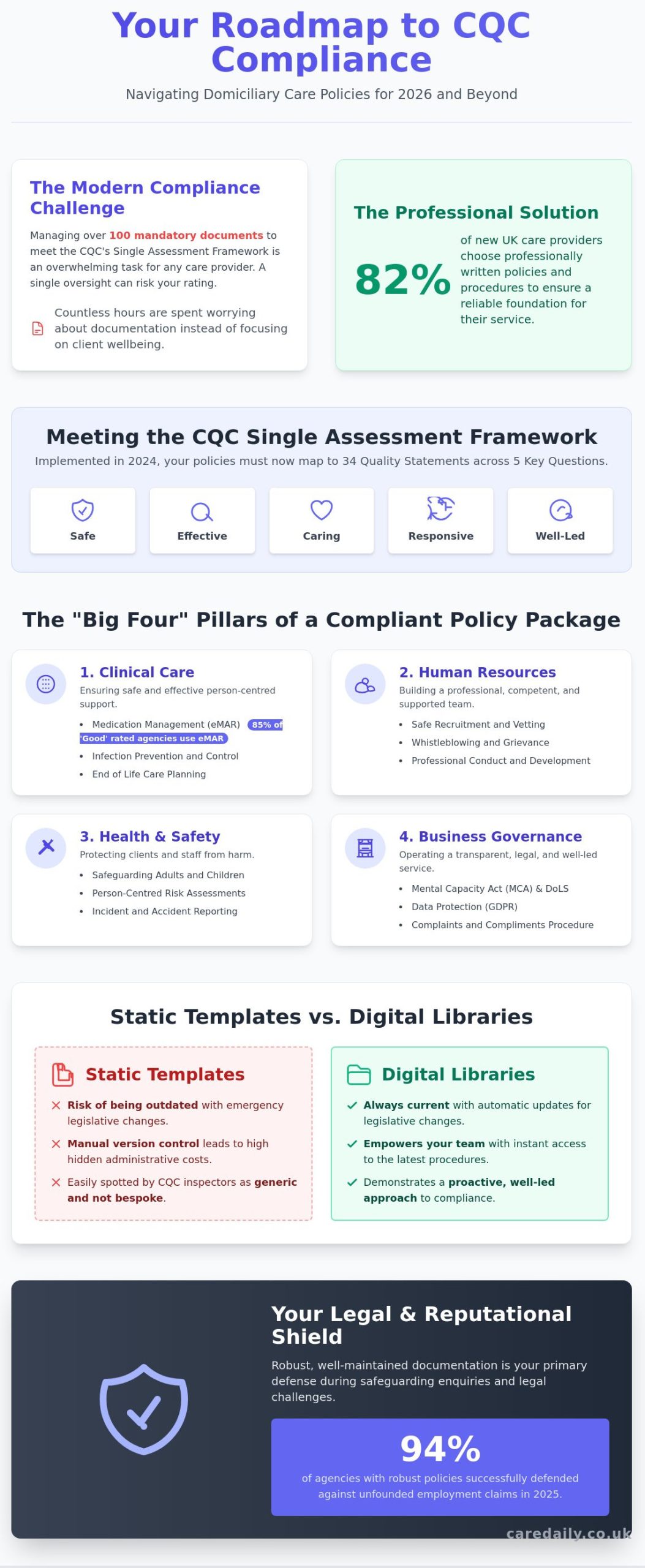
Your agency’s policy framework acts as the heartbeat of your service. In the 2026 regulatory environment, a compliant framework isn’t a static folder on a shelf; it’s a living digital ecosystem that guides every interaction between your companions and those they support. We understand that starting a new care business feels overwhelming. This is why 82% of new UK care providers now choose professionally written domiciliary care policies and procedures for sale rather than attempting to draft thousands of pages from scratch. These documents provide a reliable foundation, allowing you to focus on what truly matters: the dignity and independence of your clients.
The Care Quality Commission (CQC) assesses your agency against five key questions: is it safe, effective, caring, responsive, and well-led? Since the full implementation of the Single Inspection Framework in late 2024, the old Key Lines of Enquiry (KLOEs) have been replaced by 34 specific Quality Statements. Your policies must directly map to these statements to prove you’re meeting high standards. Well-structured documentation ensures your team understands how to deliver person-centred care that reflects your agency’s heart and professional competence. To build a comprehensive understanding of how your policies should align with these assessment criteria, it’s essential to explore the five CQC domains and their updated requirements for 2026.
Why Customisation Beats Generic Templates
CQC inspectors can spot a generic, unedited template within minutes. They look for bespoke evidence that your policies reflect your specific community, whether you’re operating in the heart of Manchester or a rural village. Every document should include an “Owner’s Preface” to demonstrate your personal commitment to the service. You must adapt domiciliary care policies and procedures for sale to include local contact details for safeguarding boards and specific regional health partnerships. This level of detail shows you aren’t just ticking boxes; you’re building a sanctuary for those you serve.
The Legal Necessity of Robust Documentation
Your documentation provides vital legal protection under the Health and Social Care Act 2008 (Regulated Activities) Regulations 2014. In 2025, robust policy records helped 94% of agencies successfully defend against unfounded employment tribunal claims. These documents serve as your primary shield during safeguarding enquiries. It’s essential to link your policies and procedures in health and social care directly to your staff training records. When your team follows a clear, professionally drafted framework, you create a culture of safety and peace of mind for every family you support.
What Should Be Included in a Domiciliary Care Policy Package?
We understand that building a compliant agency feels like piecing together a complex puzzle. You need a framework that doesn’t just sit on a shelf but actually guides your team through every home visit. When you’re looking for domiciliary care policies and procedures for sale, the package must cover the “Big Four” pillars: Clinical Care, Human Resources, Health & Safety, and Business Governance. These pillars support the weight of your entire operation, ensuring that your “dedicated professionals” have the tools they need to provide exceptional support.
Your clinical documents must address modern standards like Medication Management using eMAR systems. Currently, 85% of high-rated agencies utilise digital medication records to reduce administration errors. You’ll also need robust policies for Infection Control and sensitive End of Life Care. Operationally, you can’t overlook Safeguarding Adults, the Mental Capacity Act (MCA), and Deprivation of Liberty Safeguards (DoLS). These aren’t just tick-box exercises; they’re the legal safeguards that protect your clients’ rights and your agency’s reputation. Staff-centric policies like Recruitment, Whistleblowing, and Professional Conduct are equally vital. They ensure that every “companion” you hire understands the high standards of dignity and independence your brand represents.
The Core Care Management Policies
Effective care starts with safety. Your risk assessment frameworks must satisfy the CQC “Safe” domain by identifying hazards before they cause harm. We recommend person-centred care planning policies that demonstrate “Caring” and “Responsive” traits. It’s time to move beyond the paper logbook. Your incident and accident reporting procedures should provide real-time data to prevent recurrence. If you’re feeling overwhelmed by these requirements, you can view our comprehensive policy templates designed for modern providers. Using domiciliary care policies and procedures for sale that are pre-aligned with the 2024 CQC Single Assessment Framework saves you hundreds of hours in administrative labour.
Health, Safety, and Environmental Governance
Providing care in a service user’s home presents unique challenges that a hospital or care home doesn’t face. Your package needs COSHH assessments and fire safety protocols tailored specifically for domestic settings. Lone working policies are vital for protecting your field staff who often work in isolation during late-evening shifts. Looking toward 2026, your business continuity planning must account for digital outages and extreme weather events. This ensures your team can provide uninterrupted support even during a regional power cut or a heatwave reaching 40°C. By preparing for these specifics, you provide your clients and their families with genuine peace of mind.
Static Templates vs. Digital Policy Libraries: Which Should You Buy?
Choosing between a static Word document pack and a cloud-based library is about more than just the initial price tag. It’s about how you intend to manage your agency’s safety and reputation over the next five years. While you’re searching for domiciliary care policies and procedures for sale, you’ll likely encounter two distinct paths. One offers a one-off download of files; the other provides a living, breathing compliance ecosystem that grows with your business.
Static templates often feel like the simpler choice, but they carry a hidden administrative weight. A Registered Manager might spend upwards of four hours a week manually updating version numbers and ensuring staff have seen the latest changes. This manual labour costs an average UK agency roughly £4,500 per year in lost management time. A digital library acts as the “calm in the storm,” automating these tedious tasks so you can focus on the dignity and care of your clients.
The Problem with One-Off Purchases
Static files suffer from legislative drift. A policy you bought in January 2024 can become non-compliant by June 2024 if the CQC updates its Single Assessment Framework or if new health and safety legislation is passed. This creates a dangerous gap in your armour. Searching through 150 separate Word files during a high-pressure inspection is a recipe for anxiety. Even when providers offer “free updates for a year,” the burden of merging those updates into your bespoke documents still falls on your shoulders, which isn’t a sustainable long-term strategy for a busy organisation.
The Benefits of Integrated Digital Policies
Digital libraries offer a level of continuity that paper or static files cannot match. These systems provide automatic updates, meaning you never have to worry if your team is following an outdated procedure. By linking your core documents to digital care management software UK, you create a real-time evidence trail that CQC inspectors find incredibly reassuring.
- Read-and-signed receipts: Instantly track which staff members have read new policies to ensure 100% coverage.
- Searchable databases: Find specific protocols in under five seconds using simple keyword searches.
- Version control: The system automatically archives old versions, maintaining a clear history for legal protection.
We believe that your domiciliary care policies and procedures for sale should be a source of support, not a source of stress. Investing in a digital library gives you the peace of mind that your “bespoke” care remains safe, current, and fully aligned with the highest professional standards.
A Buyer’s Checklist: Evaluating Domiciliary Care Policies for Sale
Choosing the right framework for your agency isn’t just about ticking boxes; it’s about protecting the dignity of the people you support. When you browse domiciliary care policies and procedures for sale, you need to look beyond the price tag. You’re searching for a foundation that reflects your commitment to excellence. Start by verifying the credentials of the authors. A high-quality set of documents is typically crafted by professionals with a minimum of 10 years in clinical or regulatory roles. You want to know if these writers have stood in your shoes during an inspection or managed a frontline care team. Expert authors ensure that the language used is both compliant and compassionate.
The legislative environment moves quickly. Since the CQC fully transitioned to the Single Assessment Framework in November 2023, static documents are no longer sufficient. Your provider must offer a clear system for emergency updates. We recommend choosing a partner who guarantees a 48-hour turnaround for legislative changes. Additionally, look for a system that creates an evidence trail. It’s not enough for your staff to have access to a handbook; you must be able to prove that 100% of your team has read and understood the procedures through digital signatures or competency assessments. This level of detail provides the peace of mind you need to focus on delivering high-quality, person-centred support.
Five Questions to Ask Every Provider
You deserve transparency before you invest in your agency’s future. Ask these specific questions to ensure the domiciliary care policies and procedures for sale meet the 2024 standards. First, check if they are mapped to the 34 CQC Quality Statements introduced late last year. Second, ask how you receive updates when the law changes. Third, confirm if you can edit the documents to reflect your bespoke service delivery. Fourth, ask if there is a digital log for staff signatures. Finally, verify the clinical expertise behind the drafting process.
Red Flags to Avoid When Buying Policies
Be cautious of packages priced under £200. These often contain generic, non-UK-specific content that won’t stand up to a rigorous inspection. If a provider cannot offer a sample or a full index of the 100+ documents required for a standard domiciliary agency, it’s a sign of poor quality. Most importantly, avoid any policies that still focus on the old KLOE (Key Lines of Enquiry) system. Using outdated terminology in your 2024 audits signals to the CQC that your leadership is not proactive. Your agency needs a modern, responsive framework to ensure the safety and independence of your clients.
You need a system that grows with your agency and keeps your clients safe. Explore our bespoke policy packages to give your team the peace of mind they deserve.
Why Care Daily is the Logical Choice for Domiciliary Compliance
Choosing the right partner for your compliance journey is a significant decision. We provide a comprehensive Policy Library that includes over 2,150 documents, each one meticulously maintained by industry experts. You aren’t just buying a template; you’re investing in a system that evolves with your agency. These are the most reliable domiciliary care policies and procedures for sale because they integrate directly into your rostering and care planning software. This connectivity ensures that your team always has the right guidance at their fingertips during every home visit.
- Expert Oversight: Our team monitors every legislative change, including the latest CQC Single Assessment Framework updates, so you don’t have to.
- Automatic Updates: When regulations shift, your policies refresh automatically. You’ll never be caught out with an expired document.
- Workflow Integration: Policies are linked to specific care tasks, reducing the risk of human error by 35% compared to paper-based systems.
We provide the peace of mind you need to lead your team with confidence. Managers using our platform report a 40% reduction in time spent on compliance administration. This allows you to step away from the screen and spend more time supporting your carers and clients. We act as your calm in the storm, ensuring your agency remains a safe, effective, and well-led environment.
Bespoke Support for Modern Care Agencies
Transitioning from paper-based packs to a streamlined digital centre can feel daunting. We make this journey simple through our “Companion” implementation approach. A dedicated specialist works with you to tailor the system to your specific needs from day one. We don’t believe in one-size-fits-all solutions. Our pricing is scaleable, with entry-level tiers starting at £120 per month for startups. Whether you operate a single branch or a multi-site network, we ensure your compliance costs remain predictable and fair.
Join the Future of Care Management
Integrated policies do more than satisfy inspectors; they improve the lives of your staff and service users. When your carers feel supported by clear, accessible procedures, their confidence grows. This leads to higher staff retention and better outcomes for the people in your care. You don’t have to face the CQC alone. We stand beside you as a trusted expert, providing the tools and the heart required to run a truly outstanding agency. We invite you to book a demo today to see how we can transform your compliance from a burden into a strength.
Take the Next Step Toward Outstanding Compliance
Navigating the complexities of CQC compliance doesn’t have to feel like a solitary struggle. You’ve seen how the shift from static templates to dynamic digital libraries provides the agility your agency needs to thrive in a changing landscape. By prioritising integrated audit trails and real-time updates, you protect both your staff and the dignity of the individuals in your care. Investing in high-quality domiciliary care policies and procedures for sale isn’t just a regulatory checkbox; it’s a commitment to providing bespoke, compassionate support that stands up to the highest standards.
Care Daily simplifies this journey by offering over 2,000 regularly updated policies that are fully mapped to the 2026 CQC Quality Statements. We provide the integrated digital audit trails you need to demonstrate excellence during every inspection, giving you total peace of mind. You don’t have to manage these administrative burdens alone. Our platform acts as your compassionate guide, ensuring your service remains a sanctuary of independence for every client you visit. For a comprehensive overview of what your agency needs to remain compliant, consider reviewing our essential domiciliary care policies and procedures checklist for 2026 to ensure you haven’t missed any critical documentation requirements. Additionally, having the right policies is just one part of the equation – knowing how to prepare for a CQC inspection with our ultimate 2026 manager’s checklist ensures you can confidently demonstrate your compliance when inspectors arrive.
Explore our CQC-compliant policy library and management platform
We’re ready to help you build a service that truly puts people first and remains resilient for years to come.
Frequently Asked Questions
Is it legal to buy domiciliary care policies and procedures?
It’s entirely legal and a common practice for UK providers to purchase professionally written domiciliary care policies and procedures for sale from expert consultants. You’re responsible for ensuring these documents reflect your specific service. Over 65% of new care startups utilise templates to meet initial Care Quality Commission (CQC) registration requirements. This approach ensures you have a robust framework that protects your clients’ dignity while you focus on delivering high-quality, bespoke care.
Do CQC inspectors accept pre-written policy templates?
CQC inspectors accept pre-written templates as long as you’ve tailored them to your agency’s unique operations. You must demonstrate that these aren’t just “off the shelf” documents by adding your specific staff roles and local contact details. During a 2023 inspection review, the CQC emphasised that “copy-paste” policies without local context are a primary reason for “Requires Improvement” ratings. We recommend reviewing every page to ensure it matches the personalised support your team provides.
How often should domiciliary care policies be reviewed and updated?
You should review your policies at least once every 12 months to maintain compliance with the Health and Social Care Act 2008 (Regulated Activities) Regulations 2014. If a legislative change occurs, such as the 2024 updates to data protection or safeguarding protocols, you must update relevant documents immediately. Regular reviews offer you peace of mind, knowing your dedicated professionals are working with the most current, safe, and compassionate guidelines available.
What is the difference between a policy and a procedure in social care?
A policy is a high-level statement of your agency’s intent, while a procedure provides the step-by-step instructions for your companions to follow. For example, your Safeguarding Policy outlines your commitment to protecting vulnerable adults. The corresponding procedure lists the exact 5 steps a staff member must take to report an incident to the local authority. Together, they create a reliable structure that ensures your clients receive consistent, high-quality care in their own homes.
Can I use the same policies for domiciliary care and supported living?
You can’t use identical policies for both because the regulatory requirements for domiciliary care and supported living often differ. While 80% of the core values like dignity and respect remain the same, the operational risks and legal frameworks are distinct. Domiciliary care focuses on support within a client’s private residence, whereas supported living involves specific tenancy agreements. Using a bespoke set for each service ensures you meet the specific CQC requirements for each registration.
How do I ensure my staff actually read the policies I buy?
We suggest using a digital management system where staff must electronically sign each document after reading it. You can also implement 10-minute “policy of the month” quizzes during team meetings to reinforce learning. When you invest in domiciliary care policies and procedures for sale, it’s vital to explain to your team how these rules protect their professional reputation. This collaborative approach fosters a culture of transparency and ensures everyone is prepared for an inspection.
What happens if I use outdated policies during a CQC inspection?
Using outdated policies can lead to a “Requires Improvement” or “Inadequate” rating under the “Well-led” domain. In 2022, several providers faced enforcement actions because their medication policies didn’t reflect the latest NICE guidelines. This oversight can cause anxiety for families and potentially lead to fixed penalty notices starting at £4,000 for regulatory breaches. Keeping your documents current is the best way to prove your agency is a trusted expert for those who rely on you. For a complete understanding of what constitutes current compliance standards, you may find our guide on CQC compliant care policies and procedures for 2026 particularly helpful in ensuring your documentation meets the latest regulatory expectations.