
What if the complex web of laws governing your daily work wasn’t a barrier to care, but actually the strongest tool you have to protect the dignity of those you support? You likely feel the weight of the Care Act 2014 and the Health and Social Care Act 2008 every time you update a bespoke care plan. It’s perfectly natural to feel anxious that a missed update regarding legislations in health and social care could compromise the safety of your service users. You want to focus on compassion, yet the volume of legal requirements for 2026 can feel like a storm you aren’t prepared to weather.
We understand that translating legal jargon into daily practice is a significant challenge for even the most seasoned professionals. This guide provides a comprehensive reference to the legal frameworks governing UK care, helping you maintain safety and achieve peace of mind. Our team has mapped out the 8 primary Acts you need to know to ensure your staff and service users remain protected. You’ll gain a clear understanding of how to meet regulatory standards while keeping independence at the heart of every interaction.
Key Takeaways
- Understand the fundamental legal framework that ensures every person receives safe, dignified care through established national standards.
- Discover how the Care Act 2014 and Health and Social Care Act 2008 serve as your roadmap for maintaining CQC compliance and excellence.
- Learn how to champion individual dignity and independence by applying the Human Rights and Equality Acts to your bespoke care practices.
- Master the complexities of legislations in health and social care to transition from outdated paper systems to a digital-first approach for 2026.
- Gain peace of mind by implementing robust safeguarding and data protection measures that keep both your staff and those you support secure.
What Are Legislations in Health and Social Care?
We understand that the legal side of care can feel overwhelming when you’re simply trying to ensure a loved one’s safety. Legislations in health and social care are the essential statutory frameworks created by Parliament to set the minimum standards every provider must meet. These laws aren’t just dry text on a page; they’re the protective shield that ensures every individual is treated with dignity and compassion. Since the implementation of the Health and Social Care Act 2008, these rules have formed the backbone of the Care Quality Commission (CQC) inspection framework. When an inspector visits a home, they check whether these legal promises are being kept in practice. Without this foundation, the rights of the 1.6 million people currently receiving social care in the UK would be left to chance.
The Purpose of Legal Frameworks in Care
Our focus is always on your peace of mind. These frameworks exist to ensure safety and prevent neglect across the 17,000+ care providers currently active in England. By removing barriers to high-quality support, these laws promote equality and diversity for everyone. They standardise care delivery so that a bespoke service in Cornwall meets the same rigorous safety benchmarks as one in Newcastle. This consistency is what allows families to trust the system during difficult transitions. A robust legal foundation ensures that care is never a matter of luck, but a guaranteed standard of excellence.
Legislation vs. Regulation: Knowing the Difference
It’s helpful to think of Acts, like the Care Act 2014, as the broad “what” of the law. These are Primary Legislations that set out your rights and our responsibilities. Regulations, such as the Health and Social Care Act 2008 (Regulated Activities) Regulations 2014, provide the specific “how-to” for care teams. For a registered manager, staying updated on these changes is a legal requirement to maintain their professional status. This dual system ensures that while the law remains firm, the practical guidance can evolve as care techniques improve. We believe that understanding these legislations in health and social care is the first step toward choosing a provider that truly values excellence and human rights.
- Primary Legislation: Broad laws passed by Parliament (Acts) that establish legal principles.
- Secondary Legislation: Detailed rules (Regulations) that explain how the Acts must be followed.
- CQC Alignment: The legal basis used to grade services as Outstanding, Good, Requires Improvement, or Inadequate.
The Core Statutory Pillars: Care Act 2014 and Beyond
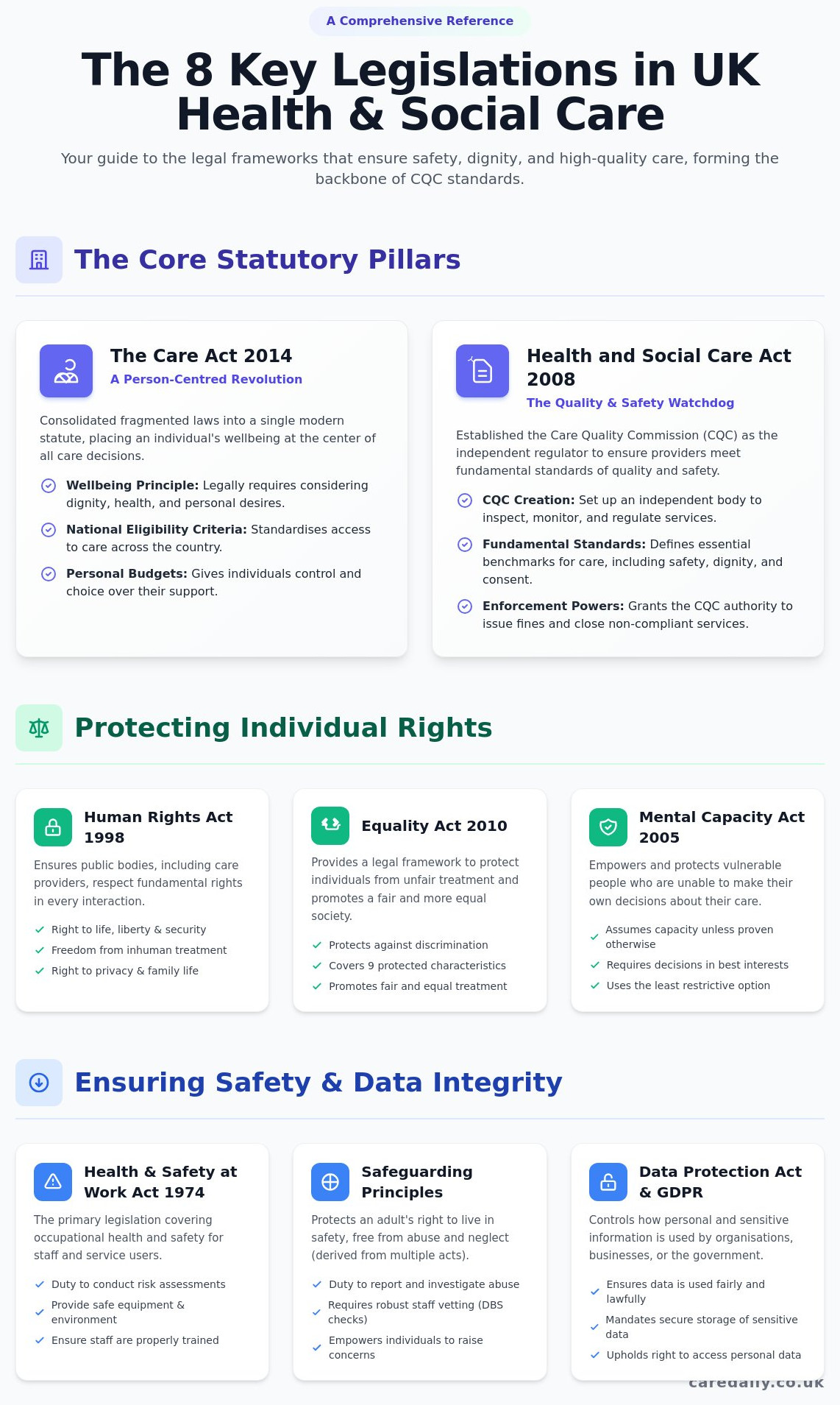
Understanding the framework of legislations in health and social care starts with two landmark pieces of law. These acts represent a fundamental move away from rigid, institutional routines. Instead, they place your loved one’s unique needs at the heart of every decision. By 2026, these pillars remain the primary safeguard for anyone receiving support in England, ensuring that care is a collaborative process rather than a cold transaction.
The Wellbeing Principle isn’t just a suggestion; it’s a legal requirement for every local authority and provider. This mandate requires professionals to consider an individual’s dignity, physical health, and emotional desires when planning any support. It ensures that care adapts to the person, rather than forcing the person to fit into a pre-existing service. This approach provides the peace of mind that comes from knowing a person’s humanity is never lost in the system.
The Care Act 2014: A Person-Centred Revolution
Before April 2014, social care law was a confusing patchwork of outdated rules. This Act cleared the clutter, introducing national eligibility criteria that apply to everyone. You now have a legal right to a personal budget, giving you the power to choose bespoke home-based support that maintains your independence. It transforms the individual from a passive recipient into an active partner in their own care journey, prioritizing quality of life above all else. Understanding social services duties under the Care Act 2014 is essential for families navigating the assessment process and securing appropriate support.
The Health and Social Care Act 2008
This Act created the Care Quality Commission (CQC) as an independent watchdog for the sector. It established 11 Fundamental Standards that no service should ever fall below. These standards cover essentials like safety, dignity, and informed consent. If a provider fails to meet these marks, the CQC has the legal authority to issue fines or even cancel registrations. This rigorous oversight ensures that your family receives high-quality, compassionate care that never drops below a safe threshold. We believe this transparency is vital for building lasting trust between families and dedicated professionals.
By centering legislations in health and social care on the individual, the law protects the sanctuary of the home. These statutory pillars ensure that as we move through 2026, the focus remains on empowering people to live with the dignity they deserve.
Protecting Rights: Human Rights, Equality, and Capacity
Legislations in health and social care act as a shield for the most vulnerable members of our community. These laws ensure that your care isn’t just a service, but a commitment to your fundamental rights. We view these legal frameworks as the foundation of trust between our dedicated professionals and the families we support. By following these mandates, we guarantee that dignity and respect are woven into every bespoke care plan we create for you.
The Human Rights Act 1998 in a Care Context
The Human Rights Act 1998 applies to private care providers whenever they perform “public functions,” such as delivering care funded by a local authority. We prioritize Article 2, your right to life, and Article 8, your right to respect for private and family life. These protections prevent institutionalized routines, allowing you to maintain your independence and stay connected to your loved ones. The FREDA acronym stands for Freedom, Respect, Equality, Dignity, and Autonomy, providing a clear framework for the high standards of care you should expect every day.
Equality and Diversity as a Legal Duty
The Equality Act 2010 protects both our staff and the people we support from discrimination across nine protected characteristics, including age, disability, and religion. We have a legal duty to make reasonable adjustments. This might mean providing a caregiver who speaks your native language or modifying your home environment to improve accessibility. Our recruitment and training policies focus on these standards to ensure our team reflects the diverse community we serve. We don’t just follow the law; we celebrate the individuality that each person brings to our care family.
The Mental Capacity Act 2005 and Deprivation of Liberty
The Mental Capacity Act 2005 is one of the most vital legislations in health and social care because it protects your right to make your own decisions. We follow five strict principles, starting with the presumption of capacity. If a decision must be made for you, it must be in your “best interests” and involve the least restrictive option possible. While the government has delayed the full transition from Deprivation of Liberty Safeguards (DoLS) to Liberty Protection Safeguards (LPS) beyond 2025, our focus remains on your liberty. We ensure that any restrictions on your movement are legally authorized, temporary, and always designed to keep you safe in your own home.
Safety and Data: Health and Safety, Safeguarding, and GDPR
We believe your loved one deserves to feel secure at every turn. The bedrock of this security lies in the core legislations in health and social care that govern how we manage risks and personal information. The Health and Safety at Work Act 1974 remains the gold standard for protection. It requires employers to provide a safe working environment and high-quality equipment, while tasking employees with the duty to follow safety training. These roles ensure that every person entering a home or residential facility is protected by a shield of professional accountability.
Protecting people from harm is our highest calling. The Safeguarding Vulnerable Groups Act 2006 established the Disclosure and Barring Service (DBS), a vital gatekeeper that ensures only suitable individuals work with those who are vulnerable. In 2023, the DBS processed over 4 million checks to maintain this barrier of safety. By combining these rigorous background checks with proactive risk management, providers can prevent accidents before they happen, preserving the dignity and independence of every individual in their care.
Health and Safety: Moving and Handling to COSHH
Care providers have a legal duty to conduct detailed risk assessments for every activity, from helping someone out of bed to managing cleaning chemicals. Under the Reporting of Injuries, Diseases and Dangerous Occurrences Regulations (RIDDOR) 2013, managers must report specific workplace accidents to the Health and Safety Executive within 10 days of the incident. This level of transparency is a core part of the CQC “Safe” domain. It ensures that your care provider isn’t just reacting to problems but is actively building a safer environment through constant monitoring and improvement.
Information Governance and UK GDPR
Managing sensitive health data requires a delicate, expert touch. The Data Protection Act 2018 outlines six principles, such as accuracy and data minimization, to protect service user records. These are the most vital legislations in health and social care for maintaining privacy in a digital world. We prioritize “Data Protection by Design,” ensuring that privacy is baked into every software update and care plan. Using digital systems like Care Daily helps providers meet strict 2026 security standards, keeping your personal stories safe, confidential, and accessible only to those who need them.
Managing Compliance: How to Stay Legally Compliant in 2026
Managing over 2,000 distinct policies and procedures is a heavy burden for any care provider. In 2026, the sheer complexity of legislations in health and social care means that traditional paper-based folders are no longer fit for purpose. These physical documents often sit gathering dust; they become outdated the moment a new statutory instrument is passed in Parliament. You need a system that breathes and evolves alongside the law to ensure your service remains a safe sanctuary for those you support.
Digital care management provides the real-time audit trail necessary to prove your compliance at a moment’s notice. It moves your organisation away from reactive fixes toward a proactive culture of safety. By digitising your records, you create a transparent history of care that demonstrates clinical competence and genuine human warmth. It’s about more than just ticking boxes; it’s about protecting the dignity and independence of every individual in your care.
The Move to Digital Evidence
The CQC now operates fully under its digital-first Single Assessment Framework. This means they use data to monitor your service remotely, often assessing your performance before a physical inspection even occurs. If your policies aren’t “live” and accessible, you risk appearing non-compliant. Having documents that update automatically when laws change is essential for maintaining your rating. It’s important to note that Welsh care providers operate under a different regulatory framework, with Care Inspectorate Wales (CIW) and Welsh care regulations governing their compliance requirements. For more details on this transition, explore our Digital Care Planning: A Guide for Modern Care Providers.
How Care Daily Protects Your Organisation
We act as your trusted guide through the complex web of legislations in health and social care. Our platform offers a library of over 2,000 professionally written, CQC-compliant policies that take the guesswork out of management. We ensure you never fall behind by providing:
- Automatic updates: We refresh your policies the moment new regulations are announced.
- Bespoke organisation: Our software organises your documentation so it’s easy to find during inspections.
- Peace of mind: You can focus on providing compassionate care while we handle the technical legal details.
Our goal is to provide you with the “calm in the storm” that comes from knowing your legal obligations are met. We help you build a bridge of trust with families by showing that their loved ones are in the safest possible hands. You don’t have to face the 2026 regulatory changes alone.
Discover how our Policy Library keeps you compliant
Securing Excellence in Your 2026 Care Standards
Navigating the complex landscape of 2026 requires more than just awareness; it demands a proactive commitment to the people you support. Staying current with the latest legislations in health and social care ensures that dignity, safety, and independence remain at the heart of every interaction. You’ve seen how the Care Act 2014 continues to shape your duties and how rigorous data protection under GDPR preserves the trust of those in your care. Compliance isn’t a static goal. It’s a continuous journey of compassion and clinical excellence.
We understand that managing these complex legal requirements can feel overwhelming when you’re focused on providing high-quality support. Our team provides the peace of mind you deserve through a system trusted by UK care providers for digital care management. You can access over 2,000 CQC-compliant policy templates that reflect the most recent standards. We provide automatic updates for all legislative changes, so your service never falls behind. This allows you to focus on your community while we handle the intricate details of legal adherence.
Ensure your care service is 100% compliant with our digital policy library
You have the expertise to lead your team toward a brighter, safer future for every individual you serve.
Frequently Asked Questions
What are the three main legislations in health and social care?
The Care Act 2014, the Health and Social Care Act 2008, and the Mental Capacity Act 2005 are the three primary frameworks governing your support. These legislations in health and social care ensure that every service provider maintains high standards of safety and dignity. We use these laws as a foundation to build bespoke care plans that honor your independence while keeping you safe.
How does the Care Act 2014 protect service users?
The Care Act 2014 protects you by establishing the “well-being principle,” which requires local authorities to consider your personal goals and feelings in every decision. It mandates that councils provide a needs assessment to 100% of adults who appear to require support, regardless of their financial status. This law ensures you remain in control of your journey, providing a legal right to advocacy if you need help expressing your wishes.
Is the Human Rights Act 1998 applicable to private care homes?
Yes, the Human Rights Act 1998 applies to private care homes whenever they provide care that is funded or arranged by a local authority. Section 73 of the Care Act 2014 specifically closed previous legal loopholes to ensure your rights to privacy and dignity are protected in all settings. This means you can expect the same legal protections for your liberty and family life, whether your care is public or private.
What is the role of the CQC in enforcing legislation?
The Care Quality Commission (CQC) acts as the independent regulator that monitors services to ensure they meet 13 fundamental standards of quality. They have the power to issue fixed penalty notices or even cancel a provider’s registration if they find that safety is at risk. Our dedicated professionals work closely with these CQC guidelines to provide you with total peace of mind and a consistently high quality of life.
How often do health and social care legislations change?
Major legislations in health and social care typically undergo significant updates every 10 to 12 years, though specific regulations change more frequently. For example, the CQC introduced a new single assessment framework in 2024 to modernize how they inspect and rate care providers. We stay informed about these changes daily so that your care always meets the latest legal requirements without you having to worry about the details.
What happens if a care provider fails to comply with legislation?
Care providers who fail to comply with legal standards face serious consequences, including unlimited fines or criminal prosecution under the Health and Social Care Act 2008. In 2023, the CQC carried out thousands of inspections that led to enforcement actions to keep vulnerable individuals safe from harm. These strict penalties ensure that every companion who enters your home is held to the highest possible standard of professional conduct.
How does GDPR affect care records in 2026?
GDPR ensures that your personal health data remains a private sanctuary by requiring all care records to be stored on secure, encrypted systems. The Data Protection Act 2018 gives you the right to access your bespoke care records within 30 days of making a written request. We prioritize your privacy by training our staff to handle your sensitive information with the utmost compassion and strict confidentiality at all times.
Do I need a lawyer to understand care legislation?
You don’t need a lawyer to understand your basic rights, as most government guidance is written to be accessible to families and individuals. Organizations like Citizens Advice provide free support to help you navigate the system without the burden of legal fees. We act as your compassionate guide, translating complex rules into a clear, supportive plan that focuses on your comfort and continued independence at home.