

National Minimum Wage 2025 & 2026: A Guide for UK Care Providers
What if the upcoming adjustments to the national minimum wage 2025 were the catalyst your agency needs to secure long-term stability rather than just another financial hurdle? You probably feel the weight of thinning profit margins as rising costs impact every corner of the UK social care sector. It is often a delicate balance to protect your business while ensuring your dedicated professionals receive the fair pay they deserve for their compassion. We understand that complex calculations for sleep-in shifts and travel time can feel overwhelming, especially with the pressure of HMRC audits and CQC standards looming.
Our guide empowers you to master these mandatory wage increases, ensuring your care agency remains compliant and profitable through 2026. You will gain a clear understanding of the rates effective from April 1, 2025, and a reliable framework for your payroll processes. We will explore how to improve your operational efficiency to offset these costs, giving you the peace of mind to focus on providing high-quality, bespoke care for your clients. This article details everything you need to know about the upcoming legislative changes and practical steps to safeguard your agency’s future.
Key Takeaways
-
Prepare your care agency for upcoming financial shifts by reviewing the mandatory National Living Wage and National Minimum Wage rate increases through 2026.
-
Navigate HMRC enforcement risks with confidence by understanding how the national minimum wage 2025 updates impact your specific "working time" calculations.
-
Master your legal obligations regarding record-keeping and pay reference periods to ensure your business remains fully compliant and ready for inspection.
-
Discover sustainable strategies to manage rising wage costs, including how to approach local authorities for fee reviews and reducing overheads through digital tools.
-
Gain peace of mind by learning how Care Daily integrates rostering and compliance data into one seamless, CQC-ready platform to protect your agency’s future.
Table of Contents
National Minimum Wage Rates for 2025 and 2026: The Essential Data
We understand that managing a care home or home-based support service requires balancing high-quality care with complex financial planning. Since the introduction of the National Minimum Wage Act 1998, providers have adapted to evolving standards to ensure their dedicated professionals receive fair compensation. Our mission is to help you stay ahead of these changes so you can continue focusing on the dignity and independence of your clients.
The jump in the national minimum wage 2025 represents a significant step for the social care sector. This increase isn’t just a numerical change; it reflects the growing recognition of the vital work your team performs every day. By understanding these figures now, you can secure the peace of mind needed to maintain continuity of care for the families who rely on you.
The 2025 vs. 2026 Rate Breakdown
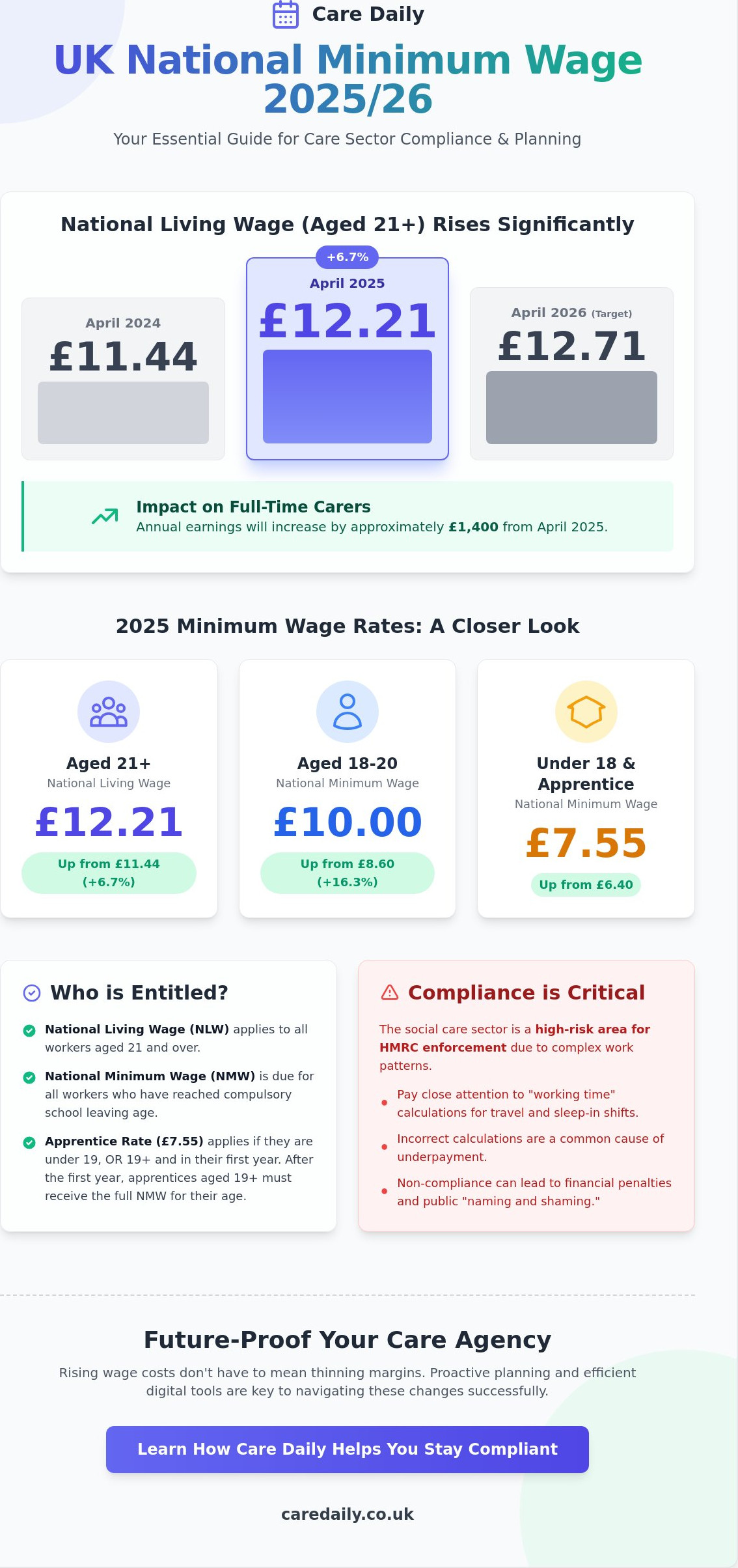
The government has confirmed substantial increases to the wage tiers to align with the cost of living. From April 2025, the National Living Wage for workers aged 21 and over will rise to £12.21 per hour, up from the 2024 rate of £11.44. This 6.7% increase is accompanied by a targeted rise for younger workers to narrow the pay gap. Looking toward the following year, the Low Pay Commission has set a projected target of £12.71 for April 2026.
-
Aged 21 and over (National Living Wage): £12.21 (April 2025) and £12.71 (April 2026 target).
-
Aged 18-20: £10.00 (April 2025), a 16.3% increase from the previous £8.60.
-
Under 18s and Apprentices: £7.55 (April 2025), rising from £6.40.
These adjustments mean that a full-time carer aged 21 or over will see their annual earnings increase by approximately £1,400 from April 2025. We encourage you to review your bespoke care plans and budgets early to accommodate these shifts without compromising the quality of life of your residents.
Who is Entitled to the National Living Wage?
The national minimum wage 2025 structure simplifies eligibility by applying the highest rate to all workers aged 21 and over. This threshold was previously higher, but the government’s move to lower the age limit ensures more of your staff receive the National Living Wage. For anyone who has reached the compulsory school leaving age, they are entitled to at least the minimum wage for their specific age bracket.
In your care setting, you might employ apprentices who are pursuing professional qualifications. The apprentice rate of £7.55 applies if the worker is under 19, or if they are 19 or over and in the first year of their apprenticeship. If an apprentice is 19 or older and has completed their first year of training, you must pay them the full minimum wage for their age group. This ensures that as they grow in clinical competence, their pay reflects their increasing contribution to your service.
We know that these figures represent a challenge for many providers. Our goal is to provide the expert guidance you need to manage these updates with quiet confidence, ensuring your staff feel valued and your clients feel safe.
Navigating NMW Compliance in the UK Care Sector
HMRC identifies the adult social care sector as a high-risk area for enforcement. This isn’t because providers are intentionally unfair, but because care work involves complex schedules that don’t always fit into traditional boxes. When you manage a dedicated team, ensuring they receive the official 2025 National Minimum Wage rates is about more than just avoiding fines. It’s about valuing the compassion your staff bring to every home visit. We’ve seen how a simple clerical error can lead to significant stress for both the business and the caregivers who rely on that income.
The biggest hurdle many providers face is the distinction between "on-shift" time and "working" time. You might schedule a staff member for an eight-hour block, but if you don’t account for unpaid breaks or uniform deductions, the effective hourly rate can dip below the legal floor. Getting this wrong leads to "naming and shaming" by the Department for Business and Trade. In their February 2024 list, over 500 businesses were called out publicly for underpayment. This type of public notice causes a reputation hit that’s hard to recover from. Beyond the legal risk, the Care Quality Commission (CQC) views fair pay as a direct reflection of your "Well-Led" rating. A provider who struggles with payroll accuracy often struggles with staff retention and safety, which are core pillars of a "Good" or "Outstanding" inspection result.
The Sleep-in Shift Dilemma
The 2021 Supreme Court ruling in the Mencap case clarified that staff performing "sleep-in" shifts are generally only entitled to the national minimum wage 2025 for hours they are actually awake and working. However, the line between being "available for work" and "actually working" remains thin. We recommend a proactive approach. If a staff member is called upon during the night, you must ensure their total pay for the pay period, including the flat-rate sleep-in fee, meets the NMW average. If you need help structuring these payments, our team at CareDaily can help you find a balance that protects your budget and your staff.
Travel Time and Training: Non-Negotiable Working Hours
For domiciliary care providers, travel time between clients is legally working time. You cannot exclude the 20 minutes spent driving between appointments from your NMW calculations. Similarly, any time your team spends in mandatory inductions or staff meetings counts as hours worked. To stay safe, you should integrate these requirements into your cqc compliant care policies and procedures . By documenting exactly how travel and training are tracked, you create a transparent audit trail for both HMRC and the CQC. This clarity gives your families peace of mind, knowing their loved ones are cared for by a supported and fairly compensated professional.
Employer Obligations: Calculating Pay and Record Keeping
We know that managing payroll in a care setting is about more than just numbers. It’s about protecting the dedicated professionals who keep your service running. You have a legal duty to maintain records proving you’ve met the national minimum wage 2025 standards for at least 6 years. HMRC can request these at any time. Keeping clear, digital logs is your best defense against accidental non-compliance and ensures your team feels valued.
The current wage pressure in the care sector means that even small errors in calculation can lead to significant legal risks. Most care workers fall under "time work" or "unmeasured work" categories. Unmeasured work often applies to live-in care where daily tasks aren’t strictly timed. In these cases, you must have a written "daily average agreement" to ensure pay remains fair and legal. This agreement protects the dignity of the caregiver while providing you with a clear framework for compliance.
Step-by-Step Calculation for a Care Pay Period
Calculating the average hourly rate ensures your team receives their full entitlement. You should follow these steps for each pay reference period to maintain peace of mind:
-
Step 1: Total all gross pay elements. This includes basic pay and certain bonuses.
-
Step 2: Subtract non-counting elements. You must exclude tips, shift premiums (the extra amount paid above the basic rate for night shifts), and reimbursed expenses.
-
Step 3: Divide the remaining figure by the total "working time" hours. This total must include travel time between home visits and all mandatory training sessions.
Avoiding Common Payroll Pitfalls
The "Uniform Trap" is a frequent cause of HMRC fines in the UK. If you require staff to wear a specific tunic and deduct the cost from their wages, that deduction cannot take their hourly rate below the national minimum wage 2025 threshold. Even if the worker agrees to the deduction, the law doesn’t allow it if it breaches the minimum limit. The same rule applies to DBS check fees and salary sacrifice schemes like childcare vouchers.
We also see providers overlook the time spent on professional development. You must ensure your medication management training time is correctly logged and paid. If a companion spends two hours completing an e-learning module at home, those hours count as working time. Failing to record this can inadvertently pull their average pay below the legal floor. It’s a simple mistake that can lead to a 200 percent penalty from HMRC, so we recommend auditing your training logs monthly.
Strategies to Manage Rising Wage Costs in 2026
The increase in the national minimum wage 2025 and the subsequent rises in 2026 place significant pressure on your care business. We understand the delicate balance you must strike between maintaining a sustainable budget and ensuring your dedicated professionals receive fair compensation. The reality is that many providers face a "funding gap" where local authority rates don’t reflect the true cost of delivering high-quality, bespoke care. According to the Homecare Association, the minimum viable price for homecare reached approximately £28.53 per hour in 2024, a figure that continues to climb.
You can approach local authorities for fee reviews by presenting a transparent, data-driven breakdown of your overheads. Use your internal reports to show how wage increases, NI contributions, and pension costs impact your ability to provide safe, consistent support. It’s about proving that higher commissioning rates are essential for the dignity and independence of the people you serve. Rather than cutting staff, which risks the quality of life for your clients, focus on reducing administrative waste. Improving staff retention is your most effective cost-saving measure. It costs roughly £3,500 to recruit and train a single new carer; keeping your existing team through fair pay and a supportive culture eliminates these recurring expenses.
Optimising Staff Rostering for Efficiency
Smart scheduling is your best defense against rising labor costs. By using an efficient staff rostering system, you can eliminate "dead time" between home visits and ensure travel routes are as logical as possible. This precision prevents expensive overtime and reduces your reliance on agency staff, who often charge a 40% premium over your permanent team. Digital tools also allow you to track travel time with total accuracy, ensuring your payroll and billing are always aligned.
Improving Margin through Better Documentation
Paper-based systems often hide small inefficiencies that drain your resources over time. Investing in digital care management software UK provides a clear ROI by giving you real-time oversight of your operations. Automated auditing saves 10+ hours of management time per week, allowing your leaders to focus on mentoring staff rather than filing paperwork. This shift to digital ensures every billable minute is recorded and every compliance requirement is met without manual effort.
Ready to strengthen your care business for the future? Connect with our team for a bespoke consultation on managing your care costs.
Future-Proofing Your Care Business with Care Daily
The 1st April 2025 deadline for the national minimum wage 2025 increase brings both a commitment to your staff and a challenge for your budget. We believe that caring for those who care is the foundation of a healthy business. Care Daily bridges the gap between these rising operational costs and the high standards of support your clients deserve. By moving away from fragmented paper systems, you gain a unified view of your entire operation. Our platform integrates your rostering and payroll data with a CQC-ready policy library that updates automatically. This ensures you never fall behind as regulations change, providing a calm and steady hand in a shifting landscape.
Transitioning from paper to digital is your strongest defense against shrinking margins. Manual systems often hide invisible costs that drain resources over time. When you empower your companions and dedicated professionals with tools that simplify their daily tasks, you reduce turnover and administrative friction. This continuity of care is vital for the peace of mind of the families you serve. We provide a bespoke digital infrastructure that treats your staff like the professionals they are, allowing them to focus on person-centered care rather than administrative hurdles. It’s about creating a sanctuary of efficiency where independence is preserved for your clients and safety is guaranteed for your business.
Integrated Rostering and Payroll
Errors in manual calculations for travel time or sleep-in shifts can lead to costly HMRC penalties that many providers can’t afford. Care Daily eliminates these risks by automating the link between your roster and payroll data. You can generate instant compliance reports for HMRC or CQC inspectors with a few clicks. This level of transparency is essential for the Well-Led assessment area, providing clear evidence that you manage your workforce fairly and legally. Our system ensures every minute of travel time is accounted for, protecting you from the risks associated with the national minimum wage 2025 uplift while maintaining the dignity of your workforce.
Next Steps for Care Managers
Preparation is the key to maintaining stability as we approach new legislative milestones. We recommend you take these three steps immediately to secure your business for the future:
-
Review all current staff contracts to ensure they are ready for the April 2026 projections and the increased National Insurance contributions.
-
Audit your existing travel time and training logs to identify any potential NMW gaps before they become legal liabilities.
-
Book a consultation with our team to see how Care Daily protects your margins while upholding the bespoke quality of your care delivery.
We are here to act as your compassionate guide through these legislative shifts. Let us help you maintain the high quality of life your clients expect while ensuring your business remains resilient, compliant, and focused on what matters most: the human connection at the heart of care.
Securing the Future of Your Care Delivery
Adapting to the national minimum wage 2025 increases requires a proactive approach to protect both your business stability and the dignity of those you support. You’ve seen how the April 2025 rate adjustments will impact your overheads. Now is the time to refine your staff rostering and financial record-keeping to ensure every hour of care is accounted for correctly. Maintaining continuity of care while meeting these new legal obligations is a delicate balance. It’s a challenge, but it’s one you don’t have to navigate alone. We’ve spent over 5 years supporting UK providers through shifting regulations, ensuring they remain focused on providing bespoke, compassionate support at home.
Our platform provides the peace of mind you need to manage rising costs without compromising on clinical safety. We offer a CQC compliant policy library with 2,000+ templates and integrated eMAR and digital care planning systems that simplify your daily operations. Discover how Care Daily simplifies NMW compliance and staff rostering so you can focus on what matters most. You’re building a legacy of quality care in your community, and we’re here to ensure your business remains as resilient and expert as the dedicated professionals you lead.
Frequently Asked Questions about the National Minimum Wage
Is travel time between care visits included in the National Minimum Wage?
Yes, you must pay your staff for the time spent travelling between care visits as this is legally considered working time. While travel from a carer’s home to their first appointment isn’t included, all journeys between clients throughout the day must be paid to meet the national minimum wage 2025 standards. We suggest using GPS tracking or digital rotas to ensure these minutes are logged accurately so your team feels fairly compensated for every part of their journey.
Do I have to pay the National Minimum Wage for sleep-in shifts?
You don’t have to pay the hourly NMW for every hour a staff member is asleep during a sleep-in shift. Following a 2021 Supreme Court ruling, only the time when a worker is awake and performing a specific task must be paid at the full minimum rate. Most providers offer a flat sleep-in allowance, but you must ensure the total pay for the entire pay period doesn’t fall below the legal average for the total hours worked.
Can I deduct the cost of a DBS check from a carer’s first month’s wages?
You can deduct the cost of a DBS check, but only if the deduction doesn’t take the worker’s hourly pay below the NMW for that pay period. If a £40 fee reduces their average hourly rate to even a penny below the legal limit, you’ll be in breach of HMRC regulations. We often find that covering these initial costs ourselves helps build trust and shows new companions that we value their commitment from day one.
How long must I keep payroll records for HMRC compliance?
You must keep all payroll and NMW records for at least 6 years to remain compliant with UK law. This timeframe was increased from 3 years in April 2021 to allow for longer look-back periods during government audits. Maintaining these records digitally provides peace of mind and ensures you can always prove that your bespoke care team is being paid correctly and fairly.
What happens if a local authority fee does not cover the new 2026 NMW rates?
You should initiate a formal fee review with your local authority if their funding doesn’t meet the increased costs of the 2026 rates. Data from the Homecare Association in 2024 shows a growing gap between council rates and the actual cost of providing high-quality support. We recommend presenting a transparent breakdown of your costs to negotiate a sustainable rate that protects the continuity of care for your clients.
Do apprentices in social care get the same minimum wage as other staff?
Apprentices are entitled to a specific apprentice rate if they’re aged under 19, or aged 19 or over and in the first year of their apprenticeship. Once an apprentice is 19 or older and has completed their first 12 months, you’re legally required to pay them the full NMW for their age group. This structure supports young professionals as they gain clinical competence while ensuring they’re rewarded as they become more experienced companions.
Does the National Living Wage apply to workers under 21 in 2026?
The government is moving toward a single adult rate, meaning the national minimum wage 2025 will see the gap narrow significantly for workers aged 18 to 20. By 2026, it’s expected that the distinction between the 18-20 rate and the standard National Living Wage will be removed entirely. This change ensures that all young professionals in the care sector receive equal pay for the vital work they do in our communities.
Is mandatory training time considered "working time" for NMW purposes?
Yes, any time your staff spend on mandatory training must be paid at the full NMW rate because it’s a requirement of their employment. This includes online modules completed at home or practical sessions held in a classroom setting. Ensuring your team is paid for their development time reinforces your commitment to their professional growth and helps maintain the high standards of safety and compassion your clients deserve.