


Did you know that BAPEN reports approximately 1 in 3 residents entering UK care settings are already at risk of malnutrition? It’s a startling figure that puts immense pressure on your team to ensure every resident’s nutritional status is accurately assessed, and their score must be recorded with total precision from the very first day. When you’re managing a busy floor, the difference between a 5% and 10% weight loss can feel like a mathematical minefield, especially when supporting residents who cannot use traditional scales.
You likely feel that nutritional monitoring should be about person-centered care rather than just ticking boxes for an inspector. We understand that the fear of a CQC "Requires Improvement" rating keeps many care managers awake at night. This 2026 guide helps you master the Malnutrition Universal Screening Tool to protect your residents’ dignity and your home’s reputation. You’ll learn how to handle non-ambulatory measurements, build robust digital audit trails, and create clear action plans that turn data into a better quality of life for those in your care.
Key Takeaways
-
Learn how the BAPEN-developed MUST tool provides a universal standard for screening malnutrition risk, helping you protect the dignity and health of every resident.
-
Master the five-step calculation process to ensure each resident’s score must be precisely determined to provide the highest standard of nutritional support.
-
Explore alternative measurement techniques, such as MUAC, to ensure accurate assessments for residents with limited mobility or complex physical needs.
-
Translate screening results into bespoke clinical actions that safeguard resident wellbeing while ensuring your setting remains fully CQC compliant.
-
Discover how digital care management software automates complex calculations, providing the peace of mind that comes with error-free, real-time records.
Table of Contents
What is the MUST Score? An Essential Definition for Care Providers
The Malnutrition Universal Screening Tool, or MUST, is a reliable five-step framework designed to identify adults who are malnourished or at risk of malnutrition. Developed by the British Association for Parenteral and Enteral Nutrition (BAPEN), it’s the most widely used screening tool across the UK healthcare system. We rely on this tool to provide a clear, objective picture of a person’s nutritional health, whether they’re in a hospital bed or the comfort of their own home. The primary goal of the score must be to trigger early intervention, ensuring that no one slips through the cracks of the care system due to undetected physical decline.
To provide truly holistic care, we often use MUST alongside other clinical assessments to build a complete profile of a resident’s wellbeing. For instance, the waterlow assessment score helps us manage skin integrity and pressure ulcer risks, while MUST ensures the body has the internal fuel it needs to stay strong. Understanding What is Malnutrition? is the first step in recognizing why these tools are so vital for maintaining dignity and health. It’s about more than just food; it’s about ensuring the body can function, heal, and thrive.
Why Nutritional Screening is Critical in 2026
Malnutrition remains a silent crisis in the UK. Recent data from BAPEN suggests that over 3 million people are affected by malnutrition at any given time, with 1 in 10 people over the age of 65 being at risk. In care homes and domiciliary settings, these numbers can be even more concerning as we navigate the complexities of an aging population in 2026. Poor nutrition isn’t just about weight loss. It directly impacts how the body repairs itself, leading to slower wound healing times and higher infection rates. By catching these issues early, we help you maintain your quality of life and stay independent for as long as possible.
The Legal and Ethical Mandate for MUST
Ensuring proper nutrition isn’t just good clinical practice; it’s a legal requirement. The Health and Social Care Act, specifically Regulation 14, mandates that care providers must meet the nutritional and hydration needs of every person they support. Staying current with the social care and health act framework is essential for understanding how these obligations have evolved under 2022 reforms and what they mean for your day-to-day practice. We have a profound duty of care to provide bespoke support that respects varying dietary requirements and medical conditions. The old strategy of "watchful waiting" is no longer acceptable in modern clinical settings. Instead, we use the score must framework to take proactive, compassionate action the moment a risk is identified. This systematic approach gives families the peace of mind that their loved one’s health is being monitored with the highest level of professional scrutiny.
The 5 Steps of the MUST Score Calculation
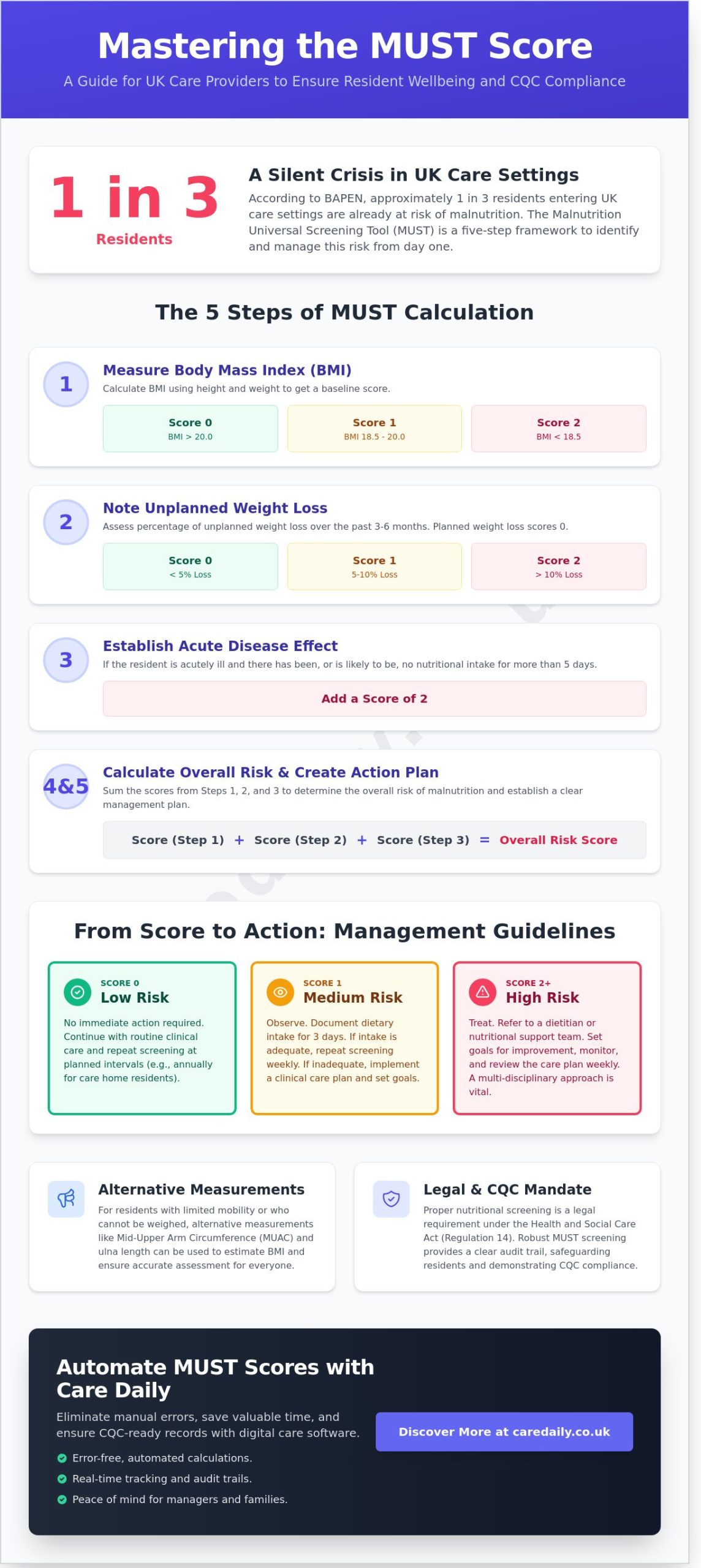
Assessing nutritional health shouldn’t feel like a clinical chore. It’s a way to safeguard your loved one’s independence and vitality. To ensure accuracy, healthcare professionals follow The 5 Steps of the MUST Score Calculation, a process designed by BAPEN to identify malnutrition risks early. This framework ensures that every person receives the specific support they need based on their unique physical state.
Step 1 & 2: BMI and Weight Loss Nuances
The first step involves measuring height and weight to find the Body Mass Index (BMI). We use this number to assign a score from 0 to 2. A higher score indicates a higher risk. You can use the following quick reference for BMI scores:
-
Score 0: BMI greater than 20 kg/m²
-
Score 1: BMI between 18.5 and 20 kg/m²
-
Score 2: BMI less than 18.5 kg/m²
Step 2 looks at unplanned weight loss over the last 3 to 6 months. To find the percentage, use the formula: (previous weight – current weight) / previous weight x 100. If the loss is more than 10%, it results in a score of 2. Losses between 5% and 10% result in a score of 1. It’s vital to remember that planned weight loss, such as a bespoke diet for obesity management, results in a score of 0. When determining the final score must you add each individual component to reach a total.
Step 3: Understanding the Acute Disease Effect
This step accounts for people who are acutely ill. We apply a score of 2 if a person has had no nutritional intake, or is likely to have none, for more than 5 days. This is most common when someone is being discharged from a hospital after a major surgery or severe illness. In stable domiciliary care settings where your loved one is generally well, this score is rarely applied. It acts as a safety net for those facing sudden, serious health challenges.
Step 4 is where we aggregate the points from previous stages. This total score must be used to determine if a person is at low, medium, or high risk of malnutrition. Finally, Step 5 guides us in formulating a management plan. For those at high risk, this might involve a referral to a dietitian or the introduction of nutritional supplements. Our team at CareDaily can help you implement these steps, providing the professional support needed to maintain health at home. This systematic process offers families peace of mind by turning clinical data into a clear path for compassionate care.
Alternative Measurements: MUAC and Ulna Length
Standard measurements aren’t always easy or dignified for every individual. We often care for residents who live with severe kyphosis, which is a significant curvature of the spine, or those who are comfortably settled in bed and cannot stand. In these moments, forcing a traditional height or weight check can cause unnecessary distress. Our approach remains bespoke; we adapt our clinical tools to fit the physical reality of the person we are supporting. Using alternative measurements ensures that your loved one’s score must be calculated accurately without compromising their comfort.
Clinical precision doesn’t have to feel cold or institutional. By using validated proxies for height and weight, we maintain a high standard of nutritional screening. These methods are endorsed by the British Association for Parenteral and Enteral Nutrition (BAPEN) and provide a reliable safety net for residents who are unable to use standard scales or height charts. It’s about finding a "calm in the storm" solution that prioritises peace of mind for families while giving our dedicated professionals the data they need.
How to Measure MUAC Accurately
Mid-Upper Arm Circumference (MUAC) serves as a vital proxy for Body Mass Index (BMI). To perform this correctly, you should use the person’s non-dominant arm. First, ask them to bend their arm at a 90-degree angle. You then measure the distance from the bony tip of the shoulder to the point of the elbow. Mark the exact midpoint between these two spots. Once marked, let the arm hang relaxed and wrap the tape measure around that midpoint. Ensure the tape is touching the skin but not pinching it.
-
Under 23.5cm: This measurement suggests a BMI likely below 20, which may indicate a higher nutritional risk.
-
Over 32.0cm: This suggests a BMI likely above 30, helping us identify different nutritional needs.
We always record which arm was measured in the care plan. Maintaining this consistency is essential for longitudinal tracking, as it allows us to see even small changes in a resident’s physical condition over time. This level of detail helps us provide a higher quality of life through proactive adjustments.
Estimating Height from Ulna Length
If a resident cannot stand straight, we don’t guess their height. Instead, we measure the ulna bone. You do this by asking the resident to cross their arm over their chest, placing their hand on the opposite shoulder. Measure from the prominent bone at the wrist, known as the styloid process, to the point of the elbow, or the olecranon. This single measurement is then compared against BAPEN conversion tables.
These tables are specific to gender and age, which ensures the final score must be as precise as possible. Using this method means even the most frail or bed-bound residents receive an assessment that respects their independence and physical limitations. It’s a compassionate way to ensure that clinical excellence and personal dignity always go hand in hand.
Translating Scores into Clinical Action and CQC Compliance
Calculating a result is only the first step; the real value lies in how you use that data to protect a person’s dignity and health. We categorise results into three distinct risk levels to ensure every individual receives the right level of support. A score of 0 indicates a Low Risk, requiring routine clinical care and a repeat screening every month in care settings. A score of 1 signals Medium Risk, where we recommend documenting dietary intake for 3 days and reviewing the situation monthly. Any result of 2 or higher is High Risk, requiring immediate intervention and a bespoke management plan.
This structured approach is a cornerstone of cqc compliant care policies and procedures. By following these steps, you demonstrate that your service is "Safe" by preventing avoidable harm like malnutrition and "Effective" by ensuring nutritional needs are met through evidence-based practice. According to BAPEN, roughly 35% of adults admitted to care homes are at risk of malnutrition, making these actions vital for survival and quality of life.
Management Plans for Medium and High Risk
When a person reaches a medium risk level, we focus on observation. You’ll record everything they eat and drink for 72 hours to identify patterns or barriers to eating. If their weight remains stable or improves, you continue monthly monitoring. If it declines, you must escalate their care immediately. High-risk individuals require a referral to a dietitian or a nutritional support team. At this stage, we increase weighing frequency to once a week to catch small fluctuations before they become crises.
We always advocate for a "food first" approach before relying on medical prescriptions. This involves fortifying standard meals with high-calorie ingredients like butter, cream, or protein-rich additions to make every mouthful count. Oral Nutritional Supplements (ONS) are valuable tools, but they should complement a bespoke diet rather than replace the social and sensory joy of eating real food. This preserves independence and keeps the focus on the person, not just the clinical deficit.
Evidence for CQC: The Audit Trail
The Care Quality Commission (CQC) looks for specific evidence that you are meeting the "Nutrition and Hydration" Quality Statement. Your MUST records act as a primary source of proof. It’s also essential to link your score must data to incident and accident reporting. For instance, if a resident suffers a fall, an inspector will look to see if a high MUST score was identified and if the resulting weakness was addressed in the person’s care plan. Failing to connect these dots can lead to a "Requires Improvement" rating.
A digital audit trail of MUST scores provides clear, chronological evidence that your team identifies changing needs in real time and adapts support accordingly, satisfying the CQC requirement for responsive care. Ensuring your team understands their obligations under the social care and health act legislation is equally important for demonstrating full regulatory compliance during inspections.
If you need help implementing these clinical standards in your own home or for a loved one, contact our compassionate team today for a consultation on personalised care planning.
Digital Revolution: Automating MUST Scores with Care Daily
Paper-based systems often lead to unintentional risks in a busy care environment. When a dedicated carer manually calculates a nutritional assessment, a simple math error can mean a high-risk resident stays under the radar. These missed reviews or calculation mistakes can delay vital nutritional support by weeks. We believe technology should act as a safety net that supports your team’s expertise. Our digital care management software UK automates the complex BMI and weight loss calculations instantly. By removing the manual burden, you ensure every score must be precise the moment data is entered. This automation provides managers with genuine peace of mind. The system triggers immediate alerts for high-risk results, ensuring no one is left behind. These scores integrate directly into bespoke, person-centred care plans, keeping nutrition at the heart of daily support.
Real-Time Monitoring and Reporting
We provide a clear, intuitive dashboard view of nutritional health across your entire service. You can see at a glance which residents require a follow-up without ever needing to sift through heavy ring binders. Generating professional reports for MDT meetings or GP referrals takes seconds. This efficiency significantly reduces staff admin time, often saving teams up to 10 hours of paperwork per month. It frees your dedicated professionals to focus on what truly matters: providing compassionate, face-to-face care. When a score must be shared with an external dietitian, the data is accurate, formatted, and ready to send. This clarity builds trust with healthcare partners and families alike.
Seamless Compliance Integration
Care Daily’s policy library includes pre-written MUST and nutritional procedures that align with current UK regulatory standards. Having clinical scores and care policies in one unified system ensures your team always follows the most recent best practices. You don’t have to worry about outdated guidance or misplaced files. Our system keeps everything in one secure place, making inspections less stressful and more transparent. Transitioning to a digital approach is a gentle, proactive step toward safer and kinder care for your loved ones. We’re here to help you protect the dignity and independence of every individual in your service. It’s about creating a sanctuary where safety and warmth go hand in hand.
Future-Proofing Your Nutritional Care Standards
Managing nutritional risk is far more than a clinical requirement; it’s a fundamental part of protecting the dignity and independence of every person in your care. By mastering the five-step score must calculation and utilizing alternative measurements like MUAC, your team can identify malnutrition risks before they become critical health issues. Accuracy in these assessments directly influences your CQC rating and ensures your service meets the stringent 2026 regulatory standards. We know that manual tracking often leads to anxiety during inspections, which is why moving toward a digital-first approach is essential for modern providers.
Our platform provides the "Peace of Mind" compliance you need by integrating clinical scoring directly with eMAR. You’ll gain access to over 2,000 CQC-compliant policies updated for 2026, ensuring your bespoke care plans remain both current and compassionate. Automated alerts and real-time data entry remove the burden of paperwork, allowing your dedicated professionals to focus on what matters most: the residents. You don’t have to navigate these complex clinical requirements alone. We’re here to act as your trusted guide, helping you deliver safer, more responsive care every single day.
Discover how Care Daily automates MUST scoring and compliance
Frequently Asked Questions
What is a high MUST score and what does it mean?
A high risk score must be recorded when a resident reaches a total of 2 or more on the Malnutrition Universal Screening Tool. According to BAPEN guidelines, this indicates a significant risk of malnutrition that requires immediate clinical action. We recommend developing a bespoke nutritional care plan that includes food fortification and regular monitoring to ensure your loved one maintains their strength and dignity.
How often should a MUST assessment be carried out in a care home?
You should complete a MUST assessment upon a resident’s admission and at least once every 30 days thereafter to meet UK safety standards. If a resident’s clinical condition changes or you notice a sudden drop in appetite, you’ll need to reassess them immediately. Regular monthly tracking provides peace of mind that we’re identifying nutritional needs before they become serious health concerns for our seniors.
Can I use the MUST score for residents with fluid retention or oedema?
You can still use the tool, but you’ll need to account for fluid weight which often masks underlying malnutrition. In cases of severe oedema, our dedicated professionals use alternative measurements like the mid-upper arm circumference or ulna length to estimate height and weight. These methods ensure we provide accurate, personalized care even when physical conditions make standard weighing difficult or misleading.
What is the difference between MUST and other nutritional screening tools?
The MUST tool is the most widely used screening system in the UK, validated by BAPEN for use across hospitals, care homes, and community settings. While tools like the Mini Nutritional Assessment focus specifically on older adults, MUST provides a universal framework for all adults. It’s the gold standard for identifying three key criteria: BMI, weight loss, and the effect of acute disease on nutritional intake.
Do I need a dietitian to complete a MUST score assessment?
You don’t need a registered dietitian to perform the initial screening; any trained care professional or family member can complete it. However, if the result shows a high risk, we recommend a formal referral to a dietitian for a bespoke nutritional intervention. Our team acts as a compassionate guide, helping you navigate these clinical steps to ensure your loved one receives the expert support they deserve.
How does the MUST score affect my CQC rating?
The Care Quality Commission views consistent nutritional screening as a core requirement under Regulation 14, which covers meeting nutritional and hydration needs. Failure to maintain accurate records can lead to a "Requires Improvement" or "Inadequate" rating during a formal inspection. Demonstrating that you act on these scores shows you’re committed to the safety and quality of life of every individual in your care.
What should I do if a resident refuses to be weighed for a MUST score?
You must always respect a resident’s right to refuse, as preserving their dignity and independence is our priority under the Mental Capacity Act 2005. In these situations, use alternative measurements like clothing changes or mid-upper arm circumference to estimate nutritional status. Document the refusal clearly in their care plan and try again at a later date when the resident feels more comfortable and reassured.
Is the MUST score suitable for use in domiciliary care settings?
Yes, the MUST tool is perfectly suited for home-based support and is frequently used by community nurses and private carers. It’s a vital part of providing bespoke care that allows individuals to stay in their own homes for as long as possible. Using this score must be a collaborative process, giving families the confidence that their loved ones are receiving professional monitoring in a familiar environment.