
Nourish care planning pricing: compare fees and payment terms

A Nourish care planning pricing comparison is most useful when it looks beyond the headline fee: contract terms, invoicing frequency, minimum fees and any surcharge for monthly payments all affect the overall commitment. Compare those terms alongside what the care-planning tools support, including how they help providers consider CQC expectations for adult social care in England.
If you’re comparing care-planning software, predictable costs and a clear picture of what’s included matter. A lower headline fee may not show the full commitment or whether the planning tools suit how your team records and reviews care.
This article explains how to compare the main payment terms, what to look for in minimum fees and monthly payment surcharges, and how care planning can support compliance work. You’ll have a clearer basis for judging the overall value, not just the first figure you see.
Key Takeaways
- Compare contract length, renewal terms and invoicing arrangements to understand the commitment beyond the headline fee.
- Look at how minimum fees and monthly payment surcharges could affect your budget as service needs change.
- Separate setup, implementation, training and support costs when assessing the overall value of a care planning system.
- Consider whether digital care planning supports consistent records and CQC-aligned practice across your service.
- See how Care Daily’s care management software, digital care planning and staff rostering may fit your operational needs.
Contract length and renewal terms
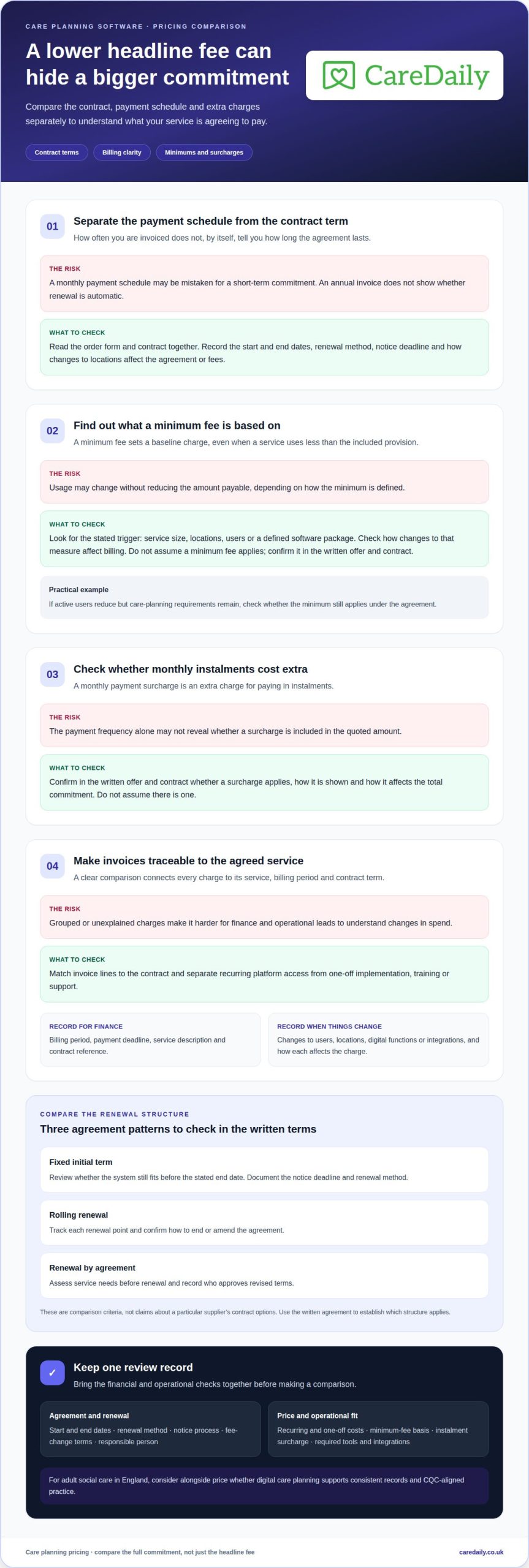
A contract’s initial term determines how long your service commits to a care-planning system before reviewing its fit. In a Nourish care planning pricing comparison, assess the initial commitment separately from renewal terms. Read the order form and contract together: service descriptions, billing terms and renewal details may appear in different documents. Note the start date, end date and notice deadline in one place so registered managers and finance leads can plan budgets and review the agreement.
Renewal terms matter as much as the initial commitment. Check whether renewal is automatic, how much notice is required to end or change the agreement, and how revised terms are communicated. Assign responsibility for each action: a registered manager can assess whether care plans meet operational needs, while finance tracks the renewal date and payment commitment. For supported living, include relevant integrations and operational dependencies when reviewing whether the system still fits.
Use the contract to distinguish the agreement term from the payment schedule. Paying monthly does not, by itself, show how long the agreement lasts. Similarly, an annual invoice does not tell you whether renewal is automatic. Check how changes such as adding a location affect the agreement and fees. In domiciliary care, expansion may change staff workflows and records; in residential care, maintaining continuity of residents’ plans may be central to a transition.
| Contract option | Commitment to review | Renewal detail to document |
|---|---|---|
| Fixed initial term | Review fit before the stated end date | Notice deadline and renewal method |
| Rolling renewal | Track each renewal point | How to end or amend the agreement |
| Renewal by agreement | Assess service needs before renewal | Who approves revised terms |
Treat these as comparison criteria, not claims about Nourish’s contract options. Use the written terms to establish which structure applies. Your comparison will be more useful if you link each renewal date to a decision-maker, a budget review and an assessment of care-planning needs. For a related view of platform costs, please review the pricing information alongside the agreement terms.
Before signing, record the contract dates, renewal method, notice process, fee-change terms and responsible person. Keep the record with procurement documents and set a calendar reminder ahead of the notice deadline. If the agreement covers several services, establish whether they renew together or separately. This matters if you want to retain care planning while changing another part of your system.
Choose the structure that gives your organisation a clear review point and a workable exit or renewal process. A registered manager should be able to connect the contract dates to service delivery, while finance can trace them to the budget. That makes the decision auditable and reduces the risk of an overlooked renewal becoming an unintended commitment.
Invoicing and pricing transparency
An invoice helps with comparison when its charges clearly match the agreed service. Check each line against the contract, billing period and supplied functions. Record the invoice date, coverage period, payment deadline and any adjustments separately. This gives finance and operational leads a consistent basis for reviewing spend and explaining changes, such as when a domiciliary service adds clients or changes its processes.
Before comparing proposals, establish what each quoted amount covers. Separate recurring platform access from one-off implementation, training or support. Check how changes to users, locations, digital functions or integrations affect the total. Compare the written scope and price with your care-planning needs, required integrations and the way your team will use the system.
Clear invoices make day-to-day administration easier. Your organisation should be able to trace charges to the agreed subscription and billing period without relying on informal notes. If a charge changes, the explanation should identify the relevant contract term or service change. Keep invoices with the supporting agreement so managers can resolve discrepancies using the same records.
- Match each invoice line to a service or agreed contract term.
- Record the billing period and payment deadline for finance.
- Separate recurring charges from one-off work.
- Document changes to users, locations or integrations.
Consider how billing fits your existing processes. A finance lead may need to reconcile software costs against a budget while a care coordinator tracks operational changes. A mobile app can support carers’ daily work, but its presence alone does not explain how the subscription is billed. Compare the proposal’s scope with the tools your teams will actually use.
For a practical comparison, record the service description, billing frequency, payment method, adjustment process and contract reference for each proposal. If an invoice groups several functions together, note which teams rely on them. A domiciliary provider may prioritise mobile working, while another organisation may focus on consistent records across services.
At Care Daily, we find that mapping invoice terms to everyday processes helps managers discuss costs with finance using shared language. If you’re setting out requirements for a care management system, you can outline your operational requirements as a useful next step.
Minimum fees and monthly payment surcharge
A minimum fee sets a baseline charge, even when a service uses less than the included provision. A monthly payment surcharge is an extra charge for paying in instalments. Do not assume either applies. Check the written offer and contract to see whether they affect the total commitment.
First, identify what triggers any minimum fee. It may relate to service size, locations, users or a defined software package. The contract should specify the measure and explain how changes affect billing. For example, a provider might reduce active users while retaining the same care-planning requirements. A minimum could still apply if the agreement ties it to the package rather than active use.
Next, distinguish a minimum charge from a usage threshold. A threshold specifies what is included before extra charges apply; a minimum is the lowest amount payable. Check how each is measured, when it is reviewed and how changes are recorded. For digital care, clarify whether assessments, compliance tools and other functions are included together or have separate charging criteria.
Review monthly payment terms just as carefully. Compare the total commitment under each available payment schedule, not only the amount on each invoice. If monthly instalments carry a surcharge, establish how it is calculated, when it applies and whether it changes at renewal. A clear comparison separates the subscription from payment-related charges. Record both in the budget so finance can explain the difference.
Changes to a service can reveal unclear contract terms. For example, moving from one location to several may require different access arrangements, even if the care-planning process remains centred on the same assessments. Check how the contract treats the change, rather than assuming the organisation must use every software function immediately. Document the proposed change and its billing effect before approving a variation.
- Identify the basis for any minimum charge.
- Separate included usage from additional charging thresholds.
- Compare the full commitment under each payment schedule.
- Record how a change in users, services or setting affects charges.
For a fair comparison, map each possible charge to its trigger, calculation method and review point. Then test the terms against a realistic operational change, such as adding a service or changing access to digital care tools. This makes the financial effect easier for managers and finance teams to discuss, without treating the headline fee as the full cost.
Choose a payment structure your organisation can budget for and reconcile, with every minimum and surcharge clearly linked to the contract. If you cannot explain a term from the written agreement, leave it unresolved in your comparison until its meaning is clear.
What setup, implementation, training or support fees does Nourish charge?
The total depends on the work included around the software, not just access to care planning. Setup, implementation, training and ongoing support are separate cost categories. The exact figure depends on your organisation’s requirements and is provided in a quote for your case. Compare each category separately, rather than treating all onboarding activity as one charge.
Setup may involve preparing accounts and configuring access for users. Implementation may include transferring information, configuring workflows or helping teams move from existing records. These are different activities. A provider with established digital records, for example, may need a different transition plan from a service moving paper care plans into a digital system.
Assess training against staff roles and everyday tasks. A registered manager may oversee care-plan reviews, while coordinators keep information current. Carers need practical guidance on recording visits and accessing relevant support information. Check how training is delivered, which roles it covers and whether further sessions are charged separately. Record the answers alongside the implementation scope.
Support covers the help available after implementation. Establish which channels are included, what issues they cover and how requests are handled. Distinguish technical assistance from operational guidance: an account-access problem differs from a question about configuring a workflow. The proposal should make these boundaries clear so managers know what support covers during routine use.
For a like-for-like comparison, document these details for each proposal:
- What setup work is included and what information your team supplies.
- Which implementation tasks are planned, including any record transfer.
- Which staff roles receive training and what the sessions cover.
- What ongoing support includes and how additional help is treated.
Then test the scope against a real operational example. A domiciliary team may need mobile workflows for carers moving between visits. A children’s service may prioritise consistent records between shifts. These needs can affect configuration, staff preparation and ongoing support. Specify the relevant tasks when discussing the proposal instead of relying on a broad label such as “onboarding”.
Care Daily’s getting-started process gives providers a way to set out their operational requirements. Use the same scope categories when comparing implementation arrangements, so the decision reflects what your teams need to use care plans confidently from the outset.
Nourish’s setup, implementation, training and ongoing support fees depend on the work included and your organisation’s requirements. The exact figure is provided in a quote for your case.
Care Daily
Care Daily helps providers assess care management software against how their teams work. Its platform includes digital care planning, staff rostering and a Policy & Procedure Library, bringing operational and compliance needs into one system. This is useful when comparing contract terms with the practical needs of different services, such as keeping care plans current alongside staff schedules.
A clear comparison starts by separating essential workflows from features your team may not use. Care Daily’s platform brings care planning, rostering and compliance tools together, giving finance and operational leads a shared basis for assessing fit beyond the payment schedule.
To discuss how Care Daily can support your organisation’s care management processes, [book a demo](https://www.caredaily.co.uk/company/demobooking).
Make the comparison useful for your next decision
A Nourish care planning pricing comparison is most useful when it supports a decision that operational and finance teams can explain. Before procurement moves forward, agree who will assess service fit, who owns the budget and how the system will be reviewed after implementation. This keeps the decision tied to care delivery, not just purchasing.
Include the people who use care plans in the discussion. A registered manager may focus on how records support continuity, while finance considers how the commitment fits the organisation’s planning cycle. Their perspectives help set clear priorities and make the final decision easier to communicate across the service.
If you’re considering whether Care Daily fits your organisation’s needs, take the next step at a pace that works for your team. Discuss your requirements with Care Daily and explore the options available for your care service.
A considered choice starts with your priorities and supports the people delivering care every day.
Frequently Asked Questions
What should UK care providers consider when comparing care planning software prices?
Compare the full service scope and how well it supports your organisation’s actual workflows, not just the headline charge. For example, trace how a coordinator would update a person’s support after a change and how a carer would access that information during a visit. Consider whether the system suits your setting, staff roles and existing processes, and whether records remain practical to use during handovers and reviews.
More from the blog

Care home risk assessment software: roles and reviews
A risk assessment should support a person’s safety without unnecessarily restricting their choices. Care home risk assessment software can help staff
Read more →
Compare home care software for real-time access and data security
A familiar system is not automatically the safer choice, and moving to cloud software is not always the right answer. To compare Tagtronics with
Read more →
Which PASS care software alternatives fit your budget?
The best fit depends on your provider’s needs and budget: compare PASS with alternatives such as Care Daily, then weigh up the costs and practical
Read more →