
An inspection looks beyond whether required paperwork exists: CQC considers whether people receive safe, effective, caring, responsive and well-led support. This CQC inspection preparation guide explains how to connect your service’s stated approach with what people, staff and records show in practice.
Preparing for scrutiny can feel demanding when managers and teams are already balancing operational pressures. The aim isn’t to coach people into perfect answers or create a display of paperwork. It’s to make everyday practice clear, help staff explain their responsibilities and ensure leaders can show how they learn and respond when something needs to change.
This guide covers practical ways to prepare staff for conversations, organise evidence and keep governance meaningful between inspections. It also explains how to make policies useful in daily work, rather than documents staff open only during a review. Use these steps to identify what your team does well, where processes need attention and how to make inspection readiness part of consistent, person-centred support.
Key Takeaways
- Prepare staff to explain how they handle safeguarding, report concerns and find the policies they need. If they’re unsure of an answer, they should say so rather than guess.
- Keep training, supervision and competency evidence organised so you can show how staff apply learning in practice, not just which courses they’ve completed.
- Map care records, feedback and audit findings to the five key questions and relevant quality statements to make the evidence easier to follow.
- Review policies and governance records together, checking that procedures reflect current practice and that actions from audits, incidents and complaints are tracked.
- Use a regular readiness review to spot gaps early, assign actions and keep inspection evidence easy to locate.
What questions do CQC inspectors ask staff?
Prepare staff to describe their practice, not recite a script. A CQC inspection preparation guide should help the team explain how safeguarding, training and reporting procedures work during everyday care.
-
Review staffing and training records
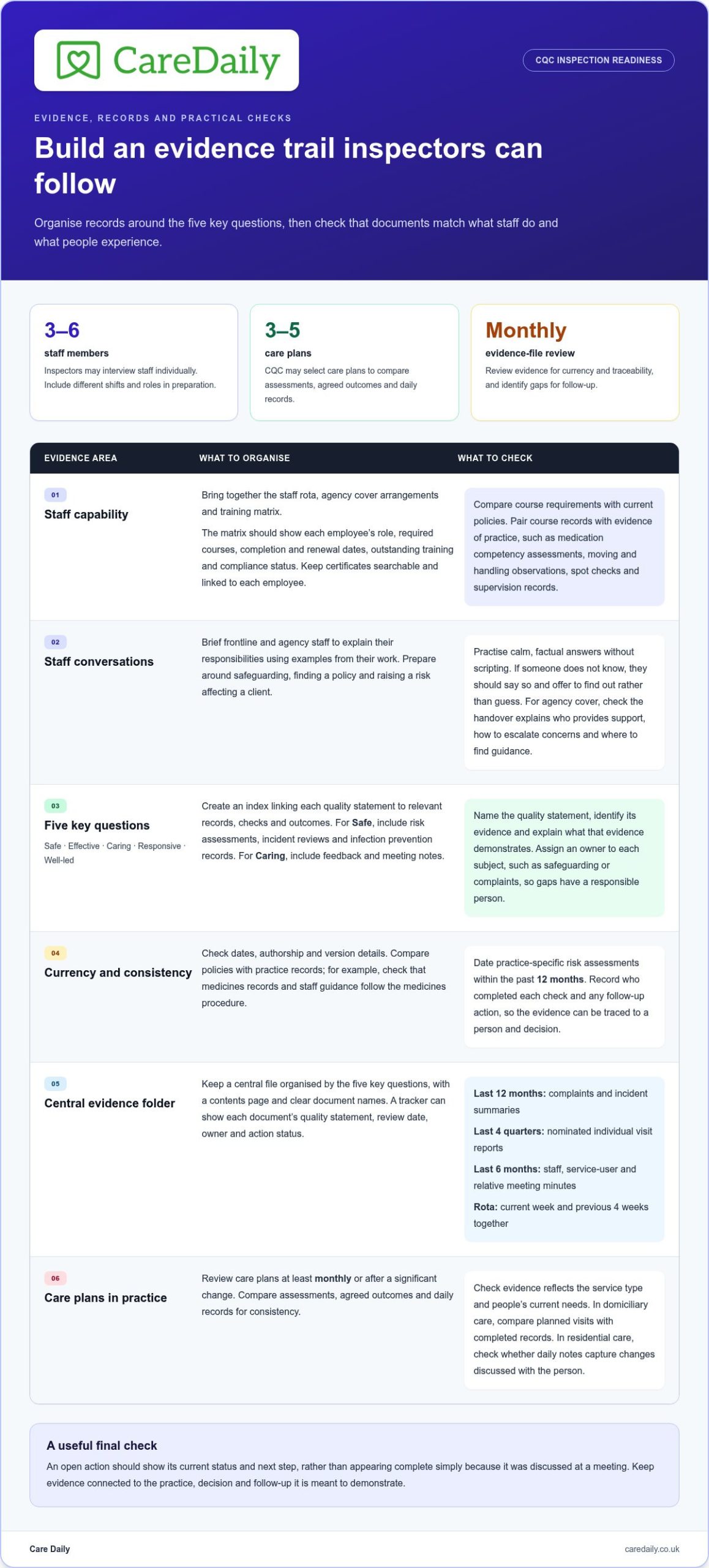
Check the staff rota, agency cover arrangements and training matrix together. The matrix should show each employee’s role, required courses, completion and renewal dates, outstanding training and compliance status. Compare those requirements with current policies. For example, if the safeguarding policy requires Level 2 safeguarding for care staff, check that staff records reflect it.
Review training readiness regularly, then organise certificates so they’re searchable and linked to each employee. Course completion alone won’t show how someone applies their learning. Add practical evidence such as medication competency assessments, moving and handling observations, spot checks and supervision records.
-
Practise staff communication and inspection Q&A
Brief frontline and agency staff on answering inspectors clearly, using examples from their work. CQC inspectors may interview 3-6 staff members individually, so include people covering different shifts and roles. Ask how they would report a safeguarding concern, find a policy or raise a risk affecting a client. This makes preparation relevant to each role.
Practise calm, factual answers without scripting them. If a staff member doesn’t know, they should say so and offer to find out rather than guess. For agency cover, make sure the handover explains who provides support, how to escalate concerns and where to find guidance. A useful preparation guide supports honest answers, not memorised lines.
-
Check that training reaches everyday practice
Use supervision and direct observation to check how staff apply training. For example, review a medicines record alongside the staff member’s competency assessment and the service’s procedure. Identify gaps between written processes and actual practice, then record follow-up actions through supervision or governance.
Keep training under routine review instead of treating it as an inspection-week task. Identify courses due or overdue, who needs action and how the service will maintain safe staffing meanwhile. This gives managers a clearer picture of staff readiness.
-
Know the notice period and provider duties
For an English GP practice, CQC gives 14 days’ notice of an inspection, but may inspect without notice if it has concerns. A GP practice has five working days to respond to a CQC request for information. Assign responsibility for gathering records promptly, so requests don’t depend on one person being available.
-
Prepare for inspection findings
CQC sends a draft inspection report for factual accuracy checking, and services have 10 working days to respond. Identify disputed factual statements and set out supporting evidence clearly. Keep factual corrections separate from disagreement with a rating judgement.
If findings identify a breach, address the underlying practice, assign actions and record how governance reviews their effect. Use this guide to help the team turn findings into clear, owned improvements.
What documents must be current at all times for a CQC inspection?
Organise evidence around Safe, Effective, Caring, Responsive and Well-Led. This CQC inspection preparation guide explains how to connect quality statements with records that reflect current practice.
-
Map evidence to the five key questions
Create an index linking each quality statement to relevant records, checks and outcomes. For Safe, include risk assessments, incident reviews and infection prevention records. For Caring, use feedback and meeting notes to show how people’s views shape support. Name the statement, identify its evidence and explain what that evidence demonstrates. Assign an owner to each subject, such as safeguarding or complaints, so someone is responsible for addressing gaps.
-
Check evidence currency and consistency
Review dates, authorship and version details before filing documents. Compare policies with practice records: if a medicines policy sets out a process, check that medicines records and staff guidance follow it. Date practice-specific risk assessments within the past 12 months. Record who completed each check and any follow-up action, so the evidence can be traced to a person and decision.
- Ask each evidence owner to maintain source records and flag gaps to the registered manager. A tracker can show the document name, quality statement, review date, owner and action status. This helps managers spot missing or inconsistent information early. For example, an open action should show its current status and next step, rather than appearing complete simply because it was discussed at a meeting.
-
Maintain inspection-ready evidence folders
Keep a central file organised by the five key questions, with a contents page and clear document names. Include complaints and incident summaries from the last 12 months, nominated individual visit reports from the last 4 quarters, and staff, service-user and relative meeting minutes from the last 6 months. File the current week’s rota and the previous 4 weeks of staffing rotas together for quick retrieval.
- Check that evidence reflects the service type and people’s current needs. Care plans should be reviewed at least monthly or after a significant change. CQC may select 3-5 care plans, so compare assessments, agreed outcomes and daily records for consistency. In domiciliary care, compare planned visits with completed records; in residential care, check whether daily notes capture changes discussed with the person.
Review the evidence file monthly for currency, traceability, consistency and completed actions. If you want a more joined-up way to organise compliance evidence, explore getting started.
CQC assessment framework and quality statements
CQC assesses services against five key questions: Safe, Effective, Caring, Responsive and Well-Led. Ratings range from Outstanding and Good to Requires Improvement and Inadequate, signalling how well the service meets expectations and where improvement is needed.
-
Understand the assessment framework
Map your evidence to the relevant quality statements, not just broad topic headings. CQC replaced Key Lines of Enquiry with quality statements in late 2023, so review older assessment tools and update their terminology. For GP practices, the current Single Assessment Framework and its 34 quality statements applied throughout the pilot. Keep the focus on how evidence shows people’s experience and outcomes.
-
Review governance and quality improvement
Ask the registered manager to trace an improvement from concern to action and review. Bring together audit results, risk assessments, incident learning, supervision records and quality improvement plans. For example, if an audit identifies missed reviews, show the action owner, follow-up and how the manager knows practice changed. Leadership evidence is strongest when decisions and outcomes connect, rather than sitting in separate files.
-
Check training and qualifications records
Compare training records with staff roles, induction requirements and current policies. A training matrix should help the registered manager identify courses due soon, expired certificates and overdue high-risk learning. Then connect completion to practice: a certificate alone won’t show whether a carer can apply learning safely. Use supervision, competency assessments and observed practice to show how qualifications and training support people’s outcomes.
-
Manage risk and quality
Review each risk assessment alongside incidents, complaints and changes in people’s needs. Check whether controls remain practical and whether staff know what to do when circumstances change. For example, a change in mobility should prompt a review of relevant support and risk controls, with actions recorded and followed through. The framework considers how the service identifies concerns, responds and learns.
- Use a quality review meeting to test whether governance leads to meaningful action. Ask each evidence owner to explain what changed, who benefits and what remains unresolved. Record decisions and assign follow-up to a named manager. This makes leadership accountable for learning, rather than treating an audit as a completed task.
- Set a rolling review of training, audits and improvement actions across the previous 12 months. Check for recurring concerns, overdue actions and evidence that a change has been sustained. If the same issue appears in a new audit, revise the response rather than closing the action without checking its effect. This gives the registered manager a clearer view of quality and risk.
Governance, policies and procedures
Strong governance connects written policies with decisions, daily practice and learning. Use these steps to show how leadership responds to feedback, identifies risk and checks whether actions improve people’s experience.
- Compare your statement of purpose with the service you currently deliver. A service’s statement of purpose is required by Regulation 12 of the CQC (Registration) Regulations 2009, according to UK Legislation. Check that its description reflects the service’s actual model, the people it supports and the care provided. If the service’s focus has changed, record the review and the action taken to keep the document accurate.
- Review each policy against current practice, related records and staff understanding. A medicines policy, for example, should match the steps staff follow to record administration and report an error. Check that version details and review dates are visible, then remove superseded copies from shared folders. Policies should guide decisions in real situations, not simply sit in a governance file.
- Use complaints and compliments to identify patterns, not just close individual cases. Summarise complaints received in the 12 months before inspection, actions taken and how learning was implemented. For each theme, record who reviewed it, what changed and how the service assessed the result. Feedback about missed communication, for instance, should connect to a specific improvement and a later review.
- Bring serious incidents, audits and quality improvement actions into one governance review. Evidence requests may include a summary of serious adverse events from the previous 12 months, actions taken and how learning was implemented. Record the concern, decision, action owner and follow-up. If an audit identifies repeated gaps, show how leadership investigated the cause and checked whether the revised approach reduced recurrence.
- Check whether governance information is easy to explain and follow. Ask a manager to trace one concern from its initial report through decision, action and review. Confirm that dates, meeting notes and policies tell a consistent story, and that unresolved actions have a named owner. This helps demonstrate leadership in practice, rather than relying on claims of outstanding care without supporting evidence.
- Keep policy review part of routine governance, with staff feedback informing revisions and clear records showing what changed. If you want a structured way to manage policy documents alongside compliance work, explore how Care Daily can support your governance workflow.
Care Daily: Care Management Software
Care Daily brings care records, digital care planning, staff rostering and policy compliance into one platform. It can help when inspection preparation involves tracing information across separate systems, such as matching a planned visit with the care plan and staff rota.
Care Daily’s Policy & Procedure Library brings policies together with operational records, helping managers connect written guidance with service processes. Governance evidence is easier to use when it supports routine oversight, not just inspection preparation. Care Daily supports different care settings, including domiciliary care, residential care and supported living.
If you’re considering a more joined-up way to manage care operations and compliance, you’re welcome to contact Care Daily or visit caredaily.co.uk.
Make readiness part of everyday practice
Inspection preparation works best as a management habit, not a temporary project. Use this CQC inspection preparation guide to build regular reflection into team meetings, supervision and quality reviews. A useful next step is to choose one governance process and decide how you’ll keep it active between inspections.
For example, a registered manager could use a routine review to connect client feedback with staff learning and service changes. That makes improvement part of how the team works, rather than a separate exercise for inspection day. Care Daily’s care management software helps providers bring operational and compliance processes together.
Every service has its own priorities. Start with the area where clearer oversight would help your team most, then develop the approach at a manageable pace. Explore how Care Daily can support your service and take a confident next step towards consistent, person-centred practice.
Frequently Asked Questions
What Do CQC Inspectors Look For?
CQC inspectors look for evidence that people receive safe, effective, caring, responsive and well-led support. They consider what people say, observe interactions and compare practice with records. Test your service by following one person’s experience from assessment through a change in need. For example, check whether a new mobility concern is reflected in staff actions and the person’s own account of their support.
What are the most common first-inspection mistakes?
Common preparation mistakes include treating inspection as a paperwork exercise, relying on one manager to explain the service and overlooking differences between written procedures and everyday practice. Ask a staff member on a different shift how they would respond to a concern, then compare their answer with the relevant procedure. Also check whether actions arising from earlier audits or feedback have a clear outcome, not just a recorded completion.
What happens during a CQC inspection day?
Inspectors gather evidence by observing care, reviewing documents and speaking with people connected to the service. The inspection team may include clinicians, pharmacists or Experts by Experience, who bring personal experience of care. A care home inspection is often carried out by a single inspector and an Expert by Experience. The team’s focus is shaped by information collected before the visit, so discussions on the day can differ between services.
When will I get my first CQC inspection as a new registered manager?
A registered manager’s appointment does not itself set a first-inspection date. For a newly registered service in England, the first rated inspection typically takes place within 12 months of registration, although timing varies according to risk. If you’ve taken over an existing service, concentrate on understanding its current performance and open actions. Build a clear handover with the provider so you can explain decisions and improvements made during your tenure.
What does the CQC assess during an inspection in England?
In England, CQC assesses services through five key questions: Safe, Effective, Caring, Responsive and Well-Led. These areas apply across service types, but the evidence differs in practice. In domiciliary care, inspectors may consider how support is delivered across visits; in a care home, they can observe interactions within the setting. Ratings reflect the evidence gathered, including people’s experiences and how leaders oversee the service.
What are the CQC Single Assessment Framework quality statements and evidence categories?
The Single Assessment Framework uses quality statements in place of the former Key Lines of Enquiry, which CQC replaced in late 2023. For adult social care in England, evidence comes from four sources: local information and data, information collected just before inspection, accounts from people connected with the service, and the inspection itself. This means a document should be considered alongside what people report and what inspectors observe.