
Children’s home policies in England must address the protection of children under Regulation 34 of the Children’s Homes (England) Regulations 2015. Regulation 35 covers behaviour management policies and records, according to The National Archives. These requirements sit alongside the wider standards that shape children’s care, safety and day-to-day experience.
Keeping children’s home policies practical and up to date takes more than filing documents. Policies need to reflect the children’s needs and guide staff through real decisions, from responding to behaviour to recording an incident.
This guide explains what policies and procedures cover, how a home’s suitability is assessed, and where to find relevant standards, statutory guidance and regulatory updates. Requirements differ across the UK, so do not assume that rules for England apply everywhere.
Key Takeaways
- In England, Regulation 35 of the Children’s Homes (England) Regulations 2015 concerns behaviour management policies and records, according to The National Archives (legislation.gov.uk).
- Assess suitability by considering whether the home’s purpose, care plans and day-to-day support reflect the needs of the children it serves.
- Use the Quality Standards and related statutory guidance to connect written policies with children’s safety, education, health and views.
- Keep track of relevant amendments and circulars, and review whether they affect the policies staff use in practice.
- See how digital policy and care management tools can help keep procedures accessible and connect them with care planning and staff organisation.
What are policies and procedures for Children’s Homes in England?
Policies set out a home’s approach; procedures explain the steps staff follow. In England, they should connect leadership, safeguarding and behaviour support with each child’s individual needs.
Provider and Manager Responsibilities
The provider is responsible for clear oversight, while the registered manager leads the home’s day-to-day operation.
Ofsted says a children’s home manager in England must have worked for at least 2 years in a role relevant to children’s residential care within the previous 5 years. Ofsted also says a registered manager must attain the specified level 5 diploma or an equivalent qualification within 3 years of managing a home.
A responsible individual represents the provider in overseeing the service. The provider should define responsibilities clearly, so staff know who reviews concerns, follows up actions and oversees the home’s policies.
Reflect fitness and suitability in governance rather than treating them as a one-off paperwork exercise. Keep relevant experience, qualifications and oversight arrangements clear, and review whether the manager has the support and authority to address concerns.
For more than one home, Ofsted may consider registering one person to manage two homes only if both are run by the same provider. Separate oversight records can show how the manager responds to each home’s distinct needs.
Behaviour Management and Positive Outcomes
Behaviour management is the consistent, child-centred support staff use to understand behaviour and promote positive outcomes.
According to The National Archives (legislation.gov.uk), Regulation 35 of the Children’s Homes (England) Regulations 2015 concerns behaviour management policies and records. A useful policy turns that requirement into clear practice: staff record what happened, the response taken and relevant follow-up.
Restorative practice helps repair relationships and rebuild trust after harm or conflict. Children’s homes are advised to use restorative approaches and avoid punitive measures that could cause harm or undermine trust.
For example, after a disagreement between young people, staff can record each child’s account and the support provided. Reviewing the incident can show whether a care plan needs to address a trigger or mental health concern.
This distinction matters: repeated behaviour may signal distress, not deliberate defiance. Policies should guide staff to consider a child’s wellbeing and development while recording decisions consistently.
Safeguarding and Child Protection Policies
Safeguarding and child protection policies explain how a home prevents harm, responds to concerns and protects children.
Regulation 34 of the Children’s Homes (England) Regulations 2015 concerns policies for the protection of children. The home’s procedures should explain how staff raise a concern, record relevant information and ensure it reaches the appropriate person for action.
Allegations procedures should give staff a clear route for reporting an allegation involving an adult, while keeping the child’s immediate safety central. They should explain how to maintain accurate records and share information with the appropriate people.
Make the steps usable during a real shift. For instance, a night worker who hears a child disclose harm needs to know whom to contact and what to record, without delaying protective action.
Review these procedures against the home’s practice and children’s needs. Clear roles, timely records and consistent follow-up help staff protect children and maintain trust.
Suitability for residential children’s homes
Suitability means matching a home’s purpose, arrangements and workforce to children’s needs. In England, the regulatory framework and quality standards guide that assessment.
Regulatory Framework
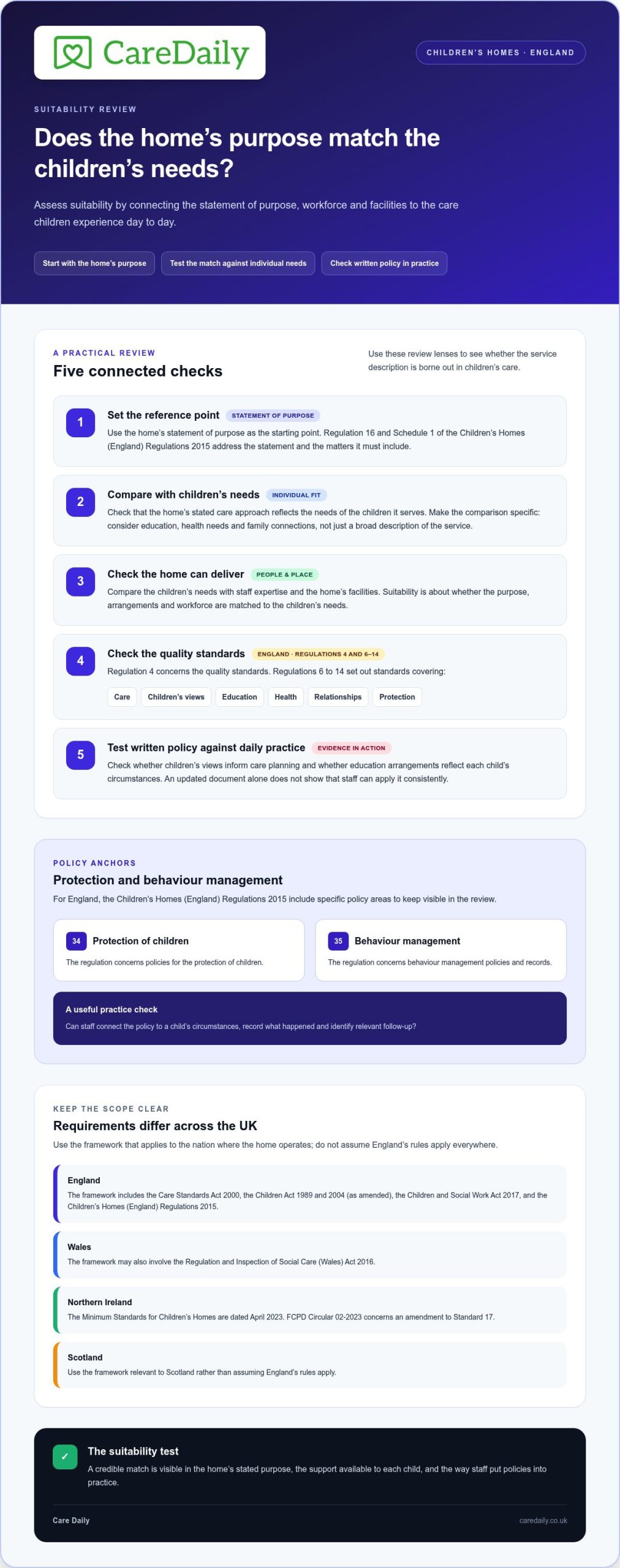
The regulatory framework is the legislation and requirements governing how a children’s home operates. In England, key legislation includes the Care Standards Act 2000, the Children Act 1989 and 2004 (as amended), the Children and Social Work Act 2017, and the Children’s Homes (England) Regulations 2015.
Use the home’s statement of purpose as the starting point for a suitability review. Regulation 16 and Schedule 1 of the 2015 Regulations address that statement and the matters it must include. Compare its stated care approach with children’s needs, staff expertise and the home’s facilities.
Make this comparison specific. For example, consider whether the home can support a child’s education, health needs and family connections, rather than relying on a broad description of the service.
Minimum Standards and Quality Standards
Quality standards describe the outcomes and areas of care that a children’s home must address. In England, Regulation 4 of the 2015 Regulations concerns the quality standards; Regulations 6 to 14 set out standards covering care, children’s views, education, health, relationships and protection.
Minimum standards are a separate reference point used within the relevant national framework. Northern Ireland’s Minimum Standards for Children’s Homes are dated April 2023. FCPD Circular 02-2023 concerns an amendment to Standard 17, so providers should consider that circular when reviewing relevant policies.
For a suitability review, connect each policy to daily practice. Check whether children’s views inform care planning and whether education arrangements reflect each child’s circumstances. An updated document alone does not show that staff can apply it consistently.
Differences Across the UK Nations
National frameworks are the legislation, regulations and standards that apply in each country. England’s children’s homes framework includes the Children’s Homes (England) Regulations 2015; Wales may also involve the Regulation and Inspection of Social Care (Wales) Act 2016.
In Scotland and Northern Ireland, providers must use the framework relevant to that nation rather than assume England’s rules apply. Northern Ireland’s children’s homes are governed by The Children’s Homes Regulations (Northern Ireland) 2005, alongside its Minimum Standards for Children’s Homes. This means policies need a clear country-specific reference, not a UK-wide label alone.
Staffing Requirements
Staffing requirements are the arrangements that enable workers to meet children’s needs safely and consistently. Ofsted’s manager criteria address relevant experience and qualifications, while staff recruitment includes Disclosure and Barring Service (DBS) checks.
Read the rules on training, supervision and staffing ratios alongside children’s needs and the home’s purpose. Match staff skills and shift cover to each child’s support needs. A child needing close support during education transitions may require different planning from one whose main support relates to family contact.
Record how induction, ongoing learning and supervision help staff apply the home’s procedures. Review rotas against planned support, incidents and changes in children’s needs, then document adjustments and their rationale. As you organise rotas alongside policy reviews, Care Daily’s care management platform can support the management of these operational arrangements.
Links to statutory guidance and Quality Standards
Statutory requirements and quality standards give providers a framework for reviewing care. Link each reference to the policy, evidence and follow-up action it informs.
Connecting policies to statutory references
A statutory reference is a law or regulation that informs a home’s responsibilities. In England, the Children’s Homes (England) Regulations 2015 provide key references, including Regulation 4 on quality standards and Regulation 16 on the statement of purpose.
Start a policy review with the statement of purpose. Check whether each policy supports the home’s stated aims, then identify the records or practice that demonstrate this. For example, a policy supporting children’s education should connect with arrangements for each child’s learning and progress.
Keep a simple cross-reference table: name the relevant standard, identify the policy, then record the evidence and review action. This helps managers spot where a policy exists but staff practice or documentation needs attention. It also makes the connection between written procedures and children’s daily experiences easier to explain.
Independent visits and quality reviews
An independent visit provides scrutiny from outside the home’s routine management. A quality review examines how well the service’s arrangements work in practice, including whether actions reflect children’s experiences.
These processes serve different purposes. The Children’s Commissioner for England has statutory power to enter children’s homes; this is distinct from a provider’s own monitoring and quality review arrangements.
Use findings from visits and reviews to test a specific policy. If feedback raises concerns about children being heard, compare the policy with records of children’s views and decisions made in response. Record who owns each action and how the home will assess whether practice has changed.
Quality assurance and audit forms
Quality assurance is the planned review of evidence to identify strengths, gaps and improvement actions. Audit forms can structure the review, but a completed form does not prove that staff follow a policy.
For each audit, define the question, evidence to sample and action to record. A safeguarding audit, for instance, might compare policy steps with incident records, staff understanding and follow-up. Keep personal information secure and include only details needed for the review.
Record findings so managers can track actions over time. If an audit identifies incomplete records, specify which records need attention, who will address the gap and what a later review will test. This turns a finding into a practical improvement cycle.
Keeping the evidence connected
Maintain a clear trail from statutory reference to policy, audit evidence and review action. When guidance or arrangements change, identify affected documents and communicate revised practice to staff.
This trail helps registered managers explain how quality standards shape everyday decisions instead of sitting apart in a compliance folder.
Regulatory amendments and circulars
Amendments change the wording or effect of existing regulations, while circulars communicate specific changes or guidance. For children’s homes, record each relevant update and assess whether it affects policies, staff procedures or evidence.
Identify the relevant regulatory change
The Care Standards Act 2000 (Registration)(England) Regulations 2010 set out how care providers must register with Ofsted. The Children’s Homes (England) Regulations 2015 are identified as UK Statutory Instrument 2015 No. 541. Keep these references distinct in your organisation’s compliance records.
For each amendment or circular, note its title, the regulation or standard it concerns, and the affected documents. The Children’s Homes (Amendment) Regulations (Northern Ireland) 2012 amend children’s homes regulations in Northern Ireland. Circular CCPD 02/12 concerns those regulations.
These examples show why a UK-wide policy register needs country-specific references. An England-specific procedure should not be assumed to cover Northern Ireland. Record the relevant nation and service in the document register, then assign a review action to the appropriate manager.
Assess impact and update practice
A regulatory impact assessment checks how a change affects a home’s current arrangements. Compare the amendment or circular with existing policy wording, forms, staff guidance and records. Then decide which documents need revision and who will communicate the change.
Some children’s holiday or activity stays in England do not require children’s home registration if they last less than 28 days in any 12-month period. That specific exception should not be confused with the rules governing an established children’s home. Record the circumstances and the relevant regulatory reference when assessing a service arrangement.
Ofsted oversees and regularly inspects children’s homes in England. CQC is associated with adult social care in England, so its materials should not replace the children’s homes framework. Use guidance relevant to the service and regulator, then document how the organisation has applied it.
Find inspection reports and policies
Find Ofsted inspection reports through Ofsted’s published reports by searching for the home’s name. To obtain a specific home’s policies, contact its provider and identify the documents relevant to your concern. Reports and operational policies serve different purposes: reports record inspection findings, while policies explain the home’s procedures.
Maintain a clear compliance trail
For each update, retain the source reference, assessment outcome, revised document and staff communication record; Care Daily’s policy compliance tools can help organise these records alongside policy reviews. For example, if a circular affects a procedure, record the change and how staff were informed. This gives managers a clear trail from regulatory update to practice.
Care Daily: Care Management Software
Care Daily brings care management and policy compliance into one platform for providers managing children’s services. Its Policy & Procedure Library provides written procedures, while Digital Care Planning helps organise care information around each child’s needs.
Care Management Software also brings together operational work such as Staff Rostering, helping managers consider policies alongside the staffing arrangements that support day-to-day practice. Care Daily connects these tools so providers can organise policies, planning and operations. The platform supports this work; it does not replace professional judgement or a home’s responsibility to apply relevant requirements.
To organise care management and policy compliance in one platform, visit caredaily.co.uk to learn more about Care Daily.
Make policy review part of everyday practice
Written procedures make a difference when staff can connect them with decisions they face on shift. Use each review to ask whether the guidance remains clear, relevant to children’s needs and practical to apply. A short discussion in supervision can reveal where staff need clarification, while children’s feedback can show whether the intended approach feels respectful and supportive.
Children’s home policies work best when they support consistent care without overlooking each child’s circumstances. Care Daily brings Care Management Software together with a Policy & Procedure Library and Digital Care Planning, helping providers organise these connected areas of work.
If you’re considering how to manage policy and care processes more cohesively, contact Care Daily to explore the platform. A considered next step can help your team keep the focus where it belongs: on thoughtful, dependable support for children.
Frequently Asked Questions
What policies and procedures must a children’s home in England have under the Children’s Homes (England) Regulations 2015?
The regulations specifically address child-protection policies and behaviour management policies and records. Regulation 35 concerns behaviour management policies and records, according to The National Archives (legislation.gov.uk). A home also needs procedures that make its arrangements workable in practice, including how staff record concerns, respond to incidents and handle complaints. The precise policy set should reflect the home’s statement of purpose, the children’s needs and the standards that apply.
What are the Ofsted quality standards for children’s homes in England?
The quality standards cover care, children’s views, education, enjoyment and achievement, health and wellbeing, positive relationships, protection, leadership and management, and care planning. They are set out across Regulations 6 to 14 of the Children’s Homes (England) Regulations 2015. For a practical check, compare a child’s care plan with their education arrangements, health support and expressed wishes. This helps identify where records or everyday practice need clearer alignment.
What policies govern children’s privacy, records, access to phones and contact with family in a children’s home?
Data protection policies should address the General Data Protection Regulation (GDPR) and the Data Protection Act 2018. Policies on records, phones and family contact should explain how staff respect privacy while responding to a child’s individual safeguarding and care needs. For example, a restriction on phone use should be considered in the child’s circumstances, recorded clearly and reviewed, rather than applied automatically to everyone in the home.
What are the rules for restraint, physical intervention, sanctions and missing-from-care incidents?
Policies should explain the home’s approach to behaviour, discipline, restraint and recording incidents. Regulation 19 addresses behaviour management and discipline, whilst Regulation 20 addresses restraint and deprivation of liberty under the Children’s Homes (England) Regulations 2015. Procedures should make clear how staff document what happened and the child’s response. For a missing-from-care incident, staff need a clear route for recording actions, communicating concerns and reviewing any follow-up support.
What health, medication, risk assessment and behaviour support policies must children’s homes follow?
Policies should connect each child’s health and behaviour support with their individual care arrangements. The health and wellbeing standard is set out in Regulation 10 of the Children’s Homes (England) Regulations 2015. Homes should keep accurate records when staff administer medication. In practice, staff need to record each administration clearly and follow the child’s relevant instructions. Risk assessments should inform safe, proportionate support and be revisited when the child’s needs or circumstances change.
How should children’s homes handle complaints, advocacy and children’s rights?
Homes should make complaint routes clear to children, record and investigate complaints, and review the outcome. Children should also have support to express their views and understand how to seek help. The Children’s Commissioner for England’s Help at Hand team provides advice and assistance to children in care, including those living in children’s homes. Staff can explain how to raise a concern privately and help a child access advocacy support when needed.