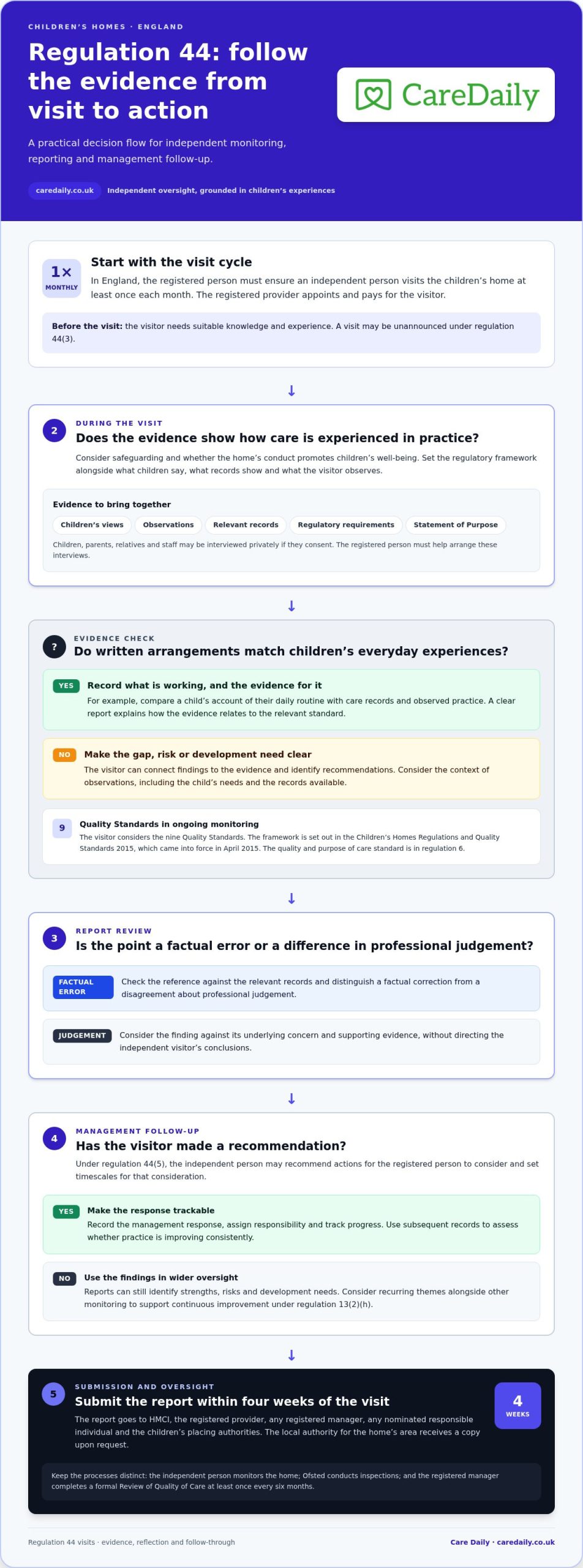
The registered provider appoints the independent person and pays for the visit: according to The National Archives, this person visits and reports on the children’s home. In England, the registered person must ensure a visit at least once each month, and The National Archives confirms that a visit may be unannounced under regulation 44(3). The report gives an opinion on whether children are effectively safeguarded and whether the home’s conduct promotes their well-being. That makes regulation 44 visits more than a routine compliance check: they can help managers see how care is experienced in practice.
It’s understandable to focus first on who appoints the visitor and what they’re expected to do. This guide explains how the appointment works, what the visitor assesses and how their findings can support ongoing management monitoring. You’ll also see how to make practical use of recommendations, so the visit contributes to a clearer picture of children’s experiences and the home’s strengths and areas for development.
Key Takeaways
- Understand who appoints and pays for the independent person, and the expected monthly visit cycle in England.
- See how visits assess safeguarding, children’s well-being and the home’s day-to-day care.
- Learn what useful reports and recommendations can tell managers about strengths, risks and areas for improvement.
- Use visit findings alongside other monitoring to track actions and support continuous improvement.
- Explore how Care Daily’s care management software, digital care planning and policy library can support organised records and compliance work.
How is a Regulation 44 Visitor Appointed?
The registered provider appoints and pays for the independent person. According to The National Archives (legislation.gov.uk), regulation 43(1) requires the provider to appoint someone to visit and report on the children’s home. The visitor needs suitable knowledge and experience to assess care quality and how the home operates. Their independent perspective should be separate from the home’s management decisions.
The report gives an opinion on whether children are effectively safeguarded and whether the home’s conduct promotes their well-being. Under regulation 44(4), the independent person reports on both matters. A useful report connects analysis to evidence, including conversations, observations and records. If a child describes difficulty raising a concern, for example, the visitor can examine how staff respond and what relevant records show.
Reports can identify strengths, risks, development needs and recommendations. Under regulation 44(5), the independent person may recommend actions for the registered person to consider and set timescales for that consideration. Leaders can record their response, assign responsibility and track progress. If recording practice needs attention, managers can review relevant entries and assess whether subsequent records show consistent improvement.
Under regulation 44(7), reports go to HMCI, the registered provider, any registered manager, any nominated responsible individual and the children’s placing authorities. The local authority for the home’s area receives a copy upon request. The report must be submitted to Ofsted within four weeks of the visit. These recipients can use its findings to inform oversight and follow-up.
Regulation 44 visits differ from Ofsted inspections and Regulation 45 reviews. The independent person provides monitoring for the home, whereas Ofsted conducts inspections; the registered manager completes the formal Review of Quality of Care at least once every six months. Keeping each process distinct helps leaders track its findings and recommendations, whilst considering related themes together.
Children, parents, relatives and staff can be interviewed privately if they consent. Under regulation 44(2), the registered person must help the independent person arrange these interviews. A child may find it easier to describe a concern without staff present. The visitor should respect their choice to participate and record their views accurately alongside other evidence.
For regulation 44 visits, report quality depends on clear evidence and careful analysis. Leaders can check factual references against records, distinguish corrections from differences in professional judgement, and log recommendations for follow-up. This supports a considered response without directing the visitor’s conclusions. It also helps the home use each report to inform safeguarding oversight and ongoing improvement.
Assessment against regulations and quality standards
The Children’s Homes Regulations and Quality Standards 2015 came into force in April 2015, according to The National Archives (legislation.gov.uk). They provide the framework for considering children’s care and how a home is managed. A visitor should connect that framework to evidence from the home, rather than treating each requirement as an isolated document check. For managers, the value lies in seeing whether written arrangements match children’s everyday experiences.
In England, the registered person must ensure an independent person visits at least once each month, according to The National Archives (legislation.gov.uk). Under regulation 44(3), a visit may be unannounced, according to The National Archives (legislation.gov.uk). An unannounced visit can show how staff apply routines during ordinary practice. The visitor still needs to consider the context of any observation, including the child’s needs and the records available.
The visitor should consider nine Quality Standards during ongoing monitoring. The quality and purpose of care standard is set out in regulation 6. A focused review might consider whether a child’s daily routine reflects their interests and stated needs. The visitor can compare care records, the child’s account and what happens in practice. These sources may tell different parts of the story, so the report should make clear how findings relate to the standard.
The home’s Statement of Purpose provides another reference point. Children’s homes are expected to operate in line with it, and visits assess this alongside regulatory requirements. For example, if the Statement of Purpose describes support for education, the visitor can consider how records show that support in a child’s daily routine. The aim is to assess how the stated approach is experienced, not simply whether the document exists.
Quality assurance means checking that findings are clear, relevant and grounded in evidence. Managers can compare a report’s references with the records it discusses, then distinguish factual corrections from professional judgement. Recommendations should be considered against the underlying concern, not just the wording of a single action. Regulation 13(2)(h) requires monitoring and review systems to support continuous improvement in care quality, so leaders can use recurring themes to inform their own oversight.
Safeguarding findings also sit within a wider regulatory picture. Regulation 40 notifications of events are among the safeguarding matters reviewed during an inspection. If a visit raises a related concern, managers can consider whether their records and internal monitoring provide a coherent account. The independent visitor’s findings remain distinct from an inspection, but the home can use both sources to examine whether its systems identify concerns and support appropriate follow-up.
Purpose of Regulation 44 visits
In England, an independent person critically examines how a children’s home is run and managed, and the quality of care it provides. This brings an external perspective to the home’s understanding of children’s experiences. The scrutiny can help distinguish between a process that exists on paper and one consistently reflected in daily life. The visitor’s perspective gives leaders evidence to consider, without taking responsibility away from them.
This focus is especially useful when a child’s experience is shaped by small, repeated interactions. Consider how staff respond when a young person declines an activity, asks for more privacy or wants to speak with a trusted adult. Each moment may seem ordinary in isolation, but together they can indicate whether the home respects the child’s choices and responds consistently to their needs.
The visitor does not decide how the home should be managed. Instead, their assessment helps leaders test whether their understanding reflects children’s experiences. For example, managers may believe a house meeting gives everyone a voice. Conversations with the visitor can explore whether children feel able to contribute and whether their views influence decisions. This distinction makes scrutiny a useful prompt for reflection.
Independent monitoring can also reveal management assumptions. A routine may seem settled to staff but feel unpredictable to a child whose placement has recently changed. The visitor can consider how the home explains routines, communicates changes and responds when a child is unsettled. These details help leaders look beyond completed tasks and consider how each child experiences care.
For children, the visit offers a separate opportunity to talk about life in the home. A young person may choose to share something they find difficult to raise in a team meeting, or prefer not to talk. Respecting that choice is part of a person-centred visit. The visitor’s role is to hear and consider children’s perspectives, not to press them to disclose information or promise a particular result.
Regulation 44 visits can therefore act as a bridge between children’s day-to-day experiences and leaders’ oversight. The report can help managers decide which questions deserve closer attention, where existing practice is working well and whether concerns call for further review. Used in this way, independent monitoring supports thoughtful leadership without turning the visitor into a manager or replacing the home’s own responsibility for care.
The clearest test of a visit’s value is whether it helps the home understand care from the child’s perspective. Leaders can consider whether the evidence challenges their assumptions, confirms effective practice or raises an overlooked question. Keep that reflection grounded in each child’s circumstances. This focuses the visit on understanding and improving care, rather than treating it as a procedural exercise.
Regulation 44 visits as part of management monitoring
Independent monitoring is most useful when managers connect its findings with the home’s wider view of quality. Create a shared record bringing together visit observations, children’s feedback, incidents, complaints and planned improvements. Note where each item came from and who will review it. This helps leaders identify connections without treating every concern as proof of a wider pattern.
Group themes by their impact on children and the response they require. A report might question whether young people understand how decisions are made. Managers can compare the observation with meeting notes and individual records, then ask children how decisions are explained. The aim is to test whether written processes are evident in daily life, not merely to confirm that a form is complete.
Review recurring themes in context. Similar comments across visits may warrant closer examination, but each child’s circumstances still matter. A change in routine, for example, could affect one young person differently from another. Managers can note the context, check relevant records and discuss the issue with staff who know the child. This avoids reducing someone’s experience to a count or category.
Record positive observations alongside concerns. If a visitor describes staff supporting a young person to take part in a decision, leaders can consider what made the interaction effective. They might compare it with the child’s plan and ask whether the approach is consistent across shifts. Documenting effective practice gives managers something specific to sustain, rather than focusing oversight only on problems.
Use governance meetings to examine whether findings change the home’s understanding. The registered manager can present the theme, evidence reviewed, decision taken and any further monitoring needed. The responsible individual can challenge whether the reasoning is clear and the child’s perspective remains central. Recording the discussion helps ensure an issue is not forgotten once it leaves the meeting agenda.
Management monitoring should distinguish completed actions from observed outcomes. Updating a procedure shows that a document changed, for example, but does not by itself show that staff practice or a child’s experience improved. Leaders can decide what evidence would demonstrate the intended change, then review it during subsequent oversight. This keeps the focus on whether the response helped, not simply whether a task was closed.
Over time, this approach gives leaders a clearer account of how independent findings inform oversight. The practical test is whether they can trace an observation through discussion, decision and review while retaining the child’s individual context. That makes the visit part of active governance, rather than a report filed away after reading.
Care Daily: Care Management Software
Care Daily’s care management software can support the work behind consistent monitoring in children’s homes. Digital care planning helps teams organise children’s plans, while staff rostering supports oversight of scheduled shifts. The Policy & Procedure Library gives managers access to relevant operational guidance.
These tools can help leaders bring records, plans and staff arrangements together for routine reviews, including follow-up on monitoring actions. They support management processes; the independent visitor remains responsible for their own assessment and report.
If you’re considering ways to organise care management and compliance work, contact Care Daily or visit caredaily.co.uk.
Make the next visit meaningful
After reviewing a report, consider how to explain its findings to the children affected. A clear, age-appropriate explanation of what happens next can help a young person see that their feedback was heard. If an action cannot be taken, explain why and how their concern will continue to be considered.
This follow-through gives managers a useful focus before the next visit: can children explain how to raise a concern, and do they know what happened after they raised one? Their answers can show whether written processes are reflected in everyday life, not just recorded in policies. Keep conversations sensitive to each child’s circumstances and avoid promising a particular outcome.
Used thoughtfully, regulation 44 visits can support a culture where children’s voices shape reflection and action. If you’re considering how digital systems could support the wider organisation of care and compliance work, contact Care Daily to discuss your needs. Each step towards listening well and following through can strengthen children’s experience of the home.
Frequently Asked Questions
What is the Role of a Reg 44 Visitor?
A Reg 44 visitor provides independent scrutiny of a children’s home’s care and safeguarding. Their role is to form a professional view based on evidence, not to manage staff or make decisions on the provider’s behalf. For example, if records show a child’s concern was raised repeatedly, the visitor can examine how the home responded and include relevant findings in their report. Managers remain responsible for deciding and recording their response.
Which regulations and statutory guidance govern Regulation 44 visits?
In England, the statutory duties for appointing an independent person and arranging visits sit in regulations 43 and 44 of the Children’s Homes (England) Regulations 2015, according to The National Archives (legislation.gov.uk). The Children’s Homes Regulations and Quality Standards prescribe the standards for children’s homes under section 22(1A) of the Care Standards Act 2000. When reviewing a specific requirement, distinguish the regulation itself from guidance that explains how to apply it.
Who is qualified to conduct Regulation 44 visits?
The independent person must have suitable knowledge and experience to assess care quality and how the home operates. This is not simply an administrative visit: the person needs to weigh children’s experiences alongside relevant practice and records. Understanding how a placement plan relates to daily routines, for example, helps the visitor ask focused questions. The provider appoints the person, but the visitor’s assessment and report must remain independent.
What must an independent visitor do during a Regulation 44 visit?
The visitor examines how the home operates and gathers evidence relevant to children’s safeguarding and well-being. This may include speaking with children and staff, considering records and noting whether observed practice aligns with the home’s stated approach. Interviews with children, parents, relatives and staff must be supported in private when they consent. Respect a child’s choice to speak or not, and report their views fairly.
What should a Regulation 44 visit report include?
A report should set out the visitor’s findings and opinion on safeguarding and whether the home promotes children’s well-being. It can identify strengths, risks, development needs and recommendations for the registered person to consider. If a potential conflict of interest comes to light after a visit, it is useful to explain the circumstances and why the provider was not informed earlier. Clear evidence helps readers understand how conclusions were reached.
What happens if a Regulation 44 visit identifies safeguarding concerns or failures?
The home’s leaders should consider the concern promptly and take appropriate action to protect the child, following the home’s safeguarding procedures. Record the decision, actions taken and person responsible, then consider whether the issue needs escalation through relevant safeguarding channels. The independent person records findings and may recommend action. Their report does not replace the provider’s responsibility to respond to risks and keep children safe.