
Ofsted inspects every registered children’s home at least once per year under the SCCIF. The inspection year for children’s homes runs from 1 April to 31 March, and Ofsted considers the Children’s Homes (England) Regulations 2015. The guidance was updated on 1 April 2026, with a clearer focus on children’s stability and progress.
Preparing for SCCIF inspections of children’s homes can feel demanding because evidence must show more than completed tasks. It needs to reflect children’s lived experience and the difference care makes. You’ll learn how inspection frequency works, what rules underpin the framework and what the 2026 update means for safeguarding and day-to-day practice.
We’ll also look at how leaders can use evidence to explain placement decisions, children’s progress and multi-agency working, so you can prepare for inspection with a clear view of what matters.
Key Takeaways
- Understand the annual inspection cycle and how a home’s registration date can shape the timing of its first inspection.
- Connect the SCCIF’s inspection approach with the legal standards and quality expectations that apply to children’s homes in England.
- Prepare to explain how placement decisions support children’s needs, stability and progress under the 2026 update.
- Strengthen safeguarding evidence by showing how staff work with partner agencies, share information and manage risk.
- See how digital care planning, staff rostering and a policy library can help organise operational and compliance records.
How often are children’s homes inspected under the SCCIF?
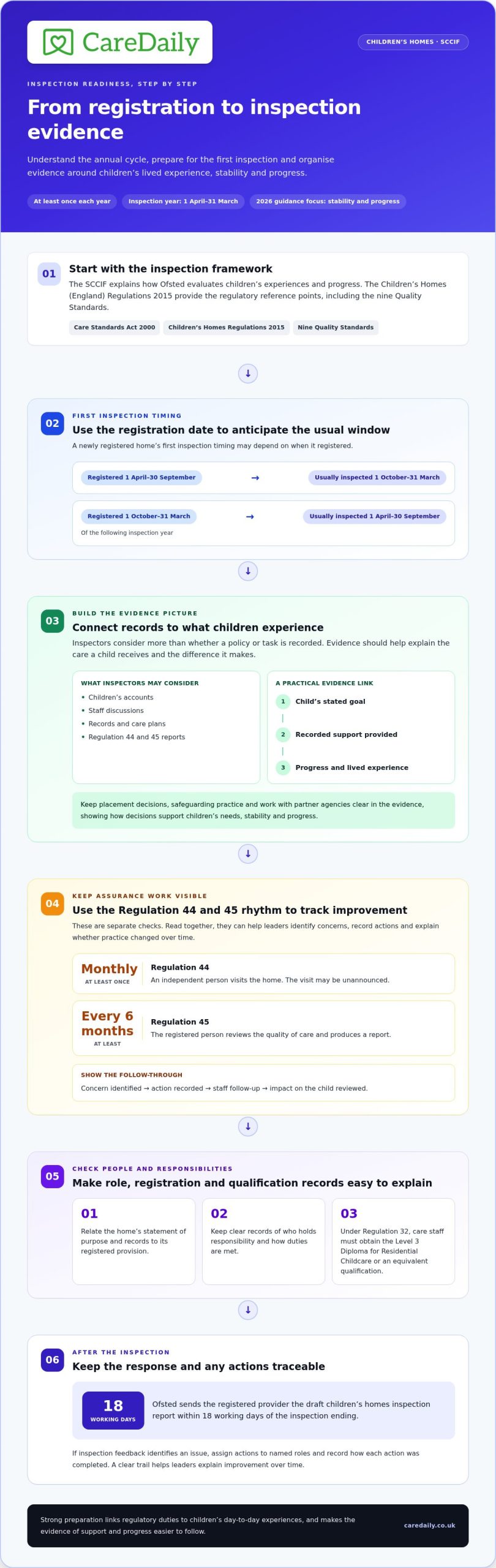
The Social Care Common Inspection Framework (SCCIF) sets out how Ofsted inspects children’s homes. Every registered home is inspected at least once per year, and the inspection year runs from 1 April to 31 March. Ofsted considers the Children’s Homes (England) Regulations 2015 when inspecting children’s homes in England.
The inspection cycle is the annual period in which Ofsted plans and carries out inspections. The timing of a newly registered home’s first inspection may depend on when it registered. For example, a home registered between 1 April and 30 September will usually be inspected between 1 October and 31 March. A home registered between 1 October and 31 March will usually be inspected between 1 April and 30 September of the following inspection year.
The Quality Standards are the nine standards in the Children’s Homes (England) Regulations 2015. They give the inspection framework its regulatory reference points, whilst the SCCIF sets out how inspectors evaluate children’s experiences and progress. The standards cover areas such as the quality of care, protection and leadership. The inspection looks beyond whether a policy exists: leaders need to show how practice supports children in the home.
Inspection judgements are Ofsted’s structured evaluations of a home’s provision. The SCCIF applies a common judgement structure across the settings it covers while recognising that services differ. Inspectors focus on children’s experiences and progress, and on the difference the home makes to their lives.
Inspection evidence is information inspectors use to understand care, safeguarding and outcomes. This can include children’s accounts, staff discussions, records, care plans and Regulation 44 and 45 reports. A practical example is comparing a child’s stated goals with recorded support and later progress. Ofsted sends the registered provider the draft children’s homes inspection report within 18 working days of the inspection ending.
A Regulation 45 review is the registered person’s assessment of the quality of care. According to UK legislation, regulation 45 requires the registered person in England to review care quality and produce a report at least every 6 months. Regulation 44 provides a separate quality-assurance visit: according to UK legislation, an independent person must visit the home at least once a month, and the visit may be unannounced. A guide to Regulation 44 visits explains what the independent person assesses and how findings can support ongoing management monitoring. Together, these reports can help leaders identify concerns, track actions and explain improvements over time.
Staff qualifications are requirements for workers carrying out specific roles in children’s homes. Under regulation 32, care staff in England must obtain the Level 3 Diploma for Residential Childcare or an equivalent qualification. Leaders should also keep training and qualification records organised, so they can explain how staff knowledge supports the care children receive.
The Ofsted SCCIF guidance for inspecting children’s homes explains the inspection process and evidence expectations. The guidance is for use from April 2019; providers can find it in Ofsted’s published children’s homes inspection guidance.
Legal basis of the SCCIF and the Children’s Homes Regulations
To prepare for an Ofsted inspection, map the home’s practice to its registered responsibilities and keep evidence organised. The legal framework sets out what the home must do; inspection preparation should show how those duties shape children’s everyday experiences and progress.
SCCIF regulatory framework
The SCCIF is Ofsted’s inspection framework for assessing children’s homes against their regulatory requirements. The Care Standards Act 2000 provides the wider statutory context, and section 23 is the basis for the Guide to the children’s homes regulations, including the Quality Standards. The Children’s Homes (England) Regulations 2015 set out those standards. Together, the framework and regulations connect inspection criteria with the care and protection children experience.
Registration is the legal permission to carry on or manage a children’s home in England. Under section 1 of the Care Standards Act 2000, a children’s home must be registered with Ofsted. The Chief Inspector is the registration authority under section 5(1A). A provider preparing for inspection should be able to relate the home’s statement of purpose, records and decisions to its registered provision.
Regulation 44 and 45 reports
Regulation 44 and 45 reports are separate quality-assurance records that help leaders review practice and identify action. According to UK legislation, regulation 44 requires an independent person to visit a children’s home at least once a month; the visit may be unannounced. The independent person’s observations can capture concerns, feedback and children’s experiences that routine management checks might not reveal.
Regulation 45 reports record the registered person’s review of the quality of care. Read alongside Regulation 44 findings, they can show whether identified issues led to changes and whether those changes supported children’s progress. For example, a report can connect a concern about inconsistent routines with a recorded action, staff follow-up and the child’s subsequent experience. Keep the reports and action records accessible for inspection.
Regulatory requirements and enforcement
Regulatory requirements are the legal duties that registered providers and managers must meet. A person must register with Ofsted to carry on or manage a children’s home; doing so without registration is a criminal offence under section 11 of the Care Standards Act 2000. These requirements make accurate records important: leaders need to show who holds responsibility and how the home meets its obligations.
A compliance notice is a formal measure Ofsted may use when a home fails to meet an inspection requirement. Ofsted may serve one when it considers a notice the most appropriate response to the concern. Failing to comply with a notice is a ground for cancelling registration. To prepare, managers can review inspection feedback, assign actions to named roles and record how each action was completed.
For a practical way to organise inspection-readiness work, explore a structured approach to care operations.
Implications of the 2026 SCCIF update
The 2026 SCCIF update is Ofsted’s revised guidance for inspecting children’s homes. Ofsted updated the guidance on 1 April 2026, clarifying how inspection recognises providers’ work to promote stability, safeguarding and children’s progress. The change puts greater emphasis on what care achieves for each child, rather than treating policies or activities as outcomes in themselves.
Stability means helping children experience consistent care and avoiding unnecessary moves. Inspectors consider whether a placement suits the child’s needs and the home’s statement of purpose. Leaders should be ready to explain the reasoning behind each admission, including its effect on children already living there. Placement records should show how the home can meet needs safely and sustain support.
Preparing for a move means helping a child understand and manage the transition from the home. The updated focus asks whether preparation happens promptly and reflects the child’s circumstances. Records can show how staff involve the child, coordinate practical arrangements and maintain relationships during a planned move. This makes the transition part of the care record, not just an administrative date.
Lived experience means the child’s perspective on the care they receive and its effect on daily life. The updated framework emphasises evidence of experience, outcomes and progress, including the significance of small steps. A list of activities alone may not show whether a child feels safer or more settled. Staff observations, the child’s views and changes over time can provide a fuller picture.
Relational, whole-family practice means considering the child’s relationships and relevant family context when providing support. The updated safeguarding guidance places greater emphasis on this approach and on providers’ statutory duties. Working Together to Safeguard Children was updated in March 2026 as statutory guidance on multi-agency working to help, support and protect children. Homes should be able to describe how they work with authorities and partner agencies around a child’s needs.
Multi-agency evidence shows how professionals share information and respond to risk. Inspectors may look for a clear link between a concern, communication with relevant agencies, agreed actions and follow-up. Records should identify who is responsible for each action and how staff adapt the child’s support afterwards. This demonstrates joined-up safeguarding, rather than a file of disconnected contacts.
Managers can review placement decisions, transition plans and safeguarding records against children’s actual experiences. Bring together the child’s views, staff observations and relevant partner-agency actions, then identify what has changed. Ofsted has said providers should not be penalised for taking on children with the greatest needs in the country. The focus remains on whether decisions are appropriate and care supports each child’s safety, stability and progress.
Safeguarding and multi-agency working
Safeguarding means protecting children from harm while supporting their welfare and development. Under the SCCIF, inspectors consider how children’s homes identify risks and work with partner agencies. The 2026 update gives sharper attention to how providers manage risks jointly. Leaders should be ready to explain how concerns lead to decisions, agreed responsibilities and follow-up action.
Multi-agency working means professionals and organisations coordinate support around a child. Working Together to Safeguard Children was updated in March 2026 as statutory guidance on multi-agency work to help, support and protect children. For a home, practical evidence might include a record of a concern, information shared with relevant professionals, agreed next steps and how staff review those steps.
The social care common inspection framework is Ofsted’s approach to inspecting children’s homes and other social care settings. The 2026 update aligns the framework with Working Together to Safeguard Children 2026. It sets clearer expectations around multi-agency roles, information sharing and escalation in children’s homes and supported accommodation. Residential settings are also recognised as active partners in early help.
Early help responds to emerging needs before difficulties escalate. Records should make the sequence clear: what staff observed, who they informed, what action followed and how the child experienced the response. For example, a record of a missed appointment is more useful if it also explains any contact with relevant professionals and the next agreed step. This context shows how safeguarding practice supports children’s experiences and progress.
A sound inspection judgement depends on evidence of what happened, not just a list of policies or contacts. Organise records by child and concern, linking each action to its outcome and any review. Keep the child’s views alongside professional communications. This helps leaders explain how the plan reflects the child’s circumstances, rather than relying on a general account of multi-agency work.
Some safeguarding duties apply to specified professionals in particular circumstances. In England, section 74 of the Serious Crime Act 2015 inserted section 5B into the Female Genital Mutilation Act 2003. It requires specified regulated professionals, including social workers, to report certain cases of female genital mutilation in girls under 18 to the police. This is a specific reporting duty, not a general duty for every children’s home worker.
To organise inspection evidence alongside operational records, explore a structured approach to care management.
Care Daily: Care Management Software
Care Daily provides care management software for children’s homes, bringing day-to-day records and processes together. Digital care planning supports consistent documentation of each child’s needs and support, while staff rostering helps managers organise workforce schedules.
Care Daily brings care management software, digital care planning, staff rostering and a Policy & Procedure Library together for care providers. These tools help teams organise operational information and policies alongside their compliance processes. They support staff access to relevant records but do not replace professional judgement or the home’s responsibilities under the SCCIF.
Review whether your current systems make it easy to maintain care plans, organise rotas and access policies when needed. To explore how Care Daily supports these workflows, visit caredaily.co.uk.
Make your next step count
For leaders preparing for SCCIF inspections of children’s homes, the next step is to turn expectations into routines staff can follow consistently. Review how your team records decisions, shares learning and keeps each child’s experience at the centre of practice. Then identify one practical improvement to take forward and assign clear ownership across the team.
Care Daily offers care management software, digital care planning and a Policy & Procedure Library to support providers’ operational and compliance work. These tools support daily practice by helping your team organise information alongside professional judgement and the home’s own safeguarding processes.
If you’d like to explore whether Care Daily fits your service’s needs, contact Care Daily to discuss your needs. A clear, manageable next step can help your team keep progress focused on children.
Frequently Asked Questions
What does SCCIF stand for?
SCCIF stands for the Social Care Common Inspection Framework. Ofsted uses it to describe its approach to inspecting children’s social care settings, including children’s homes. “Common” refers to its use across different settings, with adjustments where a service’s features require them. For managers, it offers a clear reference point for understanding inspection expectations and preparing evidence about the care children receive.
What is SCCIF and how does it relate to the “Ofsted handbook”?
The SCCIF is Ofsted’s framework for inspecting children’s homes; “Ofsted handbook” is a less precise term. Use Ofsted’s specific SCCIF inspection guidance to understand the approach for children’s homes, rather than assuming guidance for another type of provision applies. Keep the inspection guidance distinct from the regulations: the guidance explains how Ofsted inspects, while the regulations set out the home’s legal requirements.
What is the SCCIF Annex A?
SCCIF Annex A is a form associated with Ofsted’s children’s homes inspection guidance. Its form was updated in April 2025 and again alongside the April 2026 SCCIF update. When preparing inspection information, use the current Annex A version referenced in Ofsted’s guidance. Keep the details consistent with the home’s own records, so any differences can be understood and addressed before they create confusion during inspection preparation.
What does SCCIF stand for in children’s homes in England?
In England, SCCIF means the Social Care Common Inspection Framework, which Ofsted uses to inspect children’s homes. It is not the name of a separate qualification or care standard. A registered manager can use the children’s homes guidance to understand how Ofsted evaluates the service, then review the relevant regulations to assess whether the home meets its legal responsibilities.
What SCCIF standards apply to children’s homes?
Children’s homes are inspected against the nine Quality Standards in the Children’s Homes (England) Regulations 2015. The standards apply to the home’s provision, rather than operating as a checklist of isolated documents. In practice, leaders can use them to organise internal reviews: connect a policy or care record to the relevant standard, then consider whether it reflects children’s needs and the care delivered in the home.
How does Ofsted inspect children’s homes under SCCIF?
Ofsted uses the SCCIF to assess children’s experiences and progress, drawing on evidence about how the home operates. Before an inspection, managers can check whether a recent incident record, follow-up actions and the child’s current support arrangements tell a coherent story. This helps staff explain what happened, what changed afterwards and how the home considered the child’s perspective, rather than relying on a policy document alone.