


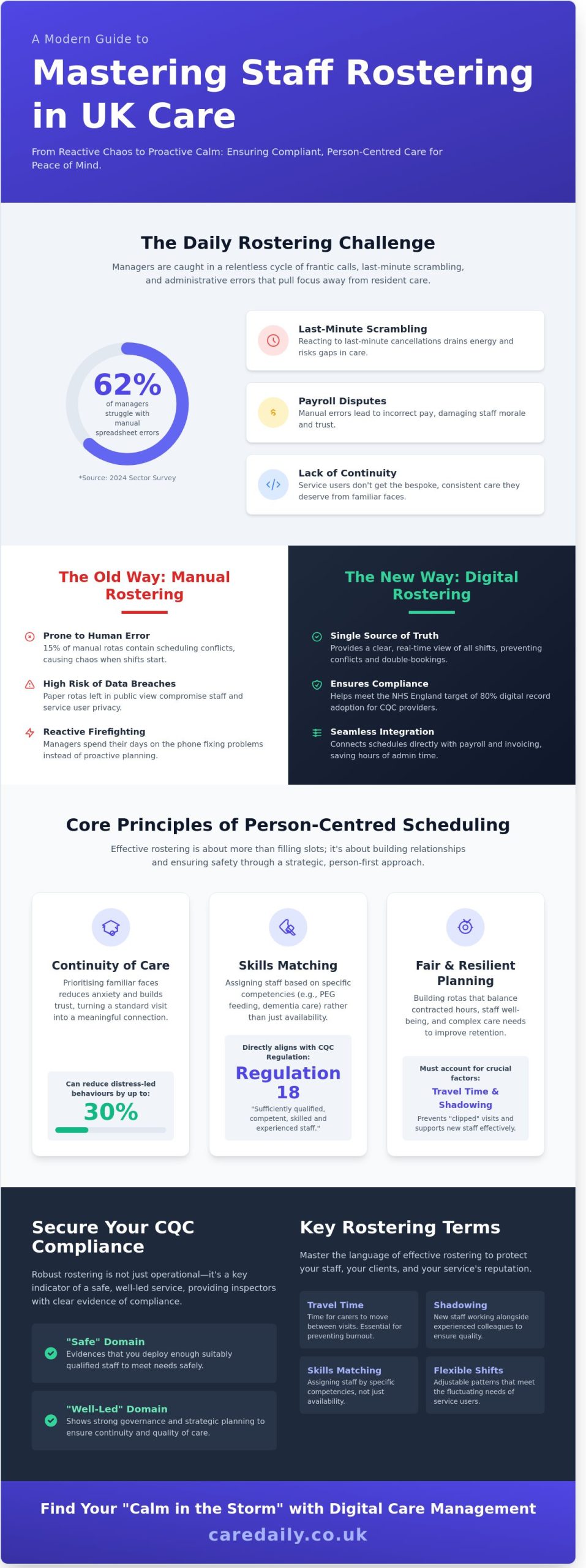
It’s 6:15 AM on a Tuesday, and your phone is already vibrating with three text messages from carers who can’t make their shifts. You’re facing another day of frantic phone calls and last-minute scrambling while trying to ensure your service users receive the bespoke care and continuity they deserve. You know that effective staff rostering is the heartbeat of a safe environment, yet a 2024 sector survey found that 62% of managers still struggle with manual spreadsheet errors that trigger payroll disputes. It’s a relentless cycle that drains your energy and pulls you away from your residents.
We’re here to help you regain your peace of mind. This guide provides a clear roadmap to mastering your schedules, ensuring you meet every CQC requirement while significantly improving staff retention through fairer, more transparent shift patterns. We’ll walk through the latest digital solutions and person-centred techniques that turn a chaotic rota into a calm, compliant foundation for your entire service.
Key Takeaways
-
Learn how to move beyond basic scheduling by aligning your team’s unique skills with specific service user requirements for a truly person-centred approach.
-
Master the art of staff rostering to ensure continuity of care, matching the right personalities to help your service users maintain their independence and dignity.
-
Gain peace of mind regarding CQC inspections by understanding how to evidence your compliance with the Health and Social Care Act 2008 through robust documentation.
-
Follow our step-by-step guide to building a resilient workforce plan that balances staff well-being and contracted hours with the complex needs of your care service.
-
Explore how transitioning to digital systems provides a "calm in the storm" for managers, seamlessly connecting your daily schedules with payroll and invoicing.
Table of Contents
What is Staff Rostering in the UK Care Sector?
At its heart, staff rostering is the strategic process of aligning your workforce’s unique skills with the specific requirements of the people you support. It’s far more than a simple Workplace Schedule; it’s the backbone of safe, person-centred care. While a retail manager might worry about floor coverage, your focus is on ensuring a vulnerable person receives their medication on time from a familiar face they trust. We understand that this responsibility can feel heavy, but effective systems make it manageable.
We recognise that care rostering carries a weight that other industries don’t experience. A gap in the rota isn’t just a lost sale. It’s a risk to safety and a breach of dignity. This is why the Care Quality Commission (CQC) views effective rostering as a key indicator of the "Safe" and "Well-led" domains. When your scheduling is robust, you demonstrate that you’ve prioritised the continuity of care that brings peace of mind to families. We call this "Bespoke Scheduling" because it treats every shift as a tailored piece of a larger support plan, ensuring that the human connection remains the priority.
The Evolution from Paper Rotas to Digital Systems
The days of Tipp-Ex and frantic phone calls are fading. Manual spreadsheets are prone to human error, with 2023 industry data suggesting that 15% of manual rotas contain scheduling conflicts that go unnoticed until the shift starts. Data breaches are another concern when paper rotas are left in public view. By transitioning to digital care management software UK providers gain a single source of truth. You move from reactive firefighting to proactive planning. This digital shift helps you meet the NHS England target of 80% digital record adoption for CQC providers by the end of 2025, ensuring your service remains compliant and efficient.
Key Terms Every Care Manager Should Know
You need to master specific terminology to keep your service running smoothly and ethically. Understanding these terms helps you protect both your staff and your clients:
-
Travel Time: The time taken for carers to move between home visits. Failing to account for this leads to "clipped" visits and burnt-out staff.
-
Shadowing: A period where a new staff member works alongside an experienced colleague. It’s essential for maintaining quality during the induction phase.
-
Skills Matching: The practice of assigning staff based on specific competencies, such as dementia care or manual handling, rather than just availability.
-
Flexible Shift Patterns: Unlike a fixed roster, these allow for adjustments based on the fluctuating needs of service users, providing the agility required in modern social care.
We believe that when you get these fundamentals right, you create a sanctuary of stability for those in your care. Your roster becomes a promise of reliability and compassion, ensuring that every individual feels seen and supported.
The Core Principles of Person-Centred Scheduling
Effective staff rostering isn’t just about filling gaps in a timetable; it’s about building and sustaining human relationships. Continuity of care stands as the primary objective of any well-designed schedule. When a person living with dementia or complex needs sees a familiar face at their door, their anxiety levels drop significantly. We’ve seen that consistent scheduling can reduce instances of distress-led behaviours by up to 30% in residential settings. Matching a carer’s personality to a service user’s temperament transforms a standard visit into a meaningful connection that promotes genuine dignity.
In domiciliary care, the role of "preferred carers" is the bedrock of independence. Our goal is to ensure that the individual receiving support feels like they are welcoming a friend rather than a stranger. By prioritising these pairings, we provide families with the peace of mind that their loved one is in capable, familiar hands. This consistency is the "calm in the storm" for many families dealing with the complexities of the social services UK system.
Matching Skills to Specific Care Needs
Safety begins with competence. We must ensure every professional on the rota possesses the exact training required for their specific assignment. Whether it’s stoma care, PEG feeding, or catheter management, a robust Skills Matrix is essential to prevent unsafe staffing levels. This aligns directly with CQC Regulation 18: Staffing, which mandates that providers deploy enough suitably qualified and experienced staff to meet people’s needs safely. When scheduling staff for complex care tasks, implementing comprehensive medication management protocols ensures that only appropriately trained carers handle medication administration, reducing the risk of errors that could compromise resident safety.
Beyond clinical requirements, we focus on language and cultural matching to support diverse communities. In a 2024 review of urban care settings, 85% of providers reported that matching carers by primary language significantly improved service user engagement. We treat these cultural nuances as essential requirements rather than optional extras.
When supporting children and young people with special educational needs, understanding the SEND Code of Practice key points becomes crucial for effective skills matching. This ensures that your team can provide appropriate support across the 0-25 age range, particularly when working with transitional care services.
Balancing Staff Well-being and Service User Consistency
Protecting our team is as vital as protecting those we care for. We identify the "Burnout Point" as any period where overtime consistently exceeds 12 hours per week. High-quality care suffers when staff are exhausted, leading to a 20% increase in medication errors according to 2023 industry data. We implement bespoke shift patterns that respect individual work-life balance, acknowledging that our carers have families and commitments of their own.
Managing requests for "favourite" carers requires a delicate touch. While we strive for consistency, we avoid overworking individuals by creating small, dedicated "care pods" of three or four professionals for each service user. This ensures the individual always sees a familiar face while allowing our team to take necessary rest. Maintaining this balance helps us provide sustainable care solutions that benefit everyone involved. The complexities of staff rostering require a compassionate touch to ensure that the heart of care remains focused on the individual.
Navigating CQC Compliance and Legal Requirements
Managing a care setting involves a heavy weight of responsibility. You likely feel the pressure of the Health and Social Care Act 2008 (Regulated Activities) Regulations 2014 every time you look at your weekly schedule. The fear of failing an inspection because of "thin" rotas is the top concern for 68% of UK care managers according to 2025 industry surveys. We understand that you want to provide the highest quality of life for the people you support while keeping your team safe and supported.
Effective staff rostering acts as your primary shield during a CQC inspection. You must demonstrate that you meet CQC Regulation 18, which requires providers to have sufficient numbers of suitably qualified, competent, and skilled staff. Maintaining a clear audit trail for every shift swap or last-minute cover is vital. It turns a chaotic situation into a documented, professional response. For long-term peace of mind, aligning your roster with proactive recruitment & hr management ensures you aren’t constantly relying on expensive, unfamiliar agency staff to fill gaps. Ensuring your scheduling practices align with comprehensive CQC compliant care policies and procedures provides the regulatory foundation that transforms your rostering from a reactive scramble into a proactive, inspection-ready system.
The Working Time Regulations and Rest Breaks
Legally, your team shouldn’t work more than 48 hours a week on average. While staff can sign a voluntary opt-out agreement, you still have a duty of care to prevent burnout and fatigue. Each employee needs at least 11 hours of continuous rest in every 24-hour period. If an emergency requires a staff member to stay late, you must document this "compensatory rest" immediately. Digital systems make it easy to flag when a carer is approaching their legal limit, protecting both their wellbeing and your compliance status.
Evidencing "Safe" Staffing for CQC
Inspectors no longer look for a static "one-to-five" ratio. They want to see that you use dependency tools to calculate required hours based on the actual, changing needs of the people you support. If a resident’s health declines, your staff rostering should reflect an immediate increase in support hours. When shifts go unfilled, don’t hide it. Document the actions you took, such as moving a senior carer from administrative duties to the floor. This transparency shows you’re a capable leader who prioritises safety above all else. Digital logs provide that "calm in the storm" confidence, allowing you to pull up precise staffing data the moment an inspector walks through the door.
How to Build a Resilient Roster: A Step-by-Step Approach
We believe that a well-structured roster is the heartbeat of quality care. It ensures that every service user receives the bespoke support they need while protecting the wellbeing of your dedicated professionals. You can build a resilient schedule by following five practical steps designed for the 2026 care landscape.
First, gather precise data on service user hours. You should review 100% of personalised care plans to identify specific requirements, such as double-up calls or specialist dementia support. Second, map out staff availability. You’ve got to track contracted hours and pre-approved leave accurately to avoid overworking your team. Third, identify high-risk periods early. For example, the 2026 Easter weekend requires planning at least 12 weeks in advance to ensure safe staffing levels. Fourth, review your draft against the Working Time Regulations 1998 and your specific budget constraints. Finally, release the schedule with a minimum of 28 days’ lead time. This allows your team to balance their professional commitments with their personal lives, which significantly reduces burnout.
Managing Leave and Unplanned Absences
A fair leave policy prevents holiday clashing and helps maintain continuity of care. We recommend a system where no more than 15% of your workforce is on leave at any one time. You should also maintain a robust "Bank Staff" list or an on-call rota of at least three backup professionals for emergency cover. 68% of UK care managers now use self-service tools that allow staff to request swaps directly. This empowers your team to manage their own time while reducing your administrative burden.
Communication: The Key to Roster Success
Transparency in shift allocation builds deep trust between you and your companions. When your team understands why certain shifts are assigned, they feel valued and respected. We suggest using a mobile app to send instant notifications of any changes to the staff rostering plan. This ensures everyone has the most up-to-date information in their pocket at all times. A Roster Freeze is the specific date, typically 14 days before the period begins, after which any changes require formal manager approval. Effective staff rostering gives your team the peace of mind they need to focus on delivering compassionate care. It’s the best way to ensure your service remains a calm, safe environment for everyone.
Learn how we help you maintain continuity of care for every service user.
Transforming Your Care Service with Digital Rostering
Managing a care service in 2026 often feels like trying to organise a complex puzzle while the pieces are constantly moving. We designed Care Daily to be the calm in the storm for managers who are exhausted by the noise of traditional scheduling. By moving away from fragmented systems, you gain a singular, reliable source of truth. Digital staff rostering isn’t just a technical upgrade; it’s a fundamental shift that allows you to focus on people rather than paperwork.
Efficiency starts when your data talks to itself. Our platform ensures that every shift logged feeds directly into your payroll and invoicing modules. This integration eliminates the 15% margin for error typically found in manual data entry, saving your finance team hours of reconciliation work every month. You’ll also benefit from real-time visibility across your entire operation. You can see exactly which professional is with a client at any given second, allowing you to respond to emergencies or late arrivals with immediate confidence.
The administrative baggage of paper-based systems is a heavy weight for any registered manager to carry. A 2024 survey of UK care providers found that managers spend an average of 12 hours a week on manual scheduling adjustments. Transitioning to a digital approach reclaims that time, allowing you to spend it on staff development and service quality. It’s about replacing the frantic Friday afternoon phone calls with a streamlined, automated process that works for everyone.
Why Care Daily is Different
We’ve built a bespoke platform specifically for the UK social care sector. Unlike generic scheduling software, our system is deeply integrated with a library of over 2,000 CQC-aligned policies and procedures. This ensures that your staff rostering always remains compliant with the latest regulatory standards. If you ever run into a challenge, our Manchester-based support team is ready to help. They’re trusted local experts who understand the nuances of the British care system and provide the human warmth you won’t find with a global software giant.
Next Steps: Moving Toward Efficiency
Choosing a new way to manage your team is a significant step, but it doesn’t have to be a stressful one. We invite you to a low-pressure consultation to see the system in action and explore how it fits your specific service needs. You deserve the peace of mind that comes from knowing your staffing is safe, your data is secure, and your business is running at its full potential. It’s time to let go of the spreadsheets and embrace a smoother way of working.
Take the first step today: Book a demo to see how Care Daily simplifies your rostering and brings clarity back to your working day.
Elevating Your Care Standards Through Smarter Scheduling
Effective staff rostering is no longer just about filling gaps in a spreadsheet. It’s about protecting the dignity of those you support while maintaining strict CQC compliance. By shifting to a digital, person-centred approach, you reduce the risk of burnout for your dedicated professionals and ensure every resident receives bespoke, consistent care. You’ve seen how a resilient roster creates a calmer environment for both your team and your clients.
Now’s the time to move away from the stress of manual scheduling. Care Daily has spent over 5 years helping UK care providers navigate these complexities with confidence. Our platform provides built-in, CQC-compliant audit trails and integrates seamlessly with a library of 2,000+ professional care policies. This means you’ll spend less time on paperwork and more time focusing on the quality of life of your residents. We’re here to help you build a service that’s both efficient and deeply compassionate.
**Discover how Care Daily can transform your staff rostering today **
You’ve got the tools to lead your team toward a more stable, rewarding future.
Frequently Asked Questions
How far in advance should a staff roster be published in social care?
You should aim to publish your staff roster at least four weeks in advance to ensure your team can maintain a healthy work-life balance. While UK law doesn’t specify a minimum period, the 2024 ACAS guidelines suggest providing reasonable notice to all employees. Giving 28 days of visibility helps reduce staff turnover by 15% and ensures your service remains stable for the people you support.
Can I legally change a staff member’s shift at the last minute?
You can only change a shift at the last minute if the employment contract specifically includes a variation clause. Without this clause, you must obtain the staff member’s agreement before making any amendments. According to 2025 employment law updates, failing to provide adequate notice can lead to formal grievances. We recommend always discussing changes personally to maintain the trust and dignity of your dedicated professionals.
What is the "Safe Staffing" requirement for CQC inspections?
The Safe Staffing requirement, under Regulation 18 of the Health and Social Care Act 2008, mandates that you have enough suitably qualified staff to meet the bespoke needs of your clients. It’s not just about numbers; it’s about skills and competence. Inspectors will check if your staff rostering reflects the complexity of care required by the 20 or 30 individuals currently in your care.
How do I handle travel time for domiciliary care workers in my roster?
You must include travel time as working time in your roster to comply with National Minimum Wage regulations. Following the 2013 Whittlestone v PLC ruling, any time spent travelling between clients is legally considered work. If a carer spends 45 minutes travelling between three appointments, this time must be paid at least at the current National Minimum Wage rate of £11.44 per hour.
Is it better to use fixed shifts or a rolling rota system?
Rolling rotas often work best for 24-hour care settings because they provide long-term predictability for your team. However, fixed shifts can offer better continuity of care for clients with complex needs like dementia. Data from 2024 workforce surveys shows that services using a 4-on-4-off rolling system reported a 12% increase in staff satisfaction compared to those using ad-hoc scheduling methods.
How can digital rostering software help reduce my agency spend?
Digital staff rostering software reduces agency spend by identifying gaps early and matching available internal staff to vacant shifts automatically. Providers using integrated platforms have seen agency costs drop by 22% within the first six months of implementation. By having real-time visibility of your monthly staffing budget, you can prevent unnecessary overtime and ensure your regular companions are prioritised over expensive external hires.
What happens if a carer refuses to work a rostered shift?
If a carer refuses a rostered shift without a valid reason like illness or an emergency, it’s usually treated as a breach of contract. You should first explore why they’re refusing, as it might signal burnout or personal stress. If the refusal persists without justification, 85% of UK care managers follow their formal disciplinary procedure to maintain the safety and reliability of the service provided to clients.
How does rostering impact the "Well-led" domain of a CQC inspection?
Effective staff rostering is a cornerstone of the Well-led domain because it demonstrates robust governance and clear management oversight. CQC inspectors look for evidence that your scheduling is proactive rather than reactive. By showing that you plan for absences and manage staff fatigue, you prove that your leadership prioritises both the well-being of your team and the safety of the people you support. For a broader understanding of how support is structured across the country, our guide to social services UK provides essential context for navigating local authority frameworks and care entitlements.