

What if the biggest barrier to your next “Outstanding” rating isn’t your team’s capability, but the very tools designed to help them? At Care Daily, we find that whilst many providers have made the leap to digital, nearly 40% of staff still report that recording care on an app feels more time-consuming than the old paper-based methods. Finding truly easy to use domiciliary care software is about more than just a clean layout; it’s about mirroring the natural, person-centred workflow of a carer so the technology becomes invisible.
You likely recognise the frustration of spending your evenings auditing incomplete digital logs or worrying about how inconsistent data entry might look to the regulator. We understand that your priority is the dignity and independence of your clients, not troubleshooting tech issues. This guide provides a clear roadmap to selecting a system that your team will actually love using, ensuring 100% staff engagement and effortless compliance. We’ll examine the specific design markers that eliminate administrative burden and explain how real-time visibility can provide the robust evidence you need to secure that top-tier rating.
Key Takeaways
- Understand why complex interfaces lead to dangerous data workarounds and how simpler tools actually protect your registration and data integrity.
- Learn how to identify easy to use domiciliary care software by applying the “Three-Tap Rule” and checking for reliable offline access in rural areas.
- Discover a practical framework for testing usability, including how to involve your least tech-savvy staff members during the software demo process.
- Find out how to support your team through the emotional transition from paper to digital by identifying internal “Digital Champions” to lead the way.
- See how integrating intuitive management tools with bespoke policies provides the robust evidence needed to secure an “Outstanding” rating from the regulator.
The Paper-to-Digital Hurdle: Why Ease of Use Is Your Biggest Compliance Asset
In a high-pressure domiciliary environment, true ease of use isn’t about aesthetics. It’s about a carer being able to record a medication administration or a skin integrity concern whilst maintaining a meaningful connection with the client. When technology is cumbersome, staff naturally find “digital workarounds.” They might jot notes on scraps of paper to enter later or, worse, wait until the end of a long shift to log multiple visits at once. This delay creates a “forgetting curve” that compromises data integrity and leaves your service vulnerable during an inspection.
The regulator’s 2026 assessment framework places a heavy emphasis on contemporaneous evidence. If your easy to use domiciliary care software allows for point-of-care recording, your data becomes a living, breathing reflection of the high-quality support you provide. Conversely, complex systems often lead to “copy-paste” entries, where tired carers use identical phrases for different service users just to finish the task. This lack of personalisation is a red flag for inspectors and suggests a “tick-box” culture rather than person-centred care.
The Hidden Cost of “Clunky” Systems
At Care Daily, our customers tell us that administrative time is their most precious resource. Managers often spend up to 15 hours a week correcting carer errors or chasing missing logs caused by confusing interfaces. This administrative burden doesn’t just drain your budget; it destroys staff morale. Tech-frustration is now cited as a significant factor in the UK’s high carer turnover rates, which Skills for Care recently reported as staying stubbornly high across the sector. When a dedicated professional feels they’re failing because of a “clunky” app, they’re far more likely to seek employment elsewhere. Selecting the right home health care software is therefore a retention strategy as much as an operational one.
Compliance Through Simplicity
Building a digital audit trail should feel like a natural part of the care visit, not an interruption. By using easy to use domiciliary care software, you ensure that incidents and medication records are captured the moment they happen. This real-time visibility allows you to intervene before a small error becomes a safeguarding issue. For those looking to future-proof their operations, our guide on digital care management software UK standards explains how simple, intuitive systems provide the 24/7 oversight necessary for an “Outstanding” rating. Simplicity isn’t about doing less; it’s about making the most important tasks impossible to miss.
Anatomy of Easy to Use Domiciliary Care Software: What “Easy” Actually Looks Like
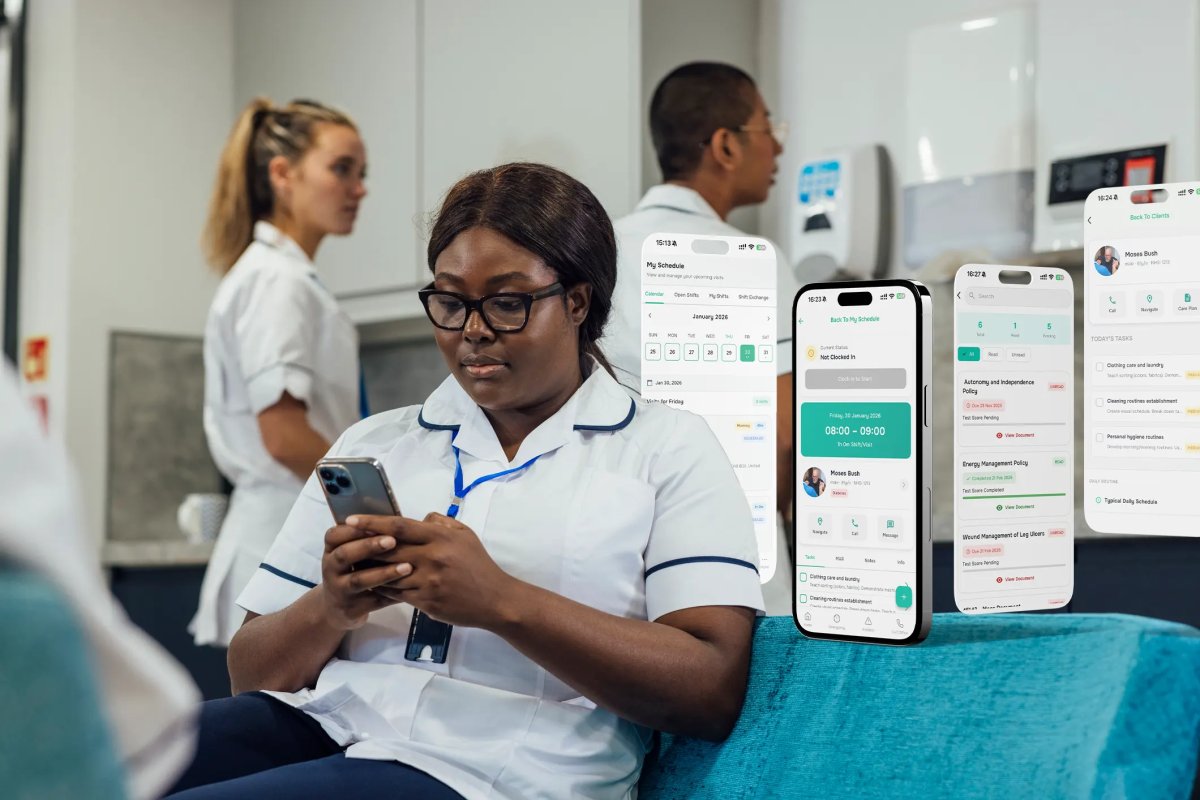
Designing easy to use domiciliary care software requires a deep understanding of the physical reality of a care visit. A carer often operates their device whilst balancing keys, bags, or supporting a client’s mobility. This is why we advocate for the “Three-Tap Rule”; any critical action, from recording a medication dose to flagging a concern, should be reachable in three taps or fewer. If the interface is cluttered or requires complex navigation, it becomes a barrier to care rather than a supportive tool for the professional.
Visual indicators are just as important as navigation speed. Instead of dense blocks of text, a well-designed system uses high-contrast colour-coding and icons to signal urgency, such as eMAR alerts for upcoming medication. This is vital for tired staff or non-native speakers who need to process information quickly. To see how these design principles improve safety, you can explore our care management and policy compliance platform which prioritises these frontline needs.
Mobile-First Design for the Frontline
Many systems fail because they are essentially desktop software “shrunk” for a phone screen. A true mobile-first design prioritises thumb-friendly navigation and one-handed operation. It also accounts for the reality of rural visits; offline functionality is essential so that notes can be recorded in signal dead zones and synced automatically later. Additionally, the app must be battery-efficient. A professional tool shouldn’t drain a carer’s phone halfway through a long shift, leaving them without their schedule or care plans.
Intelligent Automation and Alerts
Automation should remove the mental load from the carer. This includes smart staff rostering that calculates travel time automatically between visits, preventing the stress of back-to-back scheduling. Voice-to-text integration is another hallmark of easy to use domiciliary care software, allowing carers to dictate detailed, person-centred notes without the fatigue of typing. When a carer can record a summary whilst walking back to their car, the quality of evidence for the regulator improves without adding to their workload.
Evaluating Usability: A Framework for Care Managers in 2026
Choosing the right tool isn’t just about comparing features on a spreadsheet. It’s about the “Non-Tech Staff Test.” At Care Daily, we suggest involving your most tech-resistant team member in every software demo. If they can’t navigate the basic visit log or view a client’s profile within five minutes of picking up the device, the platform isn’t truly easy to use domiciliary care software. This hands-on approach reveals more than any sales presentation ever could.
The “Learning Curve” is a quantifiable metric that directly impacts your bottom line. Industry data from 2024 suggests that systems requiring more than four hours of initial training often suffer from poor long-term adoption. You should look for a platform where a new starter can be shift-ready after a focused 90-minute orientation. If the interface is intuitive, the software should feel like a natural extension of the carer’s existing expertise, not a new language they have to master.
Don’t forget to look behind the curtain at the manager’s dashboard. Often, a system that appears “easy” for the carer is a nightmare for the office team, requiring hours of manual data manipulation to generate a single report. True usability means that information flows seamlessly from the client’s home into your payroll and invoicing systems without middle-man intervention. We find that our customers value this “end-to-end” simplicity as much as the app’s interface itself.
Beyond the Slick Demo
Ask vendors specific questions about their user-testing process. Do they test with real carers in the field, or just in a controlled office environment? It’s vital to test the medication management workflow for “forced errors.” A well-designed system will prevent a carer from signing for a dose if the previous one was missed or if the timing is unsafe. You should also evaluate the speed of support. If a carer gets stuck at 9 PM on a Saturday, a “business hours only” helpdesk is a significant risk to your service delivery.
Scalability vs. Simplicity
As your business grows, your software shouldn’t become more complex to manage. Look for modular features that allow you to only turn on what your team needs today. If you’re managing multiple sites, the ability to switch between branches without logging in and out is essential for maintaining oversight. A scalable system provides “peace of mind” because it evolves with you, ensuring that easy to use domiciliary care software remains easy even as you double your client base or expand your service offerings. If you’re ready to see how a professional system handles growth, you can book a bespoke demo with our team.
Overcoming Staff Resistance: The Human Side of Digital Transformation
Resistance to change is rarely about the technology itself; it’s usually about the fear of losing competence. At Care Daily, we find that the most successful managers are those who frame easy to use domiciliary care software as a support system rather than a monitoring tool. For a carer who has spent twenty years recording their compassion in a physical logbook, a tablet can feel like a cold replacement for a personal touch. You must acknowledge this emotional weight. Adopting intuitive tools isn’t just about efficiency; it’s about giving your team the confidence that their hard work is being seen and valued without adding to their exhaustion.
The link between software usability and staff retention is critical in the 2026 labour market. When technology is intuitive, it reduces the “cognitive load” on your staff, allowing them to focus on the client’s dignity rather than a screen. Our customers tell us that carers are significantly more likely to stay with a provider that respects their time by providing tools that actually work. To begin this journey with your team, you can get started with our intuitive platform today and see how we prioritise the user experience of the frontline professional.
A Step-by-Step Implementation Strategy
Successful adoption follows a structured path. We recommend a three-phase approach to minimise disruption. First, launch a pilot with a small group of “Digital Champions” who are naturally tech-confident. Their success will act as social proof for the rest of the team. Second, move into tailored training sessions that focus on the specific benefits for the carer, such as finishing notes faster. Finally, execute the full rollout with on-site support available for the first 48 hours. This presence ensures that any minor “hiccups” don’t turn into long-term frustrations.
Communication is Key
Transparency removes the “Big Brother” fear often associated with GPS and time-stamping. Explain these features as safety measures for lone workers rather than surveillance tools. If a carer is late to a visit in a rural area, the system allows the office to check they are safe. You can also use the Family Portal feature to show carers the positive impact their notes have on a client’s loved ones. When a carer sees a daughter’s “thank you” message in response to a well-recorded visit, the software stops being a chore and starts being a bridge for compassion.
Care Daily: Simplifying Domiciliary Management Without Sacrificing Depth
At Care Daily, we believe that true easy to use domiciliary care software should do more than just digitise paper logs; it must act as a protective layer for your entire organisation. Whilst other platforms treat client records and regulatory documents as separate silos, we have integrated our library of over 2,000 cqc compliant care policies and procedures directly into the management interface. This ensures that when a carer opens a task, they aren’t just seeing a list of chores. They are supported by bespoke guidance that reflects the latest standards from the regulator, providing them with the confidence to deliver exceptional care.
Our “Peace of Mind” promise is built on the reality of a manager’s daily life. We know that anxiety often peaks during an inspection or when a complex incident occurs. By using automated compliance checks, our platform flags gaps in real-time, allowing you to breathe easier knowing your evidence is robust and ready for review. We don’t just “hand over the keys” during onboarding. Our team provides a bespoke implementation process, guiding your staff through every step of digital adoption to ensure your transition is stress-free and sustainable.
The Power of Integrated Policies
Having a library of templates at your fingertips removes the burden of manual document management. Our customers tell us they used to spend hours every month checking for legislative updates; now, those changes happen automatically within the system. By linking specific policies directly to care tasks, you provide your companions and professionals with instant, on-the-spot guidance. This reduces errors and ensures that every visit maintains the high standards of dignity and independence your clients deserve. It transforms your software from a simple record-keeper into a comprehensive quality assurance tool.
Your Partner in Care
We pride ourselves on a “Calm in the Storm” approach to support. Our UK-based experts understand the nuances of the care sector because they’ve lived it. Beyond the internal team, our Family Portal builds a bridge of trust between your service and the client’s loved ones. It significantly reduces the volume of “Where is the carer?” phone calls, as families can see real-time updates and feel reassured about the continuity of care being provided. If you are ready to move away from tech-frustration and towards a more supported way of working, you can experience the simplicity of Care Daily with a personalised tour today. Our easy to use domiciliary care software is designed to let you focus on what truly matters: the people in your care.
Empowering Your Team for the Future of Care
The journey towards digital maturity doesn’t have to be a source of anxiety for you or your team. By prioritising a mobile-first approach and human-centred change management, you transform your daily operations into a model of efficiency and compassion. Choosing easy to use domiciliary care software is the first step in ensuring that your carers feel supported rather than monitored; this shift leads to better outcomes for your clients and more robust evidence for the regulator.
At Care Daily, we provide more than just a platform; we offer a partnership designed specifically for the UK care sector. Our system includes over 2,000 CQC-compliant policies that link directly to care tasks, ensuring your staff always have the right guidance at their fingertips. We understand that adoption is a process, which is why we offer dedicated UK-based implementation support to guide you through every phase of the transition. Our goal is to provide you with the “peace of mind” that comes from knowing your service is safe, effective, and well-led.
You have the expertise to lead your team to an “Outstanding” future. We are here to provide the tools that make that vision a reality. Book your free, low-pressure tour of the Care Daily platform and discover how simple digital adoption can be. Your team, and your clients, will thank you for it.
Frequently Asked Questions
How long does it typically take for staff to learn new domiciliary care software?
Most carers become proficient with the system in under 90 minutes if the interface is truly intuitive. We find that a focused, hands-on orientation is far more effective than long, theoretical classroom sessions. This rapid learning curve ensures your service doesn’t face significant downtime during the transition. It also builds immediate confidence among team members who may feel anxious about moving away from their familiar paper records.
Can easy-to-use software still provide enough detail for a CQC inspection?
Simplicity in the app design actually improves the quality and depth of evidence available for the regulator. When you implement easy to use domiciliary care software, carers are more likely to record detailed, contemporaneous notes at the point of care. This prevents the “memory gap” that occurs when staff wait until the end of a shift to log visits. Clearer, more frequent data entry provides the robust audit trail needed to secure an “Outstanding” rating.
What happens if my carers lose internet connection while using the app?
Reliability is maintained through robust offline functionality that saves data locally on the carer’s device. If a professional enters a home in a rural “dead zone,” they can still record medication administration, incidents, and care notes as normal. The app syncs this information automatically with your central office as soon as a 4G or Wi-Fi connection is restored. This ensures no vital information is lost and your records remain accurate 24/7.
Is it possible to import my existing paper-based care plans into the system?
You can transition your current records into digital formats using our library of bespoke templates during the onboarding process. Our implementation team helps you organise this data so it remains compliant with the latest standards. Whilst some providers choose to start fresh, others prefer to upload existing documents to ensure continuity of care. We guide you through the most efficient method based on your service size and current record structure.
How does digital software help with staff retention in home care?
User-friendly technology reduces the daily friction and administrative exhaustion that often leads to staff burnout. By removing the need for manual auditing and repetitive double-entry, you give carers more time to focus on person-centred support. At Care Daily, we’ve seen that providers with intuitive systems report higher morale and a more stable workforce, as staff feel their professional time is respected and their paperwork burden is minimised.
Will I need to buy expensive new smartphones for all my care staff?
Most providers successfully implement a “Bring Your Own Device” policy rather than purchasing new hardware for the entire team. As long as a staff member’s phone was manufactured within the last four years, it will typically run modern care management apps effectively. This approach is often preferred by carers as they’re already comfortable with their own handsets. We ensure the app is battery-efficient to last through a full 12-hour shift without issue.
How does Care Daily handle CQC policy updates automatically?
We monitor legislative changes 24/7 and push updates to our library of 2,000 plus templates automatically. When the regulator or the Department of Health and Social Care issues new guidance, our team of experts reviews and updates the relevant policies. You’ll receive a notification in your dashboard, allowing you to review the changes and implement them across your service with a single click, which saves you hours of manual research.
Can I use the software for both domiciliary and supported living services?
The platform is fully scalable and supports various care settings from a single, centralised dashboard. Whether you’re providing easy to use domiciliary care software for home visits or managing the specific requirements of supported living, the system adapts to your operational needs. This flexibility allows you to maintain consistent compliance and oversight even if your business operates across multiple branches or diverse service types.