

Could a 500-page paper manual actually be the reason your agency falls short during an inspection? With the regulator aiming to publish 9,000 assessments under the Single Assessment Framework by September 2026, relying on static domiciliary care policies and procedures CQC standards is no longer enough to guarantee safety. We understand the weight of these changes, especially the fear that outdated documentation might lead to a “Requires Improvement” rating whilst your team is busy delivering vital care in the community.
At Care Daily, our customers tell us that compliance often feels like a moving target. We want to help you master the new framework by implementing a digital policy library that ensures your agency remains inspection-ready at all times. This guide provides a clear, actionable list of mandatory policies and explains how to build a system that updates automatically when standards change. You’ll learn how to translate your documentation into high-quality staff behaviour that prioritises the autonomy and wellbeing of your clients, ensuring your paperwork finally matches the excellent care you provide.
Key Takeaways
- Understand how the regulator’s Single Assessment Framework replaces old KLOEs with 34 specific Quality Statements focused on real-world outcomes and service user experiences.
- Identify the essential domiciliary care policies and procedures CQC inspectors expect to see, including robust safeguarding protocols and medication management aligned with 2026 standards.
- Recognise the operational risks of version control errors in paper manuals and the safety benefits of providing carers with instant, mobile access to procedures whilst on visits.
- Learn how to translate static documentation into consistent staff behaviour that protects client autonomy and improves your overall inspection rating.
- Discover how an automated policy system helps your agency stay ahead of legislative changes without the need for time-consuming manual reviews.
The 2026 CQC Regulatory Landscape for Domiciliary Care
The regulatory environment for home care in the United Kingdom has undergone a fundamental shift. The regulator’s Single Assessment Framework (SAF) is now fully operational, replacing the traditional inspection cycle with a model of continuous monitoring. This means the regulator no longer waits for a scheduled visit to assess your service; instead, they use real-time data and six evidence categories to form a rolling view of your performance. For providers, this makes your domiciliary care policies and procedures CQC documentation more critical than ever, as it serves as the foundation for the “processes” evidence category.
At Care Daily, we’ve seen that the Registered Manager’s role has evolved into that of a compliance conductor. It’s no longer enough to have a shelf of binders. You must prove that policies are embedded in daily practice. The regulator looks for “I statements” from clients and “We statements” from your team to see if your written procedures actually translate into safe, person-centred care. They want to see that your staff don’t just know where the policies are, but that they actually live them during every home visit.
Transitioning from KLOEs to Quality Statements
The old Key Lines of Enquiry (KLOEs) were often seen as a checklist for inspection day. The current framework uses 34 Quality Statements that map directly to the five key questions: Safe, Effective, Caring, Responsive, and Well-led. To stay ahead, you should re-organise your home care domiciliary care policies and operational documents to align with these statements. In 2026, compliance is defined by the ability to demonstrate “live” evidence of policy adherence.
The Health and Social Care Act 2008 (Regulated Activities) Regulations
Every policy you write must uphold the fundamental standards set out in these regulations. Regulation 17 (Good Governance) is particularly vital, as it requires providers to maintain securely an accurate, complete, and contemporaneous record for each service user. This regulation is the backbone of your domiciliary care policies and procedures CQC strategy. When applying as a new provider, the regulator now rejects incomplete applications outright. You’ll need specific documentation, including a robust Statement of Purpose and a comprehensive suite of mandatory procedures, to pass the two-stage application process that has been in place since July 2025.
Mandatory Domiciliary Care Policies and Procedures
Whilst a library of hundreds of documents might seem impressive, the regulator focuses on how you manage the core risks within your service. Your domiciliary care policies and procedures CQC strategy must prioritise the “Big Five”: Safeguarding, Medication Management, Complaints, Whistleblowing, and Recruitment. These aren’t just documents; they’re the operational guardrails that protect your clients and your staff. At Care Daily, we find that agencies who focus on the quality of these core areas, rather than the quantity of their folders, achieve much higher levels of consistency.
Safeguarding procedures must align strictly with the Care Act 2014, ensuring that your team knows exactly how to identify and report abuse. This works hand-in-hand with a robust Whistleblowing policy, which should empower carers to raise concerns without fear of reprisal. We often see that agencies with a transparent culture perform better in the “Well-led” domain because their staff feel safe to speak up. It’s about creating an environment where safety is a shared responsibility.
Your Statement of Purpose acts as the legal foundation of your agency, defining exactly what services you provide and to whom. This must be complemented by a clear Duty of Candour policy. This ensures that if something goes wrong, you are open and honest with the service user and their family. Providing a detailed Service User Guide further supports this transparency, meeting the CQC Guidance for Providers regarding information standards and service user autonomy.
Safe and Effective Care Procedures
Effective care starts with person-centred care planning and detailed risk assessments. These documents shouldn’t be generic; they must reflect the individual needs and home environment of each client. When it comes to medication management, your policies must align with NICE guidelines. Using digital eMAR systems can significantly reduce errors, providing the real-time evidence the regulator now expects. This digital transition ensures that domiciliary care policies and procedures CQC requirements are met with precision and clarity.
Governance and Leadership Documentation
A Business Continuity Plan is essential for domiciliary agencies to handle disruptions like extreme weather or staff shortages. Regular Quality of Care reviews and internal audits then close the loop, proving you are constantly monitoring your own performance. If you’re looking to simplify this process, you can explore our compliance tools to see how digital templates can save your team hours of administrative work and keep your documentation current.
Digital Implementation: Moving Beyond the Dusty Binder
Relying on a physical manual hidden in a back office creates a significant compliance gap. When domiciliary care policies and procedures CQC standards change, paper systems often fail due to version control errors. A carer might inadvertently follow an outdated protocol simply because the updated page wasn’t swapped in their folder. This isn’t just an administrative oversight; it’s a risk to client safety that the regulator scrutinises heavily. By migrating to a digital library, you ensure that every team member has the most current version of the NICE home care guideline at their fingertips.
The transition involves more than just digitising documents. It’s about linking specific procedures directly to the tasks your team performs every day. For example, when a carer logs a medication task, the relevant policy should be just a tap away. This creates a seamless flow where compliance isn’t a separate chore but a natural part of the care delivery process. At Care Daily, we find that this integrated approach gives managers peace of mind, knowing that the “how-to” is always available when it matters most.
Ensuring Staff Accessibility on the Frontline
Imagine a carer needs to refresh their memory on an Infection Control procedure whilst at a client’s home. With a mobile-accessible library, they don’t have to guess or wait until they return to the office. We recommend using “bite-sized” policy updates to help staff retain information more effectively. Rather than asking them to read a 20-page document, you can send targeted, digestible reminders. Our customers tell us that providing mobile-first policy access leads to a notable improvement in care consistency and a reduction in avoidable errors.
Version Control and the Audit Trail
A robust audit trail is the chronological record of every policy change and staff acknowledgement. To maintain this, we suggest a simple 4-step process: update the document, review for accuracy, distribute digitally, and track acknowledgements. This system automatically archives previous versions, ensuring you have a clear history for legal or regulatory reviews. If you’re ready to stop chasing paper signatures, you can get started with our digital compliance tools to automate your entire audit trail today.
Future-Proofing Your Agency with Care Daily
At Care Daily, we believe that compliance should support your mission, not distract from it. Our platform provides a comprehensive library of professionally written templates, offering a foundation for service excellence. By integrating your domiciliary care policies and procedures CQC requirements directly into your daily operations, we help you move away from the stress of “ticking boxes”. Instead, you can focus on what truly matters: delivering empathetic, high-quality care that respects the autonomy of every client. When your documentation translates into consistent, safe behaviour, you’re building a reputation for reliability and safety.
Our system ensures that your policies, staff rostering, and digital care planning work in harmony. When these elements are connected, your team has the right information at the right time, reducing the risk of errors and improving the quality of life for those you support. At Care Daily, our customers tell us that having a single source of truth for domiciliary care policies and procedures CQC standards empowers their staff to work with greater confidence. This confidence is palpable during inspections, as carers can clearly explain the procedures they follow and the values that drive their work.
A Living Compliance Ecosystem
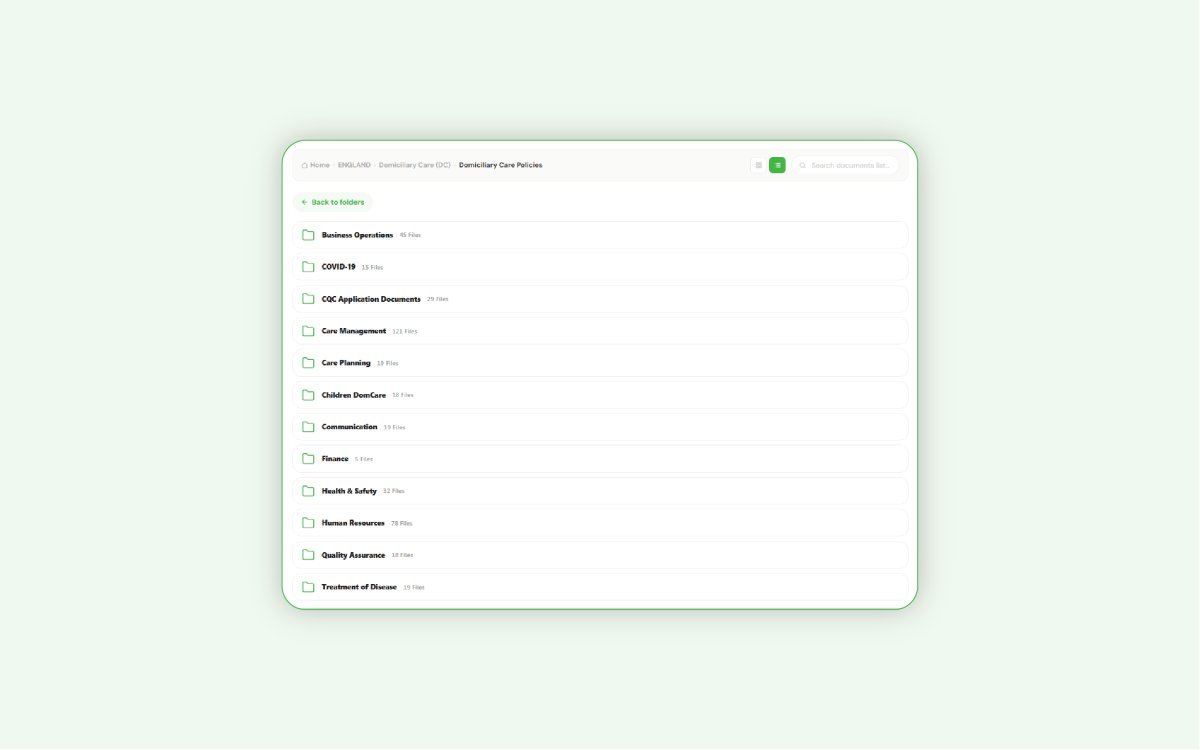
We continuously monitor the regulator’s updates so that Registered Managers don’t have to spend hours researching legislative changes. Our automated update system ensures that your documentation remains current whilst giving you the freedom to customise templates to reflect your agency’s unique culture. For many of our partners, our domiciliary care policies library is the essential starting point for building a safe and stable service. This ecosystem allows your agency to grow without the fear of falling behind on regulatory changes.
Demonstrating Excellence During Inspection
When the regulator calls, you need to provide evidence of high-quality care instantly. Care Daily’s digital reporting allows you to pull real-time data on staff engagement, policy acknowledgements, and care outcomes. You can also use our CQC Compliant Care Policies and Procedures guide as a practical training tool for your team, ensuring that every carer understands the “why” behind the “how”. If you want to see how our platform can transform your compliance journey, you can book a demo to see our compliance tools in action today.
Building a Culture of Excellence in 2026
Maintaining excellence in 2026 requires more than a tidy office folder; it demands a living system where your documentation and care delivery work as one. We’ve explored how the regulator’s shift to the Single Assessment Framework prioritises real-time evidence and person-centred outcomes. By moving your domiciliary care policies and procedures CQC library into a digital format, you ensure your team always has access to the most current guidance whilst they are supporting clients in their homes.
At Care Daily, we are proud to support 500+ UK care providers with a platform that bridges the gap between regulatory requirements and daily practice. Our library contains over 2,000 professionally written documents, all maintained by UK compliance experts to reflect real-time legislative changes. We want to help you reduce the administrative burden so you can focus on the human connections that make your service special.
Get started with our library of 2,000+ CQC-aligned policies and give your agency the gift of permanent inspection-readiness. You have the expertise to provide wonderful care, and we have the tools to help you prove it every single day.
Frequently Asked Questions
What are the mandatory policies for a domiciliary care agency in 2026?
Mandatory policies include safeguarding, medicines management, infection control, recruitment, and complaints handling. Every agency must also maintain a robust whistleblowing procedure and a clear Statement of Purpose to meet the regulator’s fundamental standards. These domiciliary care policies and procedures CQC requirements form the essential foundation of your registration. Your documentation must be specific to your service’s unique operations rather than being entirely generic.
How often should domiciliary care policies be reviewed for CQC compliance?
We recommend reviewing your policies at least once a year or immediately after any change in legislation or regulatory standards. The regulator’s move towards continuous monitoring means that keeping documents up to date is a constant requirement. If an incident occurs or a new best practice guideline is published, you should update the relevant procedure immediately. This ensures your team remains safe and your practice reflects the latest clinical or social care evidence.
Can I use generic care policy templates for my CQC registration?
You cannot use generic templates without significant customisation for your registration application. The regulator rejects applications that appear “copy-pasted” because policies must reflect how your specific agency actually operates in practice. Whilst templates provide a professional starting point, you must tailor them to include your local safeguarding contacts, specific staffing structures, and the unique needs of your service users. This demonstrates that you have a deep understanding of your own service.
How do I prove to a CQC inspector that staff have read our procedures?
You can provide “instant evidence” by using digital reading receipts that track exactly when each staff member accessed and acknowledged a policy. In a digital system, this creates an automated audit trail that is much more reliable than chasing paper signatures. During an inspection, the regulator may also interview carers to verify that their daily actions align with the written procedures you have provided. This proves that your policies are embedded in your culture.
What is the difference between a policy and a procedure in social care?
A policy is a high-level statement that outlines your agency’s position or aim on a specific topic, such as safeguarding or medication. A procedure is the step-by-step set of instructions that staff must follow to achieve that aim. For example, your safeguarding policy states you have zero tolerance for abuse, whilst the procedure tells the carer exactly who to call and what form to complete if they witness a concern. Both are needed for a compliant service.
Does the CQC require paper copies of policies to be kept in the office?
The regulator does not require you to keep paper copies of your domiciliary care policies and procedures CQC documentation in the office. In fact, they often prefer digital systems because they facilitate better version control and easier staff access on the frontline. As long as your team can access the procedures they need whilst working in the community, a secure digital library meets all regulatory requirements. This approach also reduces the risk of staff using outdated information.