


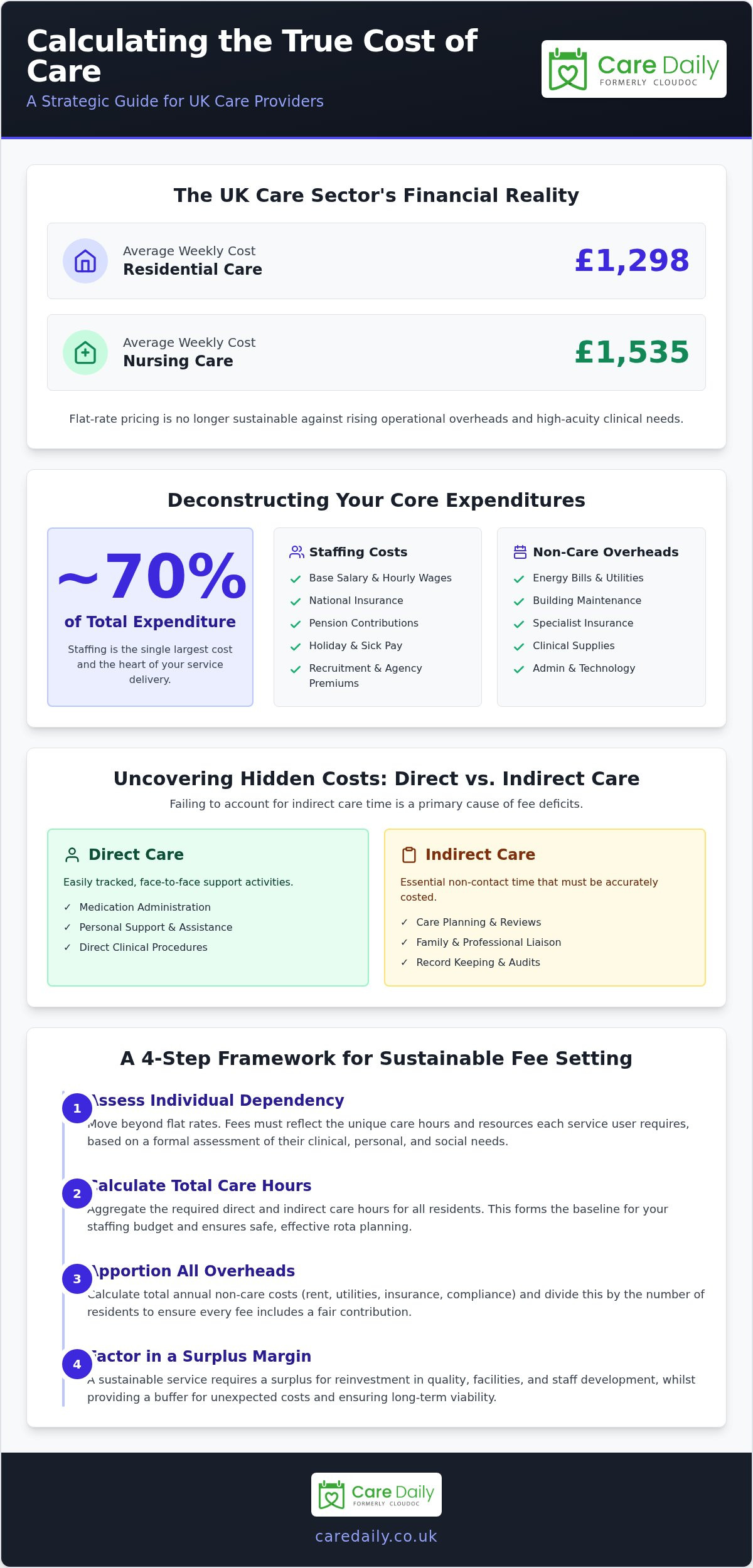
If your fee structure hasn’t shifted alongside the latest National Living Wage increases, are you actually subsidising the care you provide? With the average weekly cost of residential care now at £1,298 and nursing care at £1,535, many providers find that flat-rate pricing cannot keep pace with high-acuity clinical needs. At Care Daily, our customers tell us that calculating cost of care per resident UK wide is no longer just a back-office task; it is a vital part of protecting your home’s future and ensuring your service users receive the dedicated support they require.
We recognise the immense pressure you’re under to balance rising operational overheads with the “Fair Cost of Care” rates set by local authorities. This guide will help you master the complexities of financial sustainability by teaching you how to accurately calculate care costs whilst ensuring high-quality, compliant service delivery. We will explore a practical formula for fee-setting and discuss how robust data can improve your standing with the regulator during inspections, helping you move from reactive budgeting to a position of quiet confidence.
Key Takeaways
- Understand why staffing represents approximately 70% of your total expenditure and how to adjust your budget for the 2026 National Living Wage increases.
- Master a step-by-step framework for calculating cost of care per resident UK wide by accurately linking direct care hours to individual dependency assessments.
- Identify and recover often-overlooked operational overheads, such as rising insurance and maintenance costs, to ensure your fees reflect the true cost of service delivery.
- Learn how to use digital documentation and automated reporting as a source of truth when justifying fee structures to local authorities or the regulator.
Understanding the Variables in UK Care Cost Calculations
Registered managers often tell us that the hardest part of their role is justifying a fee increase to a family or a local authority. It’s an emotional conversation. When you are calculating cost of care per resident UK wide, it’s vital to look beyond the basic hourly wage. To maintain a stable, safe environment, you must account for National Insurance, pension contributions, and the heavy burden of non-contact time. A thorough Overview of Social Care in England shows how the funding gap persists, making the “Fair Cost of Care” exercise a vital benchmark for your 2026 financial strategy.
Geography also plays a significant role. Whilst providers in the North of England might face different property costs, those in London and the South East must contend with significantly higher staffing premiums to remain competitive. Clinical acuity further shifts the baseline when calculating cost of care per resident UK wide. For instance, the average weekly cost for nursing care sits at £1,535, compared to £1,298 for residential care. This gap reflects the increased cost of specialist equipment and registered nursing staff required for complex needs.
Direct vs Indirect Care Costs
Direct care is easily tracked through medication administration and face-to-face support. Indirect care includes the time your team spends on care planning, family liaison, and multidisciplinary meetings. Indirect care is the often-overlooked driver of fee deficits that can quietly erode your home’s financial health. Without capturing these minutes, your true operational cost remains hidden.
The Role of Regulatory Compliance in Costing
Maintaining a “Good” or “Outstanding” rating from the regulator isn’t free. It requires constant investment in staff training and robust quality assurance systems. At Care Daily, we see how the administrative weight of updating policies can drain resources. Utilising Care Daily policy libraries helps reduce this burden by providing 500+ templates, allowing your senior team to focus on service user outcomes rather than paperwork. Compliance is a fixed operational cost that safeguards both your residents and your business reputation.
Breaking Down the Core Components of Care Delivery Costs
Staffing accounts for roughly 70% of a care home’s total expenditure. This isn’t just a dry statistic; it’s the heartbeat of your service. When you’re calculating cost of care per resident UK wide, getting your staffing figures right is the difference between a sustainable business and one that’s struggling to stay afloat. It’s not just about the hourly rate. You have to factor in National Insurance, pension contributions, and the inevitable cost of holiday pay for every carer on your team.
Staffing Costs and Ratios
The true cost of a carer’s hour often surprises even seasoned managers. Beyond the basic salary, you’re looking at recruitment fees and the heavy premium of agency staff. Agency spend can quickly derail a budget, especially when unexpected sickness occurs. At Care Daily, we find that using staff rostering software helps managers optimise their ratios. This ensures you have the right mix of skills on every shift without overspending on unnecessary cover or compromising the safety of your residents.
Non-Care Operational Overheads
Your building doesn’t run for free. Energy bills, maintenance, and head office functions are fixed costs that must be apportioned across your entire resident list. Specialist insurance premiums in the social care sector have risen sharply over the last year, adding another layer of complexity. Whilst families might look at an NHS guide to financial assessments to see what they can afford, you must look at these figures to see what you can provide without compromising quality.
Tracking consumables like clinical supplies is also essential. A resident with high clinical needs will naturally use more resources than one who is relatively independent. Inflation-proofing your fees for 2026 means reviewing these costs quarterly, not just once a year. Technology often feels like an added expense, but the right infrastructure reduces administrative waste. If you’re ready to see how digital tools can clarify your figures, you can explore our management platform to start tracking these variables more effectively.
A Step-by-Step Framework for Calculating Resident Fees
Creating a sustainable fee structure requires a shift from guesswork to precise, evidence-based data. When you are calculating cost of care per resident UK wide, you need a repeatable process that protects your home’s financial viability whilst maintaining high standards of clinical excellence. We recommend a five-step framework that starts with the individual and scales up to your overall operational requirements. This method ensures that every fee accurately reflects the unique resources each service user consumes.
The Dependency Assessment
A “one size fits all” pricing model is no longer viable in the current economic climate. Instead, we see many successful providers moving toward tiered dependency levels. This approach allows you to adjust fees based on the actual intensity of support required. Using digital care planning provides real-time data on changing needs, ensuring your staffing levels always match the current resident mix. If a resident’s clinical acuity increases, your data should trigger an immediate fee review to prevent a deficit.
The Calculation Formula
To establish a fair fee, you can use this citation-ready formula: (Direct Care Hours x Hourly Rate) + (Fixed Overheads / Total Residents) + Margin. Start by calculating direct care hours per week from individual care plans. Then, apply your gross hourly staffing rate, which must include on-costs like pension contributions and National Insurance. Reference UK social care expenditure data to benchmark your costs against national averages for residential and nursing care.
Don’t forget to account for indirect care time, such as family liaison and care planning, which we’ve previously identified as a key driver of hidden costs. You must also adjust your figures for void periods and occupancy fluctuations to ensure your breakeven point is realistic. We suggest recalculating this at least quarterly to stay ahead of inflation. If you want to simplify this data collection process, you can start using our digital management tools today to gain total clarity over your operational spend.
Leveraging Digital Tools to Maintain Financial Sustainability
Mastering the art of calculating cost of care per resident UK wide is only half the battle. You must also be able to prove those figures to external stakeholders. Local authorities are under immense pressure to keep “Fair Cost of Care” rates low; they will often challenge fee increases that aren’t backed by granular data. Transitioning from paper-based systems to a digital management platform turns your care delivery records into a powerful negotiation tool. It provides an undeniable source of truth that protects your margins.
Proving Your Figures: Calculating Cost of Care per Resident UK Wide with Data
When you need to justify a specialist care premium, a generic care plan is rarely enough. Commissioners need to see the actual time spent on complex interventions. Utilising eMAR records allows you to demonstrate the exact duration and frequency of medication regimes, highlighting where high-acuity needs exceed standard residential rates. At Care Daily, we find that providers using digital records negotiate 15% more effectively with commissioners because they can present evidence-based audit trails that are difficult to dispute. This transparency builds trust with the regulator and families alike.
Long-term Viability and Reinvestment
Financial sustainability isn’t just about profit. It’s about the ability to reinvest in your team and your facilities. Reducing administrative waste through automated reporting frees up your senior staff to focus on service user outcomes. This efficiency directly impacts your staff retention. When carers aren’t bogged down by repetitive paperwork, they stay longer, which significantly lowers your recruitment and agency costs. This cycle of stability is a core component of the “Well-Led” criteria during inspections. It shows the regulator that your home is both clinically safe and fiscally responsible.
Ultimately, your ability to provide high-quality care depends on your financial health. By accurately calculating cost of care per resident UK wide and using digital tools to track every variable, you move away from reactive budgeting. You gain the freedom to plan for the future with confidence. If you’re ready to see how our platform can streamline your cost tracking and compliance, you can book a Care Daily demo with one of our experts today.
Securing Your Care Home’s Financial Future
Achieving financial stability in 2026 requires more than just balancing a spreadsheet. It’s about ensuring every resident receives the exact level of support they need whilst protecting your business from rising operational pressures. By moving away from flat-rate pricing and adopting a tiered dependency model, you can ensure your fees always reflect the true intensity of care delivered. We’ve seen how digital evidence, particularly from eMAR and care planning, becomes the foundation for successful fee negotiations with commissioners.
Mastering the process of calculating cost of care per resident UK wide allows you to reinvest in your team and improve service user outcomes. This transparency doesn’t just satisfy the regulator; it builds a bridge of trust with the families who rely on your expertise. At Care Daily, we support UK providers with 500+ professionally written policy templates and integrated care management tools designed for long-term viability. Our platform prioritises your peace of mind by linking clinical data directly to financial sustainability.
If you’re ready to gain total clarity over your operational spend and compliance, request a demo of Care Daily to see how our platform supports your financial sustainability. You have the clinical competence to lead. We’re here to provide the data that helps you thrive.
Frequently Asked Questions
How do I calculate the hourly cost of a carer including on-costs?
You calculate the true hourly cost by adding the carer’s base wage to employer National Insurance contributions, pension payments, and a pro-rata allowance for annual leave. It’s also vital to include training time and sick pay provisions to reach a gross hourly rate. At Care Daily, our customers find that these on-costs typically add 25% to 30% to the base salary, making it a critical factor in calculating cost of care per resident UK wide.
What is the “Fair Cost of Care” and how does it affect my business?
The Fair Cost of Care is a government framework designed to ensure local authorities pay providers a rate that covers actual delivery costs and a sustainable profit. Whilst it acts as a benchmark for 2026, many providers find the rates still lag behind the clinical reality of high-acuity support. You should use your own internal data to compare against these benchmarks when negotiating contracts with commissioners to protect your home’s viability.
Should I charge different fees for residents with dementia?
You should adjust fees based on the specific support needs identified in a dependency assessment rather than a diagnosis alone. Residents with dementia often require higher staffing ratios due to increased monitoring or specialist person-centred activities. If your data shows that a resident requires more one-to-one time or specialist training for your team, your fee structure must reflect this increased resource consumption to remain sustainable.
How often should a care provider review their resident fees?
You should review your resident fees at least once a year, typically in line with National Living Wage increases each April. However, we suggest a quarterly review of your breakeven point to account for rising utility and insurance costs. Frequent reviews help you identify residents whose clinical needs have increased, ensuring your financial health isn’t compromised by gradual changes in support requirements that go unrecorded.
Can I use digital care records to justify a fee increase to a local authority?
Digital records are your most persuasive tool when justifying a fee increase to a local authority or a family. By presenting eMAR audit trails and care delivery logs, you can show the exact number of minutes spent on specialist clinical tasks or emotional support. This evidence-based approach is far more effective than anecdotal claims when calculating cost of care per resident UK and negotiating sustainable rates for complex cases.
What percentage of my care fee should be allocated to operational overheads?
Operational overheads, including rent, utilities, maintenance, and administrative functions, usually account for 25% to 30% of the total resident fee. This leaves approximately 70% for direct and indirect staffing costs, which remains the largest expenditure in any care setting. It’s vital to track these overheads accurately to ensure your margin for reinvestment remains intact as energy prices and specialist insurance premiums fluctuate throughout the year.