
Why does one service receive a “Good” rating whilst another, providing similar care, achieves “Outstanding”? The answer rarely lies in the care itself, but in how you demonstrate it through specific CQC outstanding rating evidence portfolio examples. We know that the shift toward the Single Assessment Framework has left many registered managers feeling overwhelmed by the 34 Quality Statements and the demand for continuous monitoring. It’s frustrating when your team provides exceptional support, yet your documentation fails to capture that magic.
At Care Daily, our customers often tell us that proving proactive care is their biggest hurdle under the new regulatory approach. We believe that your evidence should be a living reflection of your culture, not a dusty ring binder. This guide provides a clear checklist of documentation that distinguishes an Outstanding service from a Good one. You’ll discover how to move beyond static records and use digital tools to automate your audit trails, giving you the confidence to showcase your service’s true impact during your next assessment.
Key Takeaways
- Understand the shift from static ring binders to a dynamic, “living” evidence portfolio that aligns with the regulator’s six evidence categories.
- Explore specific CQC outstanding rating evidence portfolio examples, including adaptive risk assessments and digital records that prove safe medication management.
- Learn how to demonstrate a “Well-led” culture by using robust internal audit schedules that lead to measurable improvements in service user care.
- Discover the practical steps to automate evidence collection by transitioning from paper-based records to a centralised digital care management platform.
- See how maintaining a library of 500+ professionally written and automatically updated policies provides a solid foundation for the “Processes” evidence category.
The Anatomy of a CQC Outstanding Evidence Portfolio in 2026
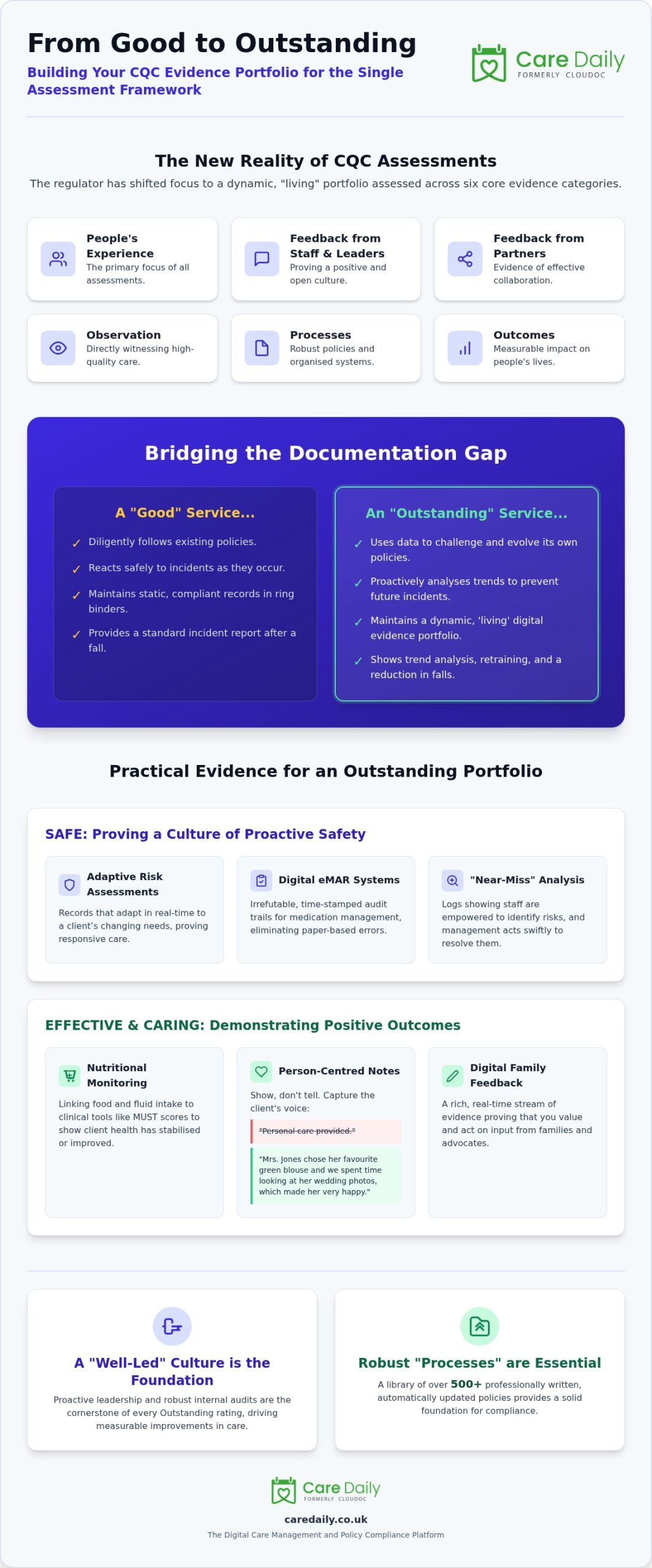
An evidence portfolio shouldn’t be a static folder you scramble to update before an inspection. Instead, think of it as a dynamic collection of “best practice in action” that lives and breathes within your service. The evidence portfolio is the bridge between daily care delivery and regulatory validation. The regulator has moved away from simply listening to your verbal assurances; they now require cogent evidence through raw data and records that prove your claims. This is assessed through six specific categories:
- People’s experience
- Feedback from staff and leaders
- Feedback from partners
- Observation
- Processes
- Outcomes
Using CQC outstanding rating evidence portfolio examples helps you visualise how these categories overlap to tell a story of excellence. By shifting from telling the inspector what you do to showing them the data behind your decisions, you create a transparent culture that prioritises safety and quality.
Moving from Good to Outstanding: The Documentation Gap
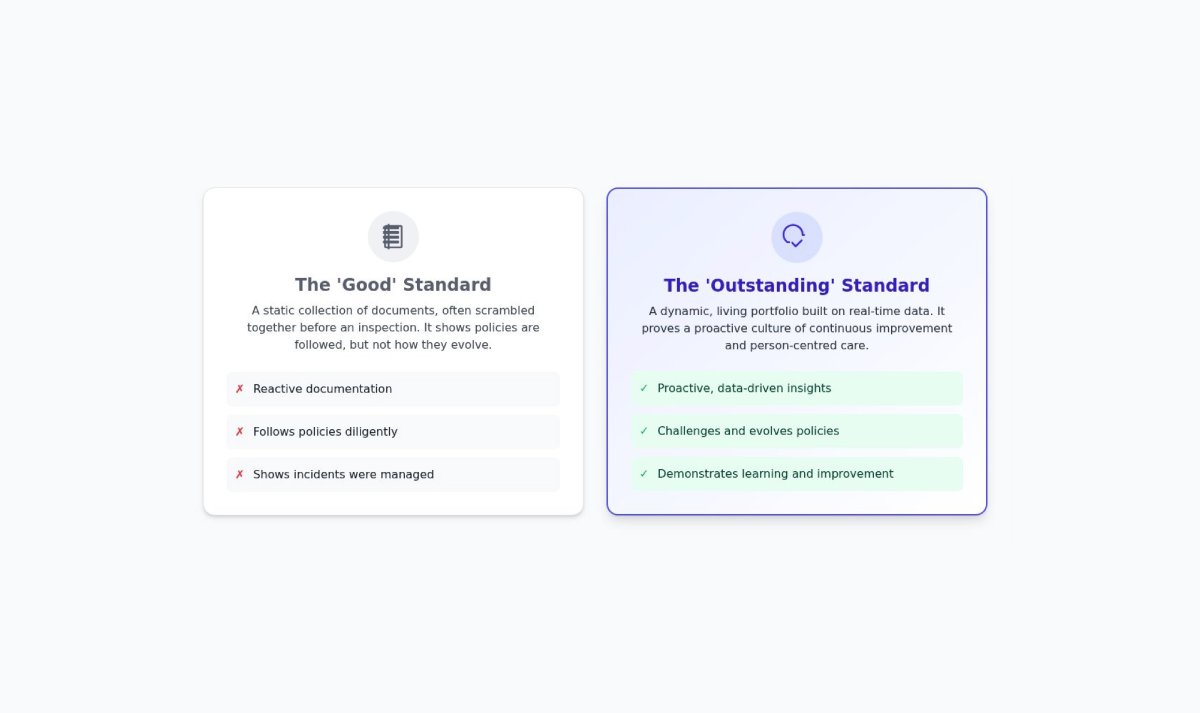
A “Good” service follows its policies diligently, but an “Outstanding” service uses its own data to challenge and evolve those policies. For instance, a standard incident report shows you reacted safely to a fall. An Outstanding evidence trail shows a monthly trend analysis of falls, identifying a specific time of day when risks increase, followed by a recorded staff retraining session and a subsequent reduction in incidents. This level of insight starts with the “Well-led” domain, which acts as the foundation for every other rating your service receives. When leadership is proactive, the evidence follows naturally.
Organising Your Portfolio Around the Single Assessment Framework
Mapping your evidence to the 34 Quality Statements can feel like a monumental task, but it shouldn’t lead to duplication. At Care Daily, we find that using a centralised digital care management platform simplifies this by creating a real-time audit trail. The regulator now prioritises “People’s experience” above all else, so your portfolio must lead with the voices of your clients and their families. When you can show that a service user’s direct feedback led to a change in their support plan within hours, you’re proving an Outstanding commitment to person-centred care.
Evidence Examples for Safe, Effective, and Caring Domains
Proving that your service is safe involves more than just the absence of incidents. It requires a proactive, transparent approach to risk that is visible in every record. When we look at CQC outstanding rating evidence portfolio examples, the most successful services move beyond basic compliance by using data to anticipate needs before they escalate into problems. This level of detail shows the regulator that safety is woven into your culture rather than being a reactive afterthought.
Safe: Beyond Basic Risk Management
An Outstanding risk assessment is never a static document. It should adapt in real-time to a service user’s changing needs. For instance, if a client’s mobility decreases due to a temporary infection, your digital records should show an immediate update to their mobility risk assessment and a corresponding change in their support plan. Using a digital eMAR system provides irrefutable evidence of safe medication management by creating a timestamped audit trail. This eliminates the “forgotten signature” issues common with paper MAR charts and allows managers to spot patterns, such as a specific carer consistently recording “refused” for a particular medication, which can then be investigated as a clinical or behavioural issue.
Proactive safety also shines through your “near-miss” logs. An Outstanding portfolio might include a record where a carer identified a frayed rug as a trip hazard and reported it immediately; the subsequent evidence shows the rug was removed and the family was consulted on a replacement within 24 hours. This demonstrates a “safe” culture where staff are empowered to act. You can use digital care planning to prove real-time oversight of these high-risk tasks, ensuring that competency checks go beyond a simple training certificate and include recorded observations of staff applying their skills in the field.
Effective and Caring: Proving Outcomes
The “Effective” and “Caring” domains are where the human element of your service meets clinical precision. Evidence for an Effective rating often involves nutritional monitoring that is directly linked to clinical tools like the MUST (Malnutrition Universal Screening Tool) score. When you can show that a client’s weight stabilised because your team identified a trend and adjusted their meal plan, you’re proving an effective outcome. Caring is evidenced through person-centred entries that capture the client’s voice. Instead of a generic “personal care provided” entry, an Outstanding record might state: “Mrs. Jones chose her favourite green blouse today and we spent ten minutes looking at her wedding photos, which she said made her feel very happy and nostalgic.”
Our customers find that capturing feedback from families through a digital portal provides a rich stream of evidence for the Caring domain. It shows that you value the domestic setting as a sanctuary and respect the autonomy of those you support. If you’re ready to see how digital tools can help you capture these moments of excellence, you can explore our compliance features here.
Demonstrating Outstanding Leadership and Responsiveness
Leadership is the engine of an Outstanding rating. It’s about showing the regulator that you don’t just spot problems; you fix them. At Care Daily, we find that the strongest portfolios show a clear link between a policy, a regular audit, and a tangible service improvement. This “closed-loop” approach is one of the most powerful CQC outstanding rating evidence portfolio examples you can provide. It moves the conversation from “we hope we are doing well” to “we know we are improving because the data says so.”
Well-led: The Power of the Digital Audit Trail
A robust governance framework relies on having a solid foundation. You can use our CQC compliant policies as the baseline for your governance, ensuring your team always works from the most current regulatory standards. For example, an Outstanding governance report might show that a monthly audit identified a pattern of falls in a specific service user’s home during the early morning. The evidence would then document a review of their footwear, the implementation of a new footwear policy for staff assisting with transfers, and a subsequent three-month period with zero falls.
Leadership also extends to how you support your team. Evidence of “Equality, Diversity, and Inclusion” can be shown through tailored staff support plans that acknowledge individual cultural needs or religious observances. Combining this with regular staff engagement surveys and “You Said, We Did” boards proves that your leadership is listening and acting on feedback. These are excellent CQC outstanding rating evidence portfolio examples that demonstrate a healthy, inclusive culture where every voice matters.
Responsive: Meeting Complex Needs
Being responsive means your service bends to fit the client, not the other way around. This is particularly vital in end-of-life care planning. An Outstanding portfolio would include evidence of exceptional coordination with GPs and district nurses, captured through secure digital records that protect service user privacy whilst ensuring everyone has the latest information. For instance, documenting how you adapted a care package within two hours to support a service user returning home from a sudden hospital admission is a prime example of responsiveness.
It also means proving your service is truly accessible. This might involve providing care plans in Easy Read formats or using pictorial communication aids for clients with speech and language difficulties. When you can show that your communication methods are as tailored as your care, you prove that you respect the autonomy and individuality of every person you support. If you want to move away from fragmented paper records and build a leadership trail that speaks for itself, get started with our compliance tools today.
Digital Transformation: Automating Your Evidence Collection
The journey toward an Outstanding rating often feels like a race against time. Managers frequently find themselves trapped in a cycle of retrospective filing, trying to capture evidence of care that happened weeks ago. Moving from paper-based records to a centralised digital care management platform changes this dynamic completely. It allows you to capture evidence at the point of care, ensuring that your records are always current and ready for review.
To build a portfolio that stands up to the scrutiny of the Single Assessment Framework, we recommend a structured approach to automation:
- Step 1: Centralise your records. Shift all service user data, staff rosters, and incident logs into one digital space to ensure a single version of the truth.
- Step 2: Build your policy foundation. Implement a library of 500+ professionally written policies from our document library that update automatically when regulations change.
- Step 3: Empower your team. Train your carers to record the “little things” that prove a person-centred culture, such as a client’s specific mood or a small personal achievement.
- Step 4: Generate reports instantly. Use automated reporting tools to pull together your evidence for the regulator at the touch of a button, rather than spending days manual sorting.
At Care Daily, we find that the most successful managers are those who use technology to amplify their team’s human touch. When your systems handle the “Processes” evidence category automatically, your leadership team is free to focus on the “Outcomes” and “People’s experience” categories that truly define an Outstanding service.
The Future of Regulatory Compliance
The regulator increasingly prefers digital records because of their time-stamped accuracy and transparency. It’s much harder to prove a culture of continuous improvement with a handwritten log than with a digital audit trail that shows exactly when a risk was identified and how quickly it was mitigated. Our customers tell us that reclaiming time from filing allows them to spend more hours on the front line, observing care and mentoring staff, which is exactly where quality is born.
An Outstanding rating is rarely the result of a lucky inspection; it is the natural byproduct of a service that uses the right tools to care better. By following these steps and curating your own CQC outstanding rating evidence portfolio examples through a digital lens, you ensure that your documentation finally reflects the high standard of support you provide every day. Providing exceptional care is your priority; making sure the regulator sees it is ours.
Preparing Your Service for an Outstanding Future
Achieving the highest rating from the regulator is a journey that requires consistency, transparency, and a commitment to continuous improvement. We’ve explored how a dynamic evidence portfolio prioritises the voices of service users whilst providing a robust digital audit trail for every interaction. By implementing these CQC outstanding rating evidence portfolio examples, you transform compliance from a stressful administrative burden into a clear demonstration of your team’s hard work and dedication.
At Care Daily, we’ve spent over five years supporting UK care providers with tools designed specifically for the regional landscape. Our platform provides a full digital audit trail and a library of 500+ CQC-aligned policy templates to ensure your service remains safe and well-led. If you’re ready to reclaim your time and lead with confidence, we invite you to book a demo to see how Care Daily automates your CQC evidence portfolio. You’ve built a service that changes lives; it’s time to make sure your documentation reflects that excellence.
Frequently Asked Questions
What are the five CQC domains for 2026?
The five key domains remain Safe, Effective, Caring, Responsive, and Well-led. These categories form the foundation of the Single Assessment Framework and are used by the regulator to evaluate the overall quality of your service. Each domain is now broken down into specific Quality Statements that describe what a high-standard care provider should look like in practice.
How much evidence do I need for each Quality Statement?
The regulator prioritises the quality and impact of your data over the sheer volume of documents. There is no set number of records required for each of the 34 Quality Statements; instead, you should focus on providing clear proof of positive outcomes for your service users. Using concise CQC outstanding rating evidence portfolio examples that show real-world improvements is far more effective than filing hundreds of repetitive, generic logs.
Can I still get an Outstanding rating with paper-based records?
Whilst it’s technically possible to achieve an Outstanding rating with paper records, it’s becoming significantly harder to do so in 2026. The regulator now looks for evidence of “continuous monitoring” and proactive risk management, which is difficult to prove without the time-stamped accuracy of digital systems. Most services achieving the top rating now use digital tools to provide the transparency and real-time oversight that inspectors expect.
What is a CQC “Evidence Category”?
An evidence category is one of the six specific sources the regulator uses to collect information during an assessment. These include People’s experience, Feedback from staff and leaders, Feedback from partners, Observation, Processes, and Outcomes. A strong portfolio should include data from each of these sources to provide a balanced and honest view of how your service operates on a daily basis.
How often should I update my evidence portfolio?
You should treat your evidence portfolio as a “living” collection that you update continuously. The move away from one-off inspections means the regulator can assess your service at any time based on the data you provide. At Care Daily, our customers find that integrating evidence collection into their weekly governance and audit routines prevents the last-minute scramble that often leads to compliance anxiety.
What does the regulator look for in the “Well-led” domain?
In the Well-led domain, the focus is on your leadership culture, governance, and how you manage your team. The regulator wants to see that you have a clear strategy for improvement and that you’re transparent when things go wrong. Providing CQC outstanding rating evidence portfolio examples like detailed incident trend analyses and records of staff engagement proves that your leadership is both proactive and deeply invested in the wellbeing of your staff and service users.