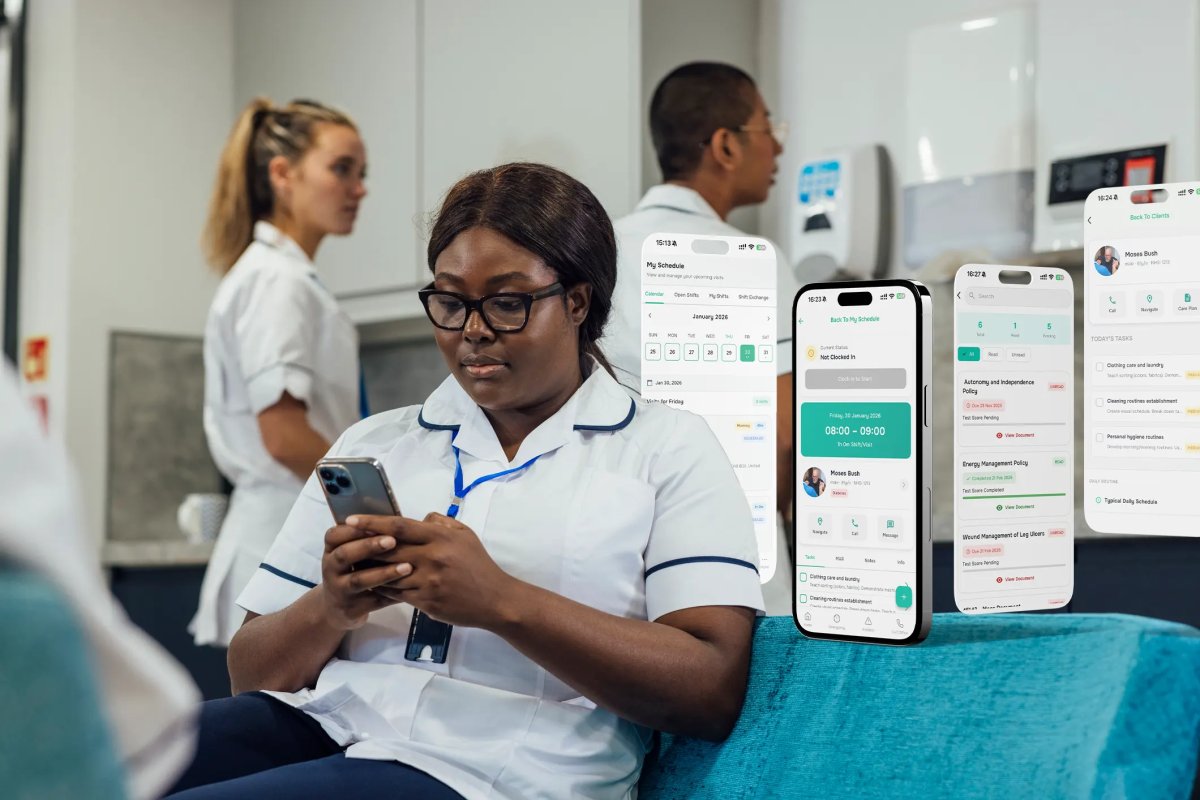


What if your last regulatory inspection report wasn’t just a bureaucratic hurdle, but actually the most persuasive sales tool your agency ever produced? Many registered managers view compliance as a relentless cycle of paperwork that pulls them away from the heart of care. It’s exhausting to balance the books whilst local authority contract margins continue to tighten and competition amongst the UK’s 13,500 domiciliary care providers grows. At Care Daily, we find that using CQC compliance to attract private clients – and leveraging strong ratings from other UK regulators like the Care Inspectorate (Scotland), CIW (Wales), and RQIA (Northern Ireland) – is the most effective way to stand out as a premium provider in a saturated market.
We understand that you want to move away from low-margin work and build a reputation as a trusted regional leader. In this guide, we’ll show you how to turn your digital records and positive inspection ratings into a powerful engine for growth. You’ll learn how to leverage digital transparency to build immediate trust with families and justify the higher fees that ensure your service remains sustainable. We’ll show you how to move from simply being compliant to being the first choice for self-funders in your community.
Key Takeaways
- Understand why targeting self-funding clients through person-centred support creates a more stable financial foundation than relying solely on fluctuating council contracts.
- Discover the practical steps for using CQC compliance to attract private clients by positioning your high regulatory standards as a hallmark of premium quality.
- Learn how to leverage digital transparency and tools like a Family Portal to provide the emotional security and “peace of mind” that private families prioritise.
- Establish a structured referral engine by engaging with professional, community, and family advocates to ensure a consistent stream of high-quality leads.
- Maintain premium service levels as you scale by prioritising staff continuity and consistent care routines, which are essential for retaining discerning private service users.
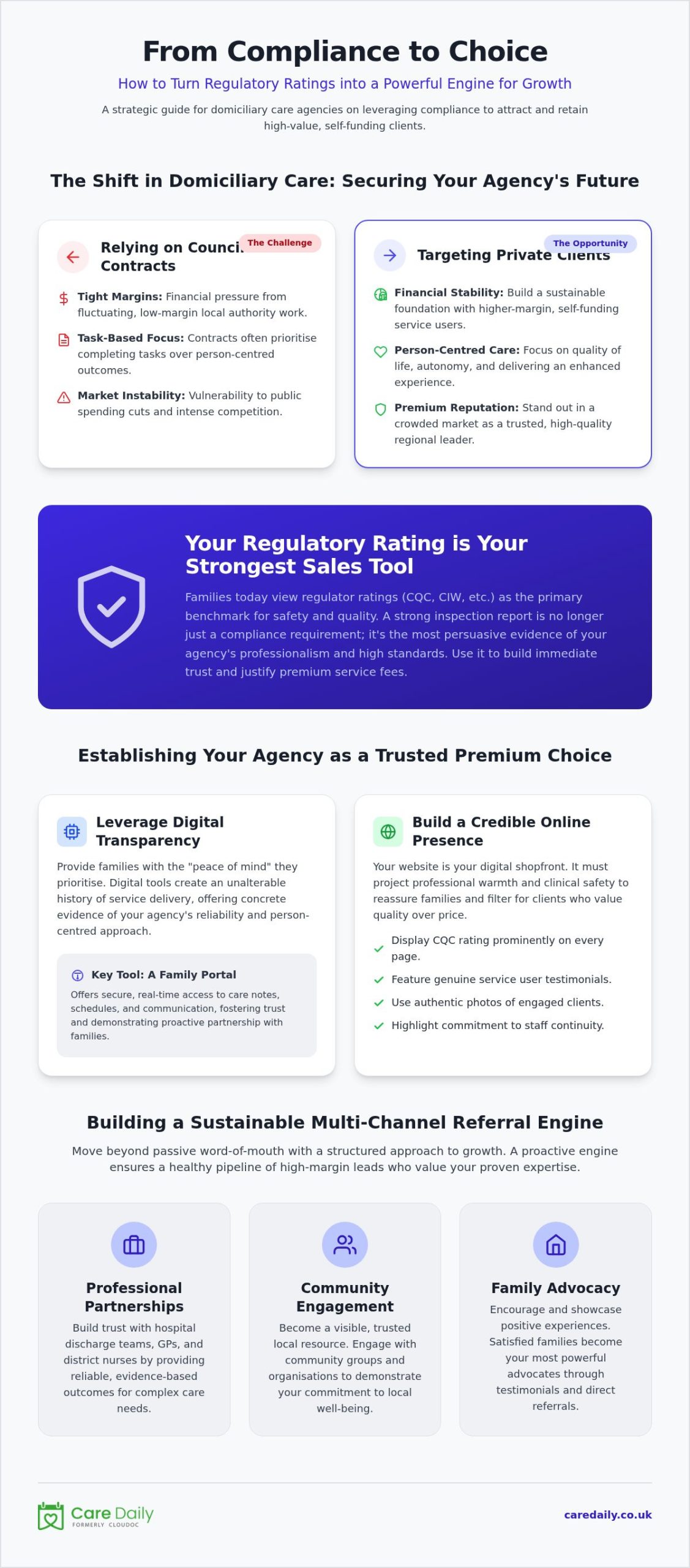
Establishing Your Domiciliary Care Agency as a Trusted Premium Choice
In the current market, the private client is no longer just looking for a basic service to fill a gap in their schedule. They are self-funders seeking a deeply person-centred experience that respects their autonomy and enhances their quality of life. Whilst local authority contracts often focus on task-based care with razor-thin margins, a private-heavy model offers the financial stability your agency needs to thrive. This shift allows you to invest more in your team and your facilities, creating a virtuous cycle of quality that council-funded work rarely permits. At Care Daily, we find that the most successful agencies treat compliance as their primary marketing asset rather than a back-office burden.
The landscape of domiciliary care in the UK has shifted; families now view a regulator’s rating as a non-negotiable benchmark of safety. In 2026, trust is the currency of the care sector. When a family chooses your service, they are handing over the safety of a loved one. Professional, well-organised documentation doesn’t just satisfy an inspector; it reflects the underlying clinical competence and genuine warmth of your entire operation. Using CQC compliance to attract private clients starts with showing them that your high standards are woven into every interaction, from the first phone call to the daily care notes.
The Role of CQC Compliance in Lead Generation
Families are more informed than ever before. They often scrutinise your latest inspection report and your “Safe” or “Well-led” scores before they even pick up the phone to make an enquiry. Having robust domiciliary care policies and procedures in place ensures your staff are consistently prepared for the continuous evidence-gathering model of the Single Assessment Framework. Digital audit trails create a transparent, unalterable history of service delivery that provides the concrete evidence regulators and families now demand. This level of detail transforms a standard care plan into a powerful testament to your agency’s reliability.
Building a Credible Online Presence
Your website is your digital shopfront. It must project a delicate balance of professional warmth and clinical safety to reassure anxious relatives. We recommend moving away from institutional, cold language; instead, use person-centred terms that emphasise the individual’s worth and domestic sanctuary. To build immediate credibility, you should consider the following elements for your online presence:
- Display your latest CQC rating prominently on every page to comply with Regulation 20A.
- Include genuine service user testimonials that highlight the emotional security your carers provide.
- Use photography that shows active, engaged clients in their own homes rather than generic stock images.
- Highlight your commitment to staff continuity, as private clients value familiar faces and consistent routines.
- Ensure your contact details are easy to find, offering a low-pressure invitation for a friendly consultation.
By clearly communicating your standards, you signal to the market that you are a premium provider. This clarity helps you filter for high-quality leads who value expertise over the lowest possible price. Using CQC compliance to attract private clients is about proving that your agency provides the gold standard of care that every family hopes to find.
Building a Multi-Channel Referral Engine for Sustainable Growth
Whilst many managers rely on passive word-of-mouth, a truly sustainable agency requires a structured, multi-channel approach to growth. Our customers tell us that the most reliable leads come from long-term relationships with local healthcare partners who trust your clinical competence. By using CQC compliance to attract private clients, you move beyond being a generic provider to becoming the preferred choice for those seeking high-quality, safe support. This shift requires moving away from accidental growth and towards a strategy built on three core pillars: professional partnerships, community engagement, and family advocacy.
Maintaining professional boundaries is vital when rewarding loyalty within these networks. Ethical referral schemes should focus on reciprocal value rather than financial incentives, which can often compromise the perceived integrity of your service. Small tokens of appreciation for families or providing useful resources to community partners can foster goodwill without breaching the trust of your service users. A proactive engine ensures that even during quieter periods, your pipeline remains healthy with high-margin leads who value your expertise over the lowest price.
Winning Referrals from Healthcare Professionals
Engaging with hospital discharge teams, GPs, and district nurses requires more than a simple brochure; it requires proof of reliability. When you position your agency as a specialist in complex care areas like dementia or end-of-life support, you solve a direct problem for these busy professionals. We recommend providing ‘evidence of outcomes’ by showing how your tailored care plans and consistent monitoring help reduce hospital readmissions. This data-driven approach builds a bridge of trust that traditional, paper-based providers often struggle to replicate. To see how digital tools can help you capture and manage these high-quality leads, you can explore our platform features here.
Engaging with Local Community Organisations
Families seeking care often turn to trusted community voices during times of crisis. Partnering with local charities, dementia cafes, and solicitors specialising in elderly care or probate allows you to reach decision-makers early in their search. Sponsoring local community events is particularly effective for building brand recognition amongst the “sandwich generation” who are often overwhelmed by the responsibility of organising support for their parents. Hosting free educational talks on navigating the UK care system builds your authority as a knowledgeable mentor. This community-oriented approach ensures that when a family finally needs support, your agency is already a familiar and dependable name.
Leveraging Digital Transparency and the Family Portal to Convert Leads
When a family approaches your agency, they are often navigating a period of significant emotional stress. They aren’t merely looking to purchase care hours; they are seeking the profound reassurance that their loved one is safe, respected, and well-supported in their own home. Traditional paper-based providers often operate as a “black box” where relatives only hear about issues after they occur. By contrast, premium agencies use digital transparency to provide immediate comfort. Using CQC compliance to attract private clients involves proving that your quality standards are visible and verifiable in real-time.
Digital systems allow you to move from a “no news is good news” approach to a model of proactive partnership. For relatives who live many miles away, the anxiety of not knowing if a carer has arrived or if medication was taken can be overwhelming. Providing a window into the daily care routine doesn’t just satisfy the regulator’s requirement for being “Responsive”; it builds a bridge of trust that justifies your status as a premium regional provider.
Using the Family Portal as a Unique Selling Point
The Family Portal is perhaps your most powerful closing tool during a care assessment. It allows relatives to see visit notes, medication logs, and arrival times instantly on their own devices. We find that this shift from reactive phone calls to proactive, digital updates transforms the client experience from a transaction into a collaborative relationship. You should position this level of access as a premium feature that differentiates your service from lower-cost competitors. It provides the “peace of mind” that self-funders are willing to pay for, ensuring they feel connected to their loved one’s care sanctuary regardless of the distance.
Digital Care Planning as a Sales Tool
During your initial home visit, showcasing your technology on a tablet can be the deciding factor for a family. You can demonstrate how digital care planning ensures that every person-centred preference is recorded, from how someone likes their tea to their specific morning routine. Furthermore, showing them how eMAR charts provide safety reassurance through automated alerts and clear audit trails highlights a level of clinical safety that paper charts simply cannot match. This tangible evidence of quality makes the decision easy for families who prioritise safety above all else. To see how these tools can transform your assessment process, you can book a demonstration of our platform here.
Scaling Your Agency Whilst Maintaining Premium Care Standards
Attracting high-quality leads is a significant achievement; however, retaining those clients requires a level of consistency that many agencies struggle to maintain as they grow. Private clients aren’t just paying for care hours. They are investing in a relationship built on reliability and familiar faces. We find that staff continuity is the single most important factor for self-funders who value routine and emotional security. At Care Daily, we believe that operational efficiency is the hidden secret to sustainable private growth; it provides the stable foundation your team needs to deliver person-centred support without feeling overwhelmed.
One of the quickest ways to lose a private client’s trust is through missed or late visits. These incidents are the leading cause of churn in the domiciliary care sector. Automated scheduling helps prevent these errors by ensuring that the right carer is in the right place at the right time. When you remove the risk of human error from your rostering, you protect your reputation and your margins. Using CQC compliance to attract private clients is only effective if your daily operations actually mirror the high standards promised in your marketing materials.
The Importance of Continuous Quality Improvement
Scaling your service shouldn’t mean diluting your quality. We recommend using digital audits to spot trends or safety concerns before they escalate into formal complaints or safeguarding issues. A robust library of CQC compliant policies allows you to adapt to new regulations or framework changes without pausing your growth. By gathering and acting on regular service user feedback, you can refine your offering to ensure it remains the premium choice in your local area. This proactive approach proves to both the regulator and your clients that you are a well-led organisation committed to excellence.
Next Steps for Your Growth Strategy
To move forward, we suggest conducting a brief audit of your current lead sources. Identify which professional referral partnerships are yielding the highest-quality leads and focus your energy there. You should also review your internal documentation to ensure it provides the clear evidence of quality that private families now expect. Using CQC compliance to attract private clients is a long-term strategy that pays dividends in the form of higher margins and a stronger regional reputation. Private care is a partnership built on trust, transparency, and top-tier compliance. If you’re ready to transform your operations, you can get started with Care Daily today.
Building Your Future as a Premium Care Provider
Transitioning your agency towards a private-heavy model is a significant step towards long-term financial stability and service excellence. By using CQC compliance to attract private clients, you demonstrate that your commitment to safety and transparency is more than just a regulatory requirement; it’s a hallmark of the premium, person-centred support you provide. We’ve seen how digital tools and structured referral networks can move your agency away from low-margin contracts and towards a reputation as a trusted regional leader.
At Care Daily, we’re proud to be trusted by UK care providers for our robust compliance tools. Our platform features an integrated Family Portal for premium transparency and a library of 500+ professionally written policy templates to help you build a solid foundation for growth. We believe that when you have the right systems in place, you can spend less time on paperwork and more time fostering the meaningful relationships that define high-quality domiciliary care.
If you’re ready to showcase your quality and win the trust of self-funding families, we’re here to support your journey. Book a demo of Care Daily to see how our Family Portal wins private clients. You have the expertise to provide exceptional support, and we have the tools to help the right families find you.
Frequently Asked Questions
How do I find private clients for my care agency without a huge marketing budget?
You can find private clients by building strong relationships with local “gatekeepers” such as hospital discharge teams, GPs, and solicitors specialising in probate or elderly care. These professionals often guide families during a crisis and value reliability over flashy advertising. Engaging with community groups like dementia cafes or sponsoring local events also helps you reach the “sandwich generation” of family decision-makers without requiring a massive marketing spend.
Is a Good CQC rating enough to attract private home care clients?
A “Good” rating is a vital foundation, but it isn’t always enough on its own to stand out in a saturated market. Using CQC compliance to attract private clients involves actively translating your regulatory scores into tangible benefits for the family. You should explain how your “Good” or “Outstanding” rating in the “Safe” or “Caring” categories specifically results in better medication safety, consistent carers, and more personalised support for their loved one.
What do self-funding families look for most when choosing a domiciliary care provider?
Self-funding families primarily look for “peace of mind” and the reassurance that their loved one is in safe, capable hands. They prioritise staff continuity, wanting to know that a familiar face will arrive at the scheduled time. Families also look for evidence of clinical competence and person-centred care, seeking a provider that treats their relative as an individual with unique preferences rather than just another task on a list.
How does digital care management software help in winning more private contracts?
Digital software acts as a powerful sales tool by providing the transparency that modern families expect. During an initial assessment, you can show them how a Family Portal gives them real-time access to visit notes and medication logs. This immediate visibility reduces family anxiety and separates your agency from traditional, paper-based providers. It proves that your agency is well-led and committed to the highest standards of digital accountability.
Can I still get private clients if I primarily serve local authority contracts?
Yes, you can certainly attract private clients whilst maintaining council contracts, provided you can demonstrate a premium level of service. Using CQC compliance to attract private clients allows you to highlight how your internal policies and digital tools exceed the basic requirements of a standard local authority tender. You may need to review your branding and documentation to ensure it reflects the high-quality, domestic-based support that self-funders are willing to pay a higher rate for.
What is the most effective way to ask for referrals from current service users?
The most effective way to ask for referrals is during your regular quality assurance reviews or after a particularly positive outcome. When a family member expresses gratitude for a specific carer or a successful recovery, it’s the natural time to mention that you have capacity for new private clients. You should frame the request as a way to help other local families find the same high-quality support they are currently receiving.